La versión en español está después de la versión en inglés.
San Geraldo can sometimes (often) challenge my translation skills. He does fairly well getting the gist of Spanish conversations and can often respond in Spanish. But he hasn’t got the hang of simplifying his English to make it easier to translate into Spanish. We didn’t appreciate until moving here 13 years ago that SG uses an unusual amount of American colloquialisms. One day in May while he was visiting me in hospital, a nurse came in to draw blood (from me, not him). In the past, SG would have left the room, but he’s toughened up over the years and simply turned his back. The nurse, who spoke only a little English, laughed at the drama. San Geraldo asked, “Tiene Wuss en Español?” [Do you have Wuss in Spanish?] He was met with a blank stare of course. I was left to come up with the Spanish word for Wuss! After some thought I landed on “cobarde” [coward]. There are apparently many other more precise, and pejorative, words. But “gallina” (which literally translates to hen) is commonly used.
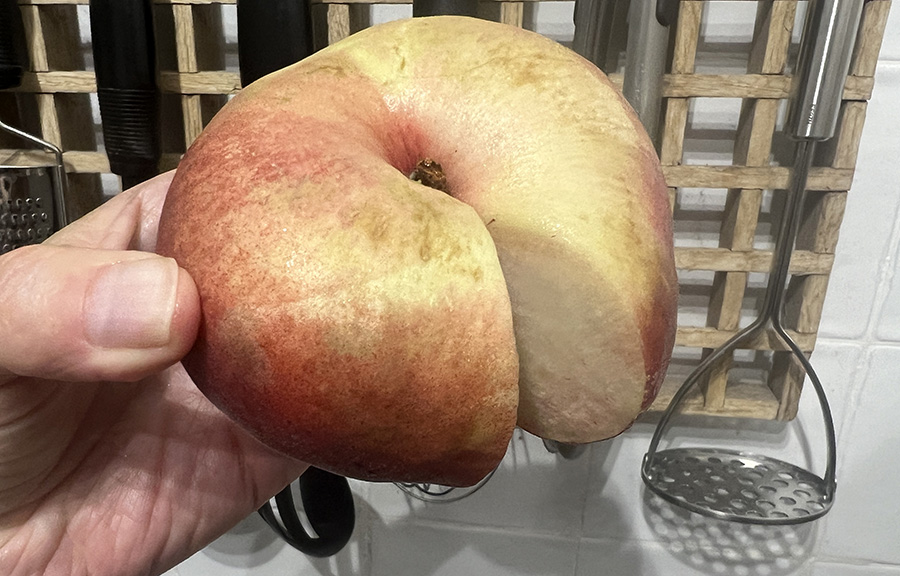
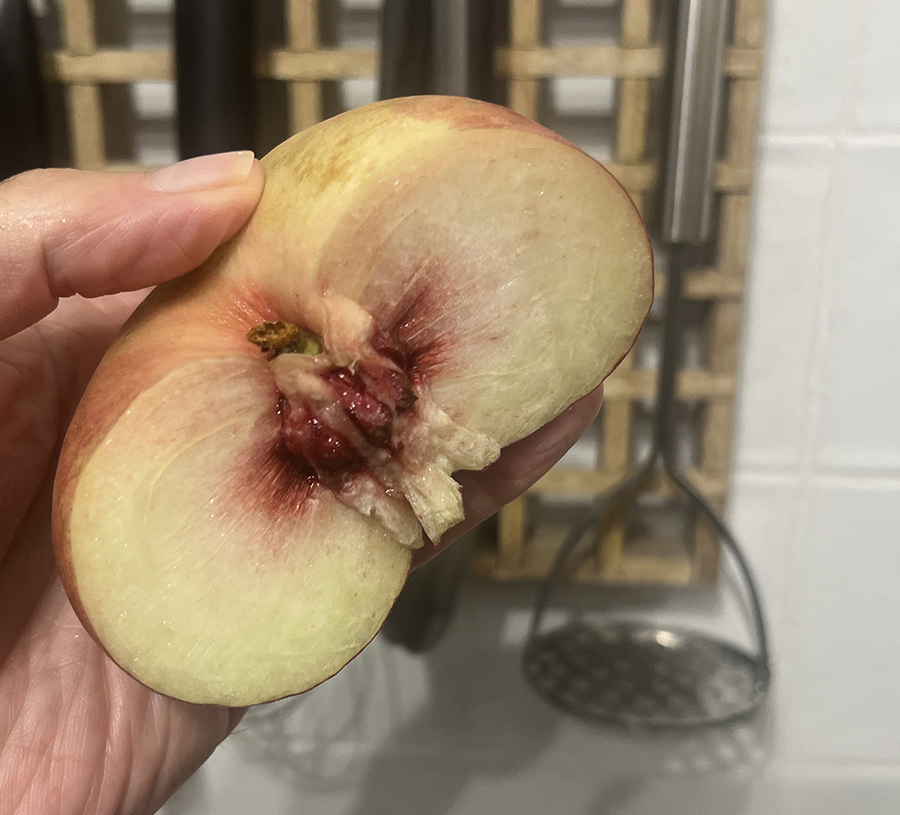
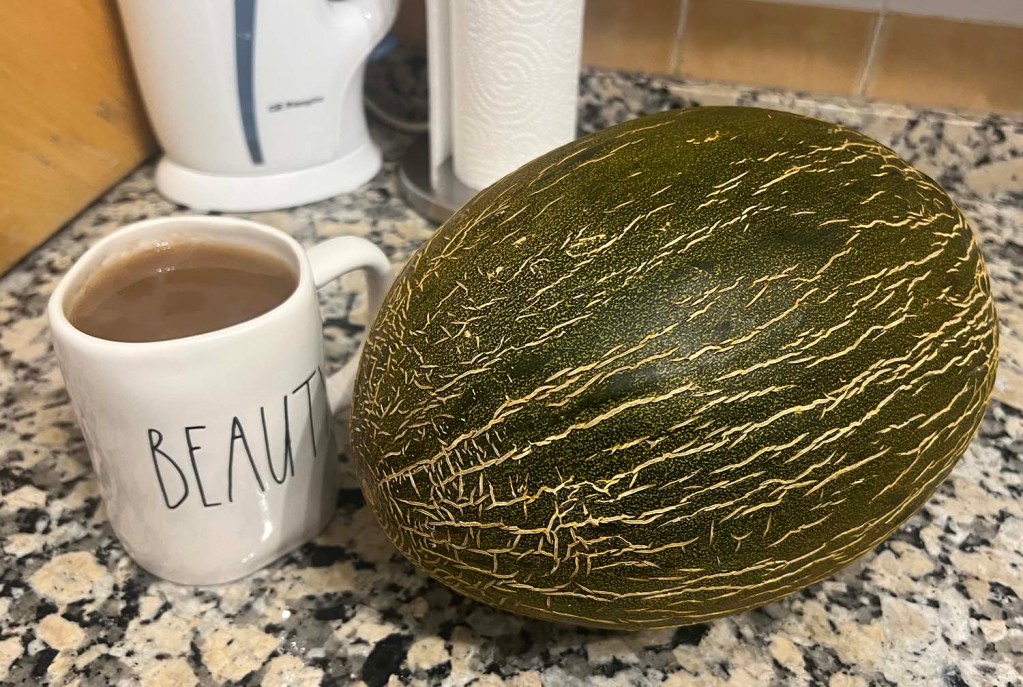
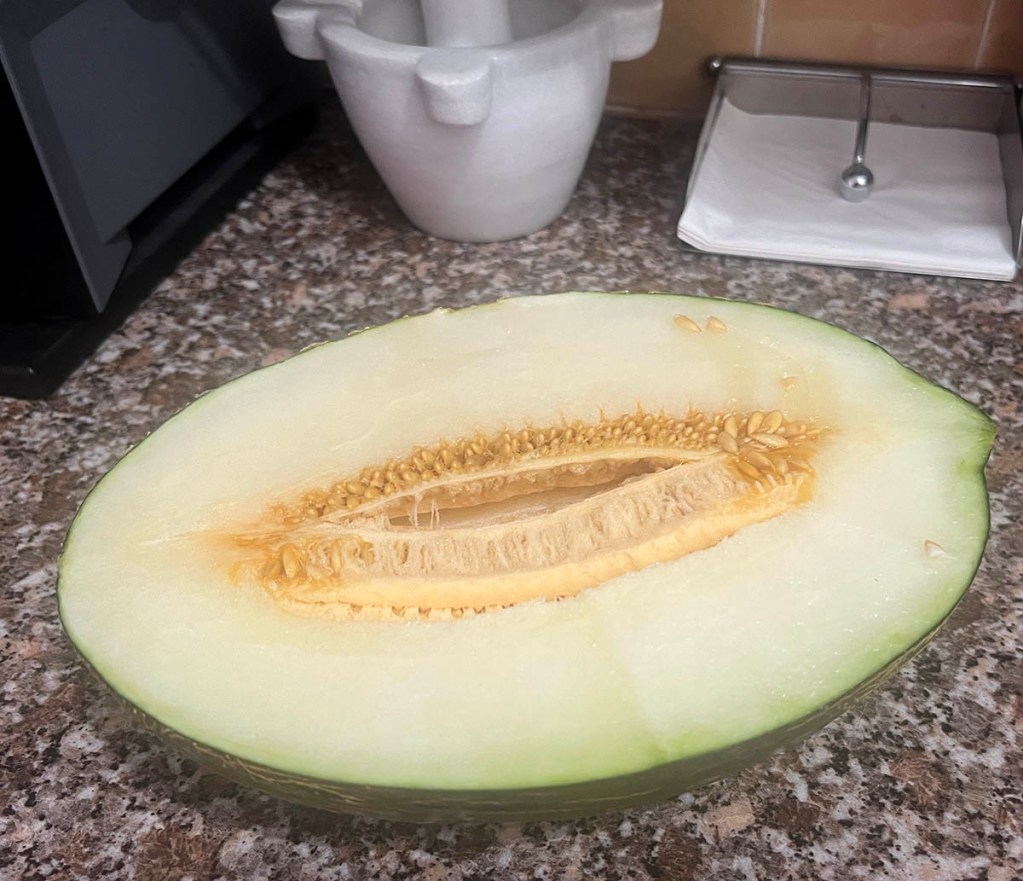
And that really has nothing to do with anything today. Our kitchen is stocked with delicious fresh fruit. I had a huge Saturn peach first thing this morning (well, first thing for me, which was 11:30) and SG brought home a Piel de Sapo (toadskin) melon, which we enjoyed (one quarter each) after lunch. Piel de Sapo melon may be known as Christmas melon or Santa Claus melon where you are (if you can get it). I had never had it until we moved to Spain and I can understand why this native is the most popular melon here. Its skin looks like that of a toad, and it tastes somewhat like a honeydew, but juicier and sweeter, and with a more pleasant texture.
And back to language. San Geraldo calls cantaloupe “muskmelon.” I had never heard that until I met him. I’ve since learned that cantaloupe is a type of muskmelon, which is a generic term for “melon,” although muskmelon specifically refers to musky, netted-rind types. I also learned that “true” cantaloupe is grown in Europe and the musky, netted-rind muskmelon just mentioned is North American cantaloupe. This will be on the test tomorrow. I had a lot of difficulty explaining this in Spanish (and, admittedly, in English, as well).
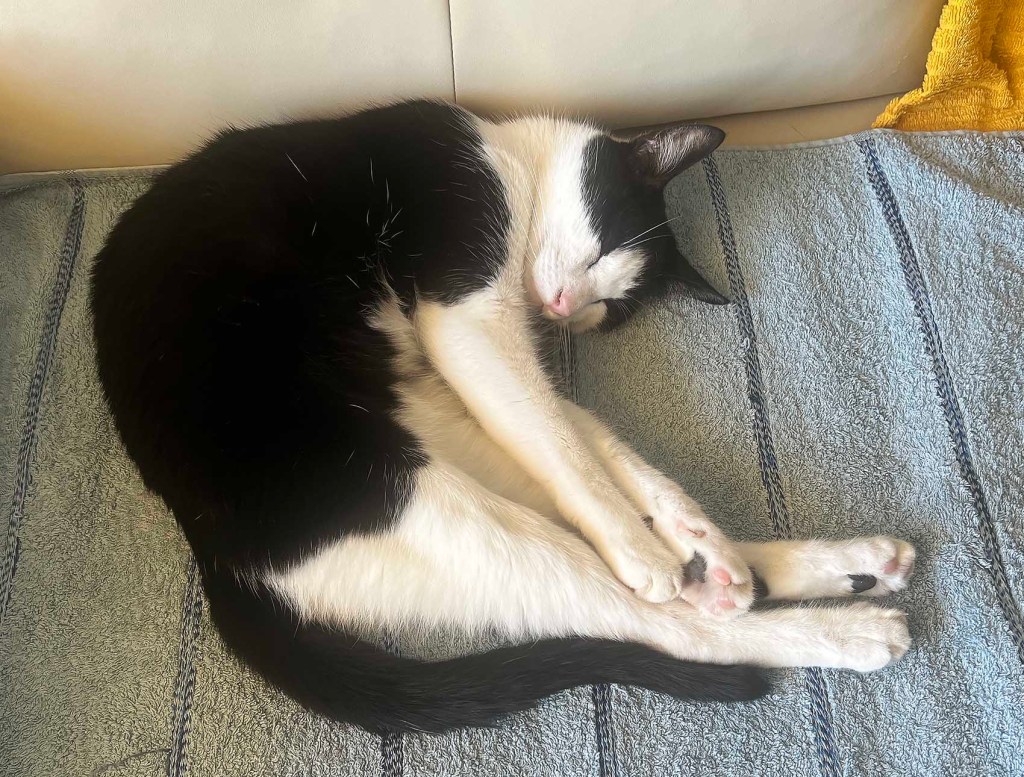
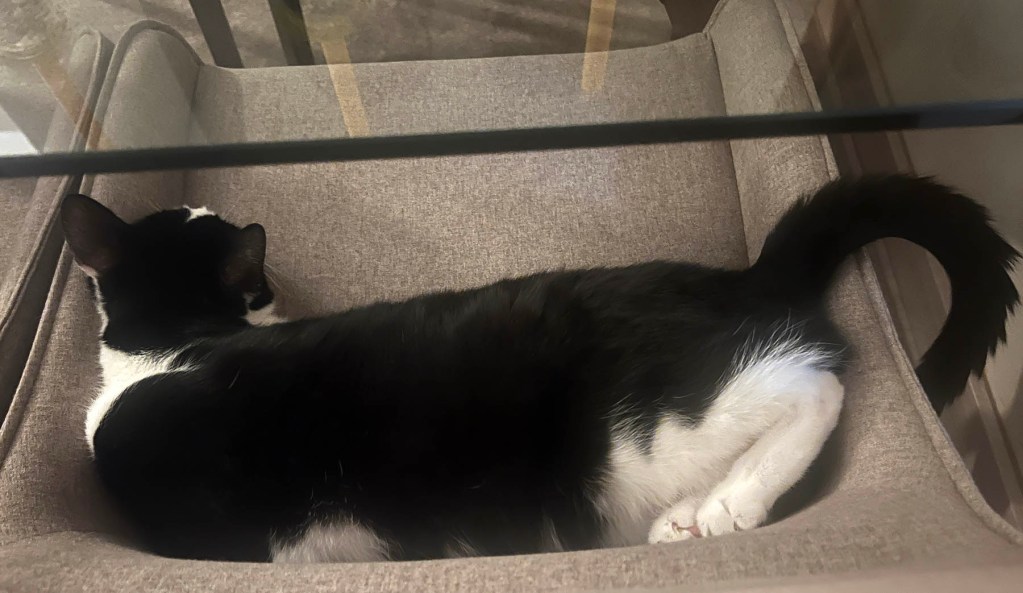
It’s been warm (or hot) and humid for days. I had intended to get out for a walk this afternoon, but somehow a siesta sounds like a better idea. After all, I’ve been up for more than 6 hours. Meanwhile, Dudo is making himself comfortable.
A veces (a menudo) San Geraldo puede desafiar mis habilidades de traducción. Se las arregla bastante bien para captar la esencia de las conversaciones en español y a menudo puede responder en español. Pero no ha aprendido a simplificar su inglés para que sea más fácil traducirlo al español. No nos dimos cuenta hasta que nos mudamos aquí hace 13 años que SG usa una cantidad inusual de coloquialismos estadounidenses. Un día de mayo, mientras me visitaba en el hospital, una enfermera entró para sacarme sangre (a mí, no a él). En el pasado, SG habría salido de la habitación, pero se ha vuelto más duro con los años y simplemente me dio la espalda. La enfermera, que hablaba poco inglés, se rió del drama. San Geraldo preguntó: “¿Tienes Wuss en español?”. Por supuesto, se encontró con una mirada en blanco. ¡Me quedé solo pensando en la palabra en español para Wuss! Después de pensarlo un poco, me decidí por “cobarde”. Al parecer, hay muchas otras palabras más precisas y peyorativas. Pero “gallina” (que se traduce directamente como gallina) se usa comúnmente.
Y eso no tiene nada que ver con nada de lo que ocurre hoy. Nuestra cocina está repleta de deliciosa fruta fresca. Esta mañana me comí un melocotón Saturno enorme a primera hora (bueno, a primera hora para mí, que eran las 11:30) y SG trajo a casa un melón Piel de Sapo, que disfrutamos (un cuarto cada uno) después del almuerzo. El melón Piel de Sapo puede ser conocido como melón de Navidad donde vives (si puedes conseguirlo). Nunca lo había probado hasta que nos mudamos a España y puedo entender por qué este melón nativo es el más popular aquí. Su piel se parece a la de un sapo y sabe un poco a melón verde, pero más jugoso y dulce, y con una textura más agradable.
Y volvamos al lenguaje. San Geraldo llama al melón cantalupo “muskmelon” (simplemente melón). Nunca había oído eso hasta que lo conocí. Desde entonces aprendí que el melón cantalupo es un tipo de muskmelon, que es un término genérico para “melón”, aunque el muskmelon se refiere específicamente a los tipos de cáscara reticulada y almizclada. También aprendí que el melón cantalupo “verdadero” se cultiva en Europa y que el muskmelon de cáscara reticulada y almizclada que acabo de mencionar es el melón cantalupo norteamericano. Esto será parte del examen de mañana. Tuve muchas dificultades para explicar esto en español (y, admito, también en inglés).
Hace días que hace calor (o más bien calor) y hay humedad. Tenía pensado salir a dar un paseo esta tarde, pero por alguna razón una siesta me parece una mejor idea. Después de todo, llevo más de seis horas despierto. Mientras tanto, Dudo se pone cómodo.

Click the thumbnails to enlarge.
Haz clic en las miniaturas para ampliar.

That’s a monster peach! SG continues to amuse, with his efforts to shoehorn American colloquialisms into Spanish – haven’t they got enough of their own? Jx
Jon:
And SG regularly confuses his American colloquialisms. This round of Saturn peaches are monsters and incredibly delicious.
Well, now you’ve got me wondering how many colloquialisms I use. Probably at least as many as your SG. Are you proficient in Spanish profanity or are you more of a gentleman than I am a lady?
Ms. Moon
Ms. Moonsigh:
I’ve noticed Southern colloquialisms in your writing, but not a huge amount. Just sometimes I can hear the music in your words. I know some “dirty” words, but not many. Not because I”m a gentleman, just because I”m uninformed.
I’ve heard the term “muskmelon” but didn’t realize that it included cantaloupes — thanks for that info!
Debra:
Stick with me. (Please)
Then of course there’s Christopher Meloni. But my mind works in mysterious ways…
Frank:
Now those are sweet melons!
I love cantaloupe – or I think that’s what I love. Perhaps I love muskmelon.
Kelly:
No matter what, you’d love toad skin!
Boud here, chiming in. That cut melon looks like a honeydew. Melons are confusing, especially in translation. So is slang, not always translatable, because of the cultural attitude.
Never mind, the fruit’s good.
Boud:
The skin is nothing like a honeydew and I think piel de sapo is so much better. (And I love honeydew.) Yes, slang is often not directly translatable from one language to another. It can present some challenges.
I’ve known they’re called muskmelon but have never heard anyone use the term.
Leave it to SG ….
Bob:
South Dakota. They used to say: “Welcome to South Dakota. Set your clocks back 10 years.” Last time I was there, there was a billboard in a town not far from the Minnesota border saying something to the effect of ’Welcome to [town name which I wish I could remember]. If you’re against guns and for abortion, go home.”
So welcoming …
I’ve heard muskmelon but I don’t remember if it was used to refer to a cantaloupe. If San Geraldo can’t watch while you have your blood drawn, then what happens when he needs to have his blood drawn? I picture him stretched out in an operating room, anesthetized for a two-minute procedure. It must be hard to catch on to the figures of speech in another language that aren’t easily translated.
Love,
Janie
janiejunebug:
SG used to have to lie down, even to get a flu shot. Now he just looks the other way.
Saturn Peach, eh? The boys call them squashed peaches! I can’t wait to tell them the real name! Love to you both!
Kathleen:
I think I love the real name. I like squashed peaches!
When I was a very young child, I used to confuse cantaloupe with antelope. At least when I sang “Home on the Range.”
Kirk:
I, too, remember singing “Where the deer and the cantaloupe play.” Great minds think alike!
First time I heard muskmelon was in Minnesota. I believe it is an upper Midwesternism. Apparently (I heard this a while back) American cantaloupe isn’t really a cantaloupe; the Euro version is a proper cantaloupe. “Originally, cantaloupe referred only to the non-netted, orange-fleshed melons of Europe, but today may refer to any orange-fleshed melon of the C. melo species, including the netted muskmelon which is called cantaloupe in North America, rockmelon in Australia and New Zealand, and spanspek in Southern Africa.” I wonder what “netted muskmelon” would be in Spanish?
wickedhamster:
You see how confusing it is? Netted muskmelon might literally be melón enredado in Spanish, but it wouldn’t be a thing.
I can’t imagine having to translate “wuss.” Even in English I don’t think it’s really a word! I’ve had one of those melons before. I remember buying it and coming home and laughing about the Spanish name with Dave. I think in English it’s called Santa Claus melon, but I have no idea why.
Steve:
Santa Claus melon, yes, and also Christmas melon. Toadskin melon is maybe a more fitting name but isn’t as appetizing. Wuss and wussy are words, but not words I would use.
No matter what you call it, that is a nice looking Mellon. There was a farm boy at the market this morning carrying a crate full of Mellon’s, and . . . what was I talking about?
David:
Speaking of which, I’m about to go for a walk along the beach. Oh, the melons!
Oh, I’m a day late! Here’s my dollar’s worth of comment: Just… oh, yummm! I learned of the existence of Saturn peaches from reading your blog. I think they call them doughnut peaches around here, but, still, I hadn’t ever seen them or heard of them. We have trouble getting good-tasting fruit… everything is picked before being ripe, and it’s hard, and even after letting it sit to ripen here at home, once it’s soft, it still doesn’t have much flavor. What a drag. Sometimes we’re lucky, often we’re not.
I’ve heard the term muskmelon 🙂
Judy C:
The fruit here is the best I’ve ever had. We’re spoiled.
I am learning Spanish and French and I am reviewing German. Oddball expressions and such in a different language are difficult to learn. I remember a boy in first grade who was learning English. English statements like it takes two to tango always puzzled him/he took them literally.
Urspo:
Learning other languages does make you appreciate the peculiarities of common sayings. Spanish friends have tried to explain many expressions to me, too.
I think fruit is the most wonderful food. I love trying new ones, and so far, ahve not tried one I don’t like.
I wish I had the luxury of being squeamish about needles and blood draws, but if I hadn’t acclimated to them as much as I have, I’d never have survived into my thirties. Being a person who can tolerate being a human pin cushion was never on my “what i want to be when I grow up” list – HA!
Sassybear:
I complain about what I have to have done. I can’t imagine what you’ve been through. But, I’m grateful to have never been squeamish about it. I watch.