
La versión en español está después de la versión en inglés.
I finally made it to Córd0ba’s archaeology museum Tuesday afternoon. It’s a 20-minute walk from home (35 minutes the way I meandered) and worth every minute. I was gone for 2-1/2 hours. Because I took 212 photos while I was out (not all at the museum), I’ll share with you some exterior shots today.
The Palace of the Páez de Castillejo was built in the 16th century and named in 1680 for the owner at the time who passed it to continuing generations. It remained in private hands for centuries and became home to the archaeology museum in 1944. The palace is a World Heritage Site.
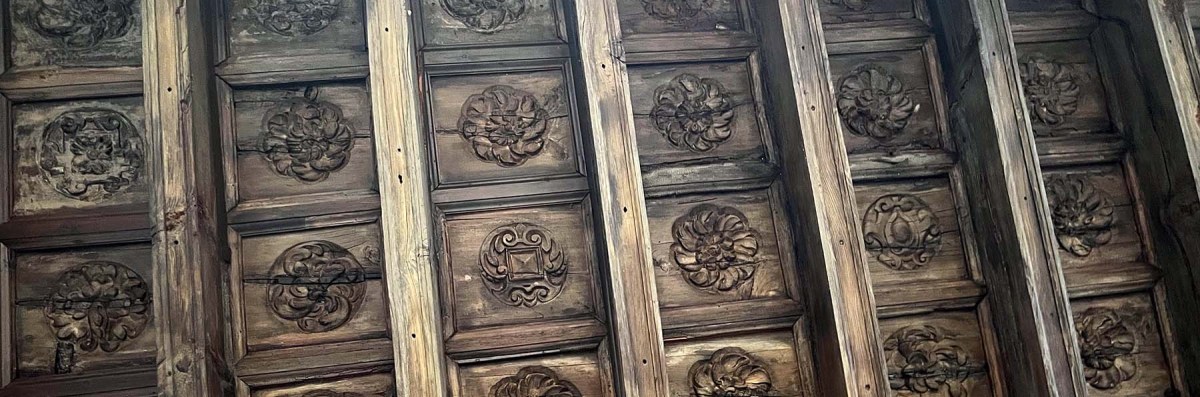
In 2011, a new building was erected next door to re-house the collection. I’ll share more details with you in the coming days. Today is just a taste beginning, above, with a ceiling inside the palace. The contemporary building is atop a Roman amphitheater that is beautifully revealed.
Finalmente llegué al museo arqueológico de Córdoba el martes por la tarde. Son 20 minutos a pie desde casa (35 minutos por el camino que yo recorrí) y vale cada minuto. Estuve fuera dos horas y media. Como tomé 212 fotos mientras estaba fuera (no todas en el museo), hoy compartiré con ustedes algunas tomas exteriores.
El Palacio de los Páez de Castillejo fue construido en el siglo XVI y recibió su nombre en 1680 en honor al entonces propietario, quien lo legó a las generaciones siguientes. Permaneció en manos privadas durante siglos y se convirtió en la sede del museo arqueológico en 1944. El palacio es Patrimonio de la Humanidad.
En 2011, se erigió un nuevo edificio al lado para albergar la colección. Compartiré más detalles con ustedes en los próximos días. Hoy es solo un adelanto que comienza, arriba, con un techo dentro del palacio. El edificio contemporáneo está sobre un anfiteatro romano que se revela hermosamente.
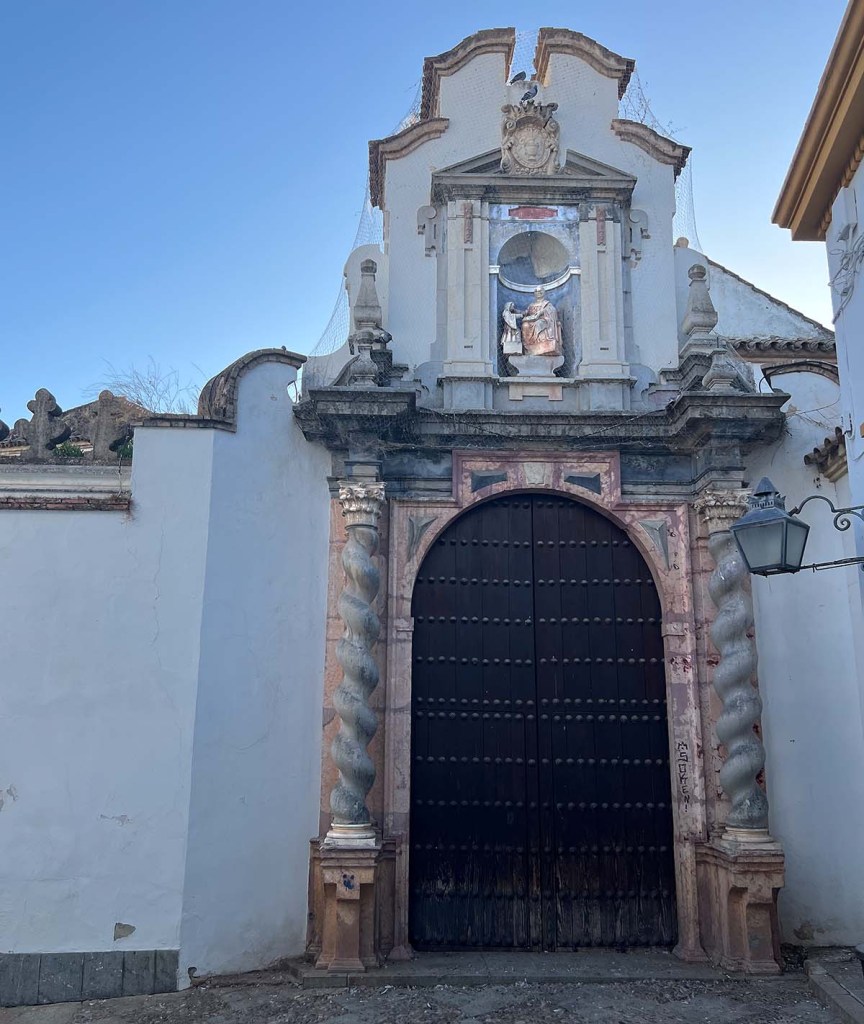
• Estoy a punto de girar a la izquierda y luego a la derecha para llegar a la plaza. Está al lado del palacio.


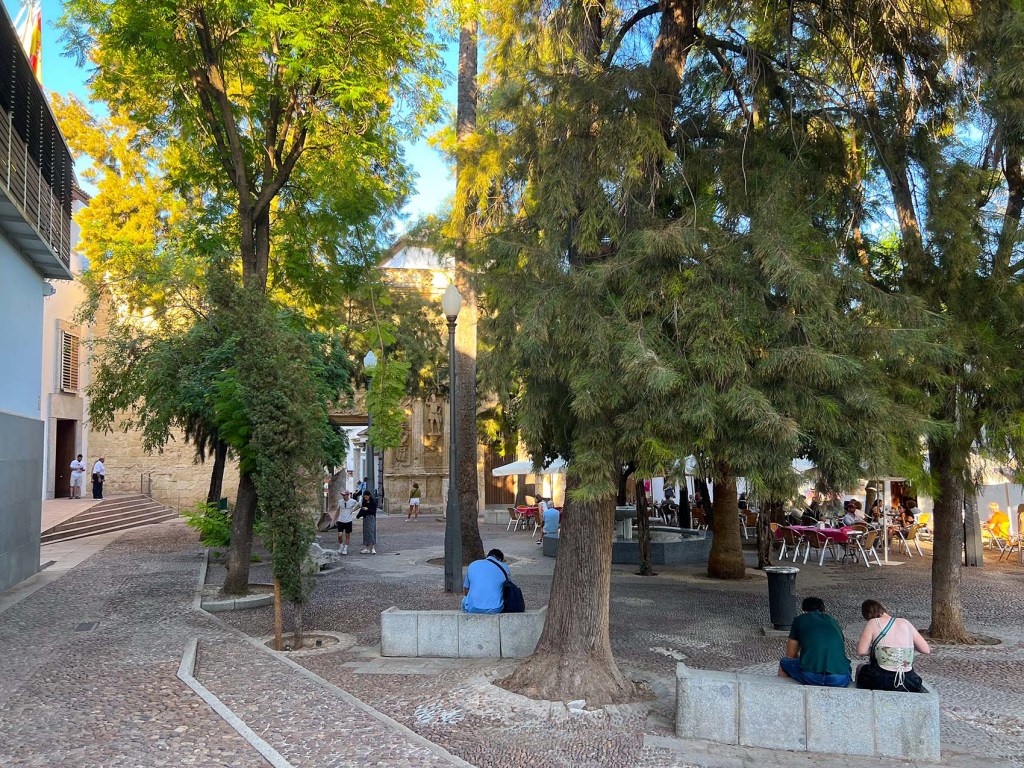
• Edificio nuevo a la izquierda. Palacio al frente. Plaza Jerónimo Páez en el centro.
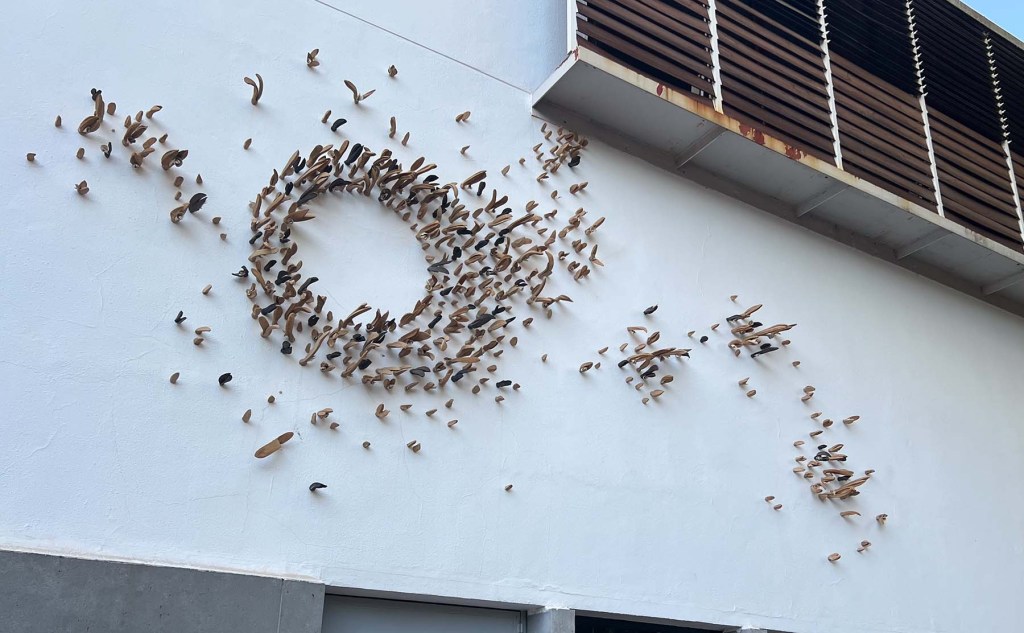
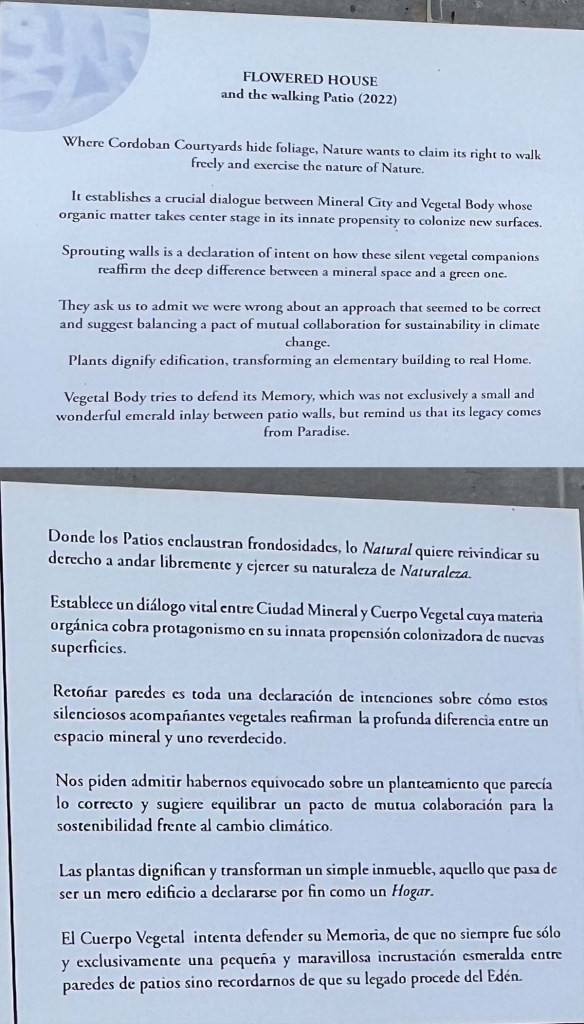
• Esta pieza adorna la pared frontal del museo. Dejaré que el artista, Silvia Favaretto, la explique. Ver más abajo. Y, por favor, compartan su opinión sobre la obra y la explicación. Me gustaba más antes de que me lo explicaran.


Click the thumbnails to enlarge.
Haz clic en las miniaturas para ampliar.

The 16th Century palace entrance is stunning! It must be impressive in person. The art installation looks to me like a cross between seedlings and the whirling pattern of dandelion seeds when dispersed by the wind. The print on the artist’s explanation is way too small to read though.
Have you found any more Green Man architectural plaques lately? Those would make a fun post too!
Tundra Bunny:
I replaced the sign with something that might be more readable. Let me know. If not, I’ll copy it out.
Thanks for enlarging the sign, Scoot. Too bad the artist’s explanation is gobbledygook!
Tundra Bunny:
I DID find an incredible stone face at the museum yesterday. It’s actually Pan but made me immediately think of Green Man… and made me want to lift it off the wall. You’ll see it soon! I at first found the art at least interesting. I didn’t like it as much on closer inspection. But the artist’s statement really put me off. I would not want to spend one moment with her.
I had no problem reading the explanation, but I have zero idea what in the heck it means?! Just babble words. 🤷♀️
Anonymous:
I agree.
To be honest, I didn’t particularly like the art either with or without the artist’s explanation.
Debra:
First glance, I found the art interesting. I was disappointed on closer inspection. But I found the artist’s statement pretentious and ridiculous.
Mineral City, vegetal body? Bizarre! I just watched a clip this morning of Dick Cavett and Lillian Gish interviewing Salvador Dali. He basically said people trying to find hidden, special meanings in his work was BS. He just painted what came to him in those 15 minutes or so before one falls asleep.
Kelly:
Usually, it’s bad curators who write pretentious insulting descriptions. Coming from the artist, even worse. I love Salvador Dali’s statement. I want to be able to appreciate or not appreciate art on my own terms.
Amazing architecture! And here I thought the art on the wall represented with tails of birds that were flying through the wall and I was hoping they hadn’t gotten stuck partway through! Even at that the artist is better at sculpting than writing.
Wilma:
I like your interpretation better. Did the birds have vegetal bodies?
So many wonderful things to see and do. Thanks for taking us along.
David:
The neighborhood around there is worth the walk by itself.
The architecture in Spain is always awe producing.
From centuries ago it still calls us.
I sometimes like reading what the artist says. In this case, I like it without the explanation…
XOXO
Sixpence
Sixpence:
I find the artist’s words nonsensical and pretentious. Still, HER work is purchased and displayed! Mine is not.
The palace/museum looks intriguing – I look forward to seeing more. It’s so revealing, though, in such a place of learning and history, how many people in that plaza are looking at nothing but their phones…
As for the “artwork” – bleurgh! It looks like cockroaches or some other infestation. I’d have the bug-killer spray out. The description explanation? “Mr/Ms Anonymous” above got it right – babble!
Jx
Jon:
I hadn’t even noticed all the mobile phone use. It’s a different world. But I suppose I can’t say much because I walking all over with my phone taking pictures. Still, conversation with others when you’re with them could be an interesting thing to try. The artist’s words make me not want to see any of her art.
Pretty sure that explanation is AI generated…. Flowing prose with insufficient structure to provide comprehension 🤪
I thought it was 🐝 🐝 having a major conflab. I choose Animal Antics over mineral and vegetal
But I’d love to visit the museum and palace.
Jssw:
That would be so funny if it were AI generated! You would LOVE LOVE LOVE the museum and the palace (and the entire neighborhood).
I like this art piece. I see a large gathering of humans all moving towards the centre circle….. I am wondering what they all have in common.
The artist’s explanation was gibberish to me.
Jim:
Sad that the artist makes it difficult to enjoy her art. No, you don’t get it! It’s Mineral City and Vegetal Body exercising the nature of nature. Don’t you understand?
Oh NOW I get it!! lol Thanks for clearing that up for me.
I am truly looking forward to seeing what’s inside the archeology museum. But I will be patient. Okay. That entrance to the Plaza? Is that what the magnificent edifice with the beautifully photographed shadow-dappled walls are? I love it. So much.
The modern artwork on the front of the museum is fine but Silvia Favaretto needs an editor or something. But you know- artists can say whatever they want about their work. They made it.
Senora Luna
Sra. Luna:
I will be going back to the museum. So much to take in. And it was free! Silvia Favaretto needs to let her art speak for itself!
So wonderful to stroll outside and wander through those beautiful structures. Just gorgeous!
Bob:
It was an exceptional day. I could have spent hours exploring the neighborhood, too.
You certainly do live in a great place to walk and explore. I just looked up Córdoba on the map. I didn’t realize how close you were to Seville, and to Portugal!
Michael:
It’s convenient and near so much, and easy to get to most places (although no trains to Portugal).
I’m surprised that there are no trains to Portugal. It looks so close on the map.
Michael:
I know. It’s a shame. There are trains but hardly any routes. I could take a train to Madrid and then another train to northwestern Spain and then head down to Lisbon changing trains a couple of times, I think. It would take well over 20 hours. Driving from here would be under 6 hours.
It is too bad for you that Portugal isn’t better connected with your part of Spain as I hear Portugal is a great place to visit.
What a marvelous post. All this to see and explore. The point of art is that it speaks for itself. Explaining it on words isn’t a great idea. Just let it happen to you. Or not! Boud
Boud:
I completely agree about the art. I didn’t love it myself on closer inspection, but I liked it even less after reading what she had to say. Let me take it in on my own terms!
212 photos!!!!!!!!!!!!!! Is that it? But what lovely architecture…as always.
Mistress Borghese:
Yes, I’m slipping. In the past, it probably would have been 400, but I’m getting a bit more reasonable.
Among the ruins–I thought this would be a post about my body. Your photos are beautiful.
Love,
Janie
Janie:
This was a post among MY ruins, not yours.
Okay, my first thoughts after seeing that seedling art, and quickly reading the explanation, was that it was representing nature being crowded out and taken over (hence the seedlings having to push through stucco)…yes? I haven’t spent much time on it, though.
I looooove what you’re showing us of this museum, Mitchell! And so glad to know that you have this in your life, to enjoy.
Judy C:
After reading the artist’s pretentious crap, I no longer had any interest in the wall.
how exciting to live in a place that has some real history, going back hundreds of years.
Urspo:
Thousands of years. There is documented history of Cordoba from 4700 years ago.
Art Speak. Blah blah blah. Let me just enjoy it.
Ellen:
An artist after my own heart!