
La versión en español está después de la versión en inglés.
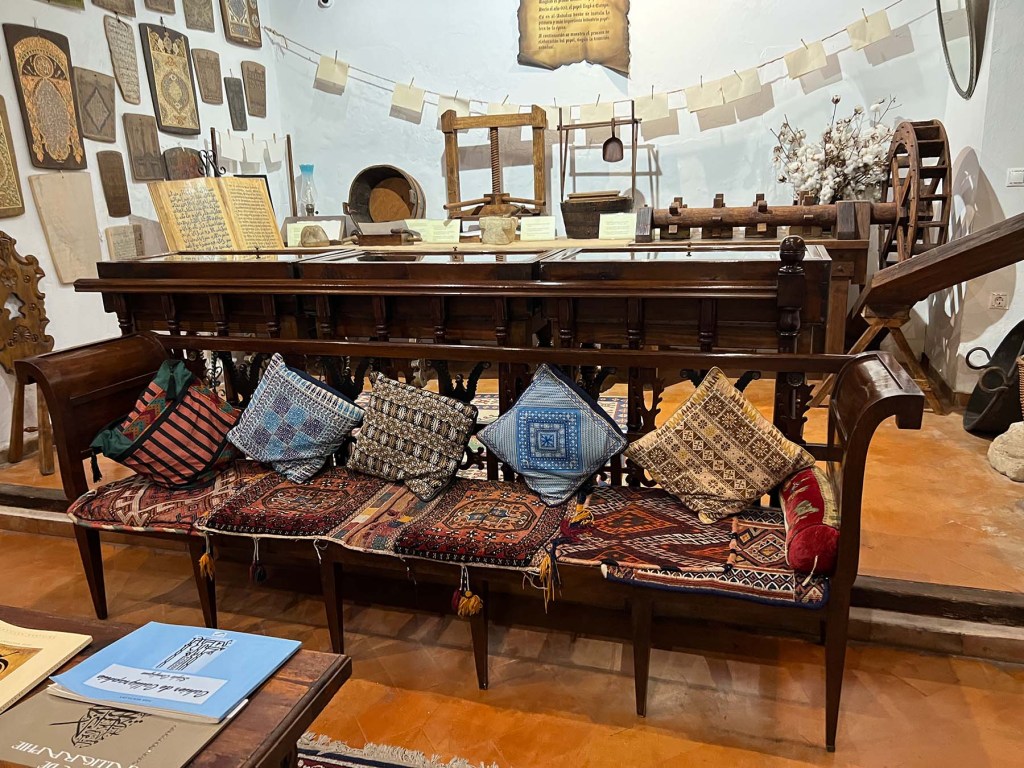
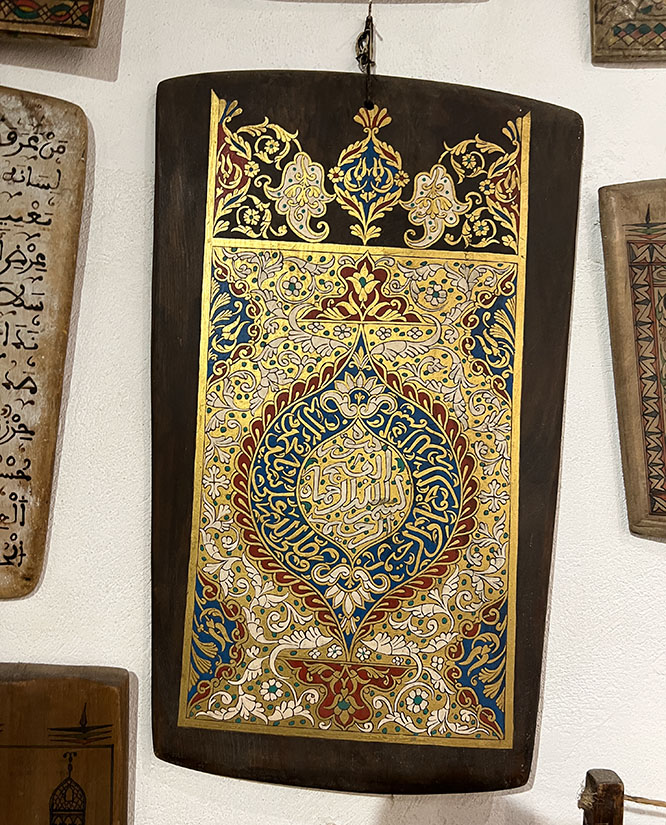
Andalusian House in the Jewish Quarter had one large room dedicated to paper making and printing. Some of the artifacts, such as the highly ornamented printing blocks, were beautiful to see. I had forgotten my reading glasses, so muddled my way through the exhibit without being able to clearly read some of the signage. The one large sign I could read hung on the main wall and explained: “In 150 AD, the Chinese inventor Ts’ai Lun obtained paper from rags. This invention became popular in the 8th century in the Islamic world. In 794, the first paper mill was put into operation in Baghdad. Around the year 900, paper arrived in Europe. It was in al-Andalus that the first and most important paper industry of the time was established.”
I’ve since read online that there was no paper mill on the Spanish mainland until the year 1151 near Valencia, which was still under Muslim rule. Córdoba didn’t fall to the Christians until 1236. The paper museum was interesting but not well curated, so left me with a lot of questions. What I could read of the small cards describing the process seemed to be out of order. But it’s not a subject for me that necessarily requires answers. Many others would find it fascinating.
White pigeons are prolific in Córdoba. Since the pigeons are rock doves, let’s say white doves are everywhere. I saw what looked like a flock of more than a dozen soaring outside our windows yesterday. Some are pure white and quite beautiful. I came upon a pair that seemed to be good friends. How sweet, I thought. You can see them at the end. They clearly didn’t mind being watched. It’s currently sunny. I’d better get out now before the rain returns.
La Casa Andaluza, en el Barrio Judío, tenía una gran sala dedicada a la fabricación e impresión de papel. Algunos artefactos, como los clichés profusamente ornamentados, eran preciosos. Había olvidado mis gafas para leer, por lo que caminé torpemente por la exposición sin poder leer con claridad algunos de los carteles. El único cartel grande que pude leer colgaba en la pared principal y explicaba: «En el año 150 d. C., el inventor chino Ts’ai Lun obtuvo papel a partir de trapos. Este invento se popularizó en el siglo VIII en el mundo islámico. En el año 794, se puso en funcionamiento el primer molino de papel en Bagdad. Alrededor del año 900, el papel llegó a Europa. Fue en al-Ándalus donde se estableció la primera y más importante industria papelera de la época».
Desde entonces, he leído en internet que no hubo ningún molino de papel en la península Ibérica hasta el año 1151 cerca de Valencia, que aún estaba bajo dominio musulmán. Córdoba no cayó en manos de los cristianos hasta 1236. El museo del papel era interesante, pero no estaba bien conservado, así que me dejó con muchas preguntas. Lo que pude leer de las pequeñas tarjetas que describían el proceso parecía estar desordenado. Pero no es un tema que para mí requiera necesariamente respuestas. Muchos otros lo encontrarían fascinante.
Las palomas blancas son prolíficas en Córdoba. Ayer vi lo que parecía una bandada de más de una docena volando fuera de nuestras ventanas. Algunas son de color blanca pura y muy hermosas. Me encontré con una pareja que parecían ser buenas amigas. Qué dulce, pensé. Se pueden ver al final. Claramente no les importaba que las observaran. Ahora mismo hace sol. Mejor salgo antes de que vuelva la lluvia.

• Supongo que esto tenía algo que ver con la fabricación de papel y no era simplemente otro dispositivo de tortura.



• Sin mis gafas, no podía ver que todavía estaba en la foto.


• Haciendo palomas. ¿Debería haber mirado hacia otro lado?


Click the thumbnails to enlarge.
Haz clic en las miniaturas para ampliar.

Yeah! Birds fucking!
There really is a wealth of history around you; seems like every street has some incredible set of artifacts on display, How incredibly fascinating! I would be pouring over all of it along with you! I truly get why Europeans are so intent on preservation and promotion!
On our continent, very little documented antiquity exists prior to 1565 (the Spanish settlement n St. Augustine Florida actually predates the Pilgrims (our Minister in Florida is actually a decedent). Perhaps a handful of rune carvings from the Viking explorers dating back to around 1000ad (settlements on Greenland and Newfoundland). The indigenous people on the continent treated the land as sacred; not creating permanent structures, but passing their history on through story.
Rade:
I remember visiting Mesa Verde in Colorado and being overwhelmed by the cliff dwellings dating from the 12th century. Still, I do prefer being able to walk the streets of a city filled with so much history. Sadly, much was lost or destroyed over the centuries thanks to less forward-thinking people.
I bet you are a tag reader in a museum. I tend to pass too quickly to read anything.
As to the last sequence of photos, that is part of the legend of the birds and the bees. Someday I will write about the sex live of honeybees, short and tragic in a nutshell.
David:
It depends on the exhibit. Some I breeze right by but other times, I read intently.
What a fascinating place, I would like to see that if I ever visit. And I too, to the dismay of many love pigeons and find them very beautiful. Highly intelligent birds too.
But does this mean your blog is now reduced to pigeon porn?
Mistress Maddie:
Reduced? Don’t you mean elevated?
So Europe has China and the Muslims to thank for paper made from fibre rather than animal skins? What a boon it was once the printing press got invented.
Debra:
Europe has China and the Arab world to thank for a lot of good things from centuries past.
That many geared item looks like an early version of the Hollander beater, used nowadays to break down cloth to pulp in order to create paper from it. And later I see a mold and deckle, similar to the one I made back when I was learning papermaking. I’d love to see this exhibit, and thank you for the pictures. Boud
Boud:
I figured you’d know what “coffee table” was! You would have been able to explain the entire exhibit. I thought of you while I perused it.
For something we so take for granted today, this was interesting as to it’s/paper’s history.
What a wonderful ‘city-scape’ photo! (the one following the ‘mirror’ photo)
Jim:
It is amazing the things we take for granted now.
Somehow it’s odd to imagine a world without paper but yes, of course it’s a relatively recent invention in the long term scheme of things. I suppose one would grow weary of trying to make a grocery list with a chisel in stone. I am reminded of Fred Flintstone.
I love your rain in the nighttime photos.
Maria Luna
Maria Luna:
Oh the Flintstones and all their brilliant “inventions.” The rain looked beautiful through the lens.
Hey pigeons! Get a room!
If that thing makes paper and ISN’T a torture device, I’d be shocked.
Love the rain pictures. We are expecting snow this weekend, and ice and rain and such. Luckily I am off for a few days so I won’t have to venture out with the crazy Camden drivers who freak in rain and snow!
Bob:
Your weather is looking awful. Glad you don’t have to venture out. I remember living in DC when everyone would go home at the THREAT of a half-inch of snow.
Feel like makin’ love 💘. . . The white doves really are pretty and I don’t mind a little pigeon passion.
Love,
Janie
janiejunebug:
Well, they’re prolific.
Well, I expect a museum to get its facts straight. Or else I’ll have to go through the place making up my own reasons for the displays.
Kirk:
I would love for you to write your own explanations for all those things. THAT would be entertaining.
Only humans want to hide procreation. Leave it to religion to make it shameful.
ellen abbott:
So, you mean I shouldn’t slut-shame the pigeons?
The invention of paper changed so much in history, yet it is so easily dismissed. True, the Egyptians had papyrus, and the Greeks of Pergamon in Asia Minor gave the world parchment and vellum, but the Arabs knew that paper could be mass-produced in a far easier process than either of its predecessors – and with it art and knowledge.
That museum’s quite a discovery! Jx
PS Pigeons, rock doves, whatever; they’re still disease-carrying vermin. Pretty vermin, but vermin nonetheless.
Jon:
Growing up in NYC, I loved to call pigeons rats with feathers. I try to be kinder now, but I don’t always succeed. Next door to the Casa Andalusi is another house that is now home to the Museum of Alchemy. Next time. I could have had a discount had I bought both tickets. Ah well. The story of my life.
If pigeons wanted privacy, then they wouldn’t be mating in the street! They’ll do it anywhere and everywhere… but they are not vermin. Wild and domesticated birds are vectors for diseases, just as we humans are. Labelling anything as vermin gives permission to people that it’s OK to kill them, usually as inhumanely as possible.
Tundra Bunny:
I used to call them rats with feathers (not an uncommon title when you live in the city). But I’m a better person now. Some sure are beautiful, too.
The white doves/pigeons are pretty. We get mourning doves at our house. (but I’ve never caught any in the act)
The paper stuff leaves me with questions, too. Where does papyrus fit in? That was made and used much earlier? Did only the Egyptians do that?
Beautiful rainy night photos!
Kelly:
Papyrus was used outside Egypt but it couldn’t travel very far because it didn’t do well in damper climates. Parchment became more practical in Europe until paper came along.
It’s really something to realize how they’ve managed to refine the paper making process to what is produced now.
Judy C:
It sure is. So many people enjoy making it the old-fashioned way.