
La versión en español está después de la versión en inglés.
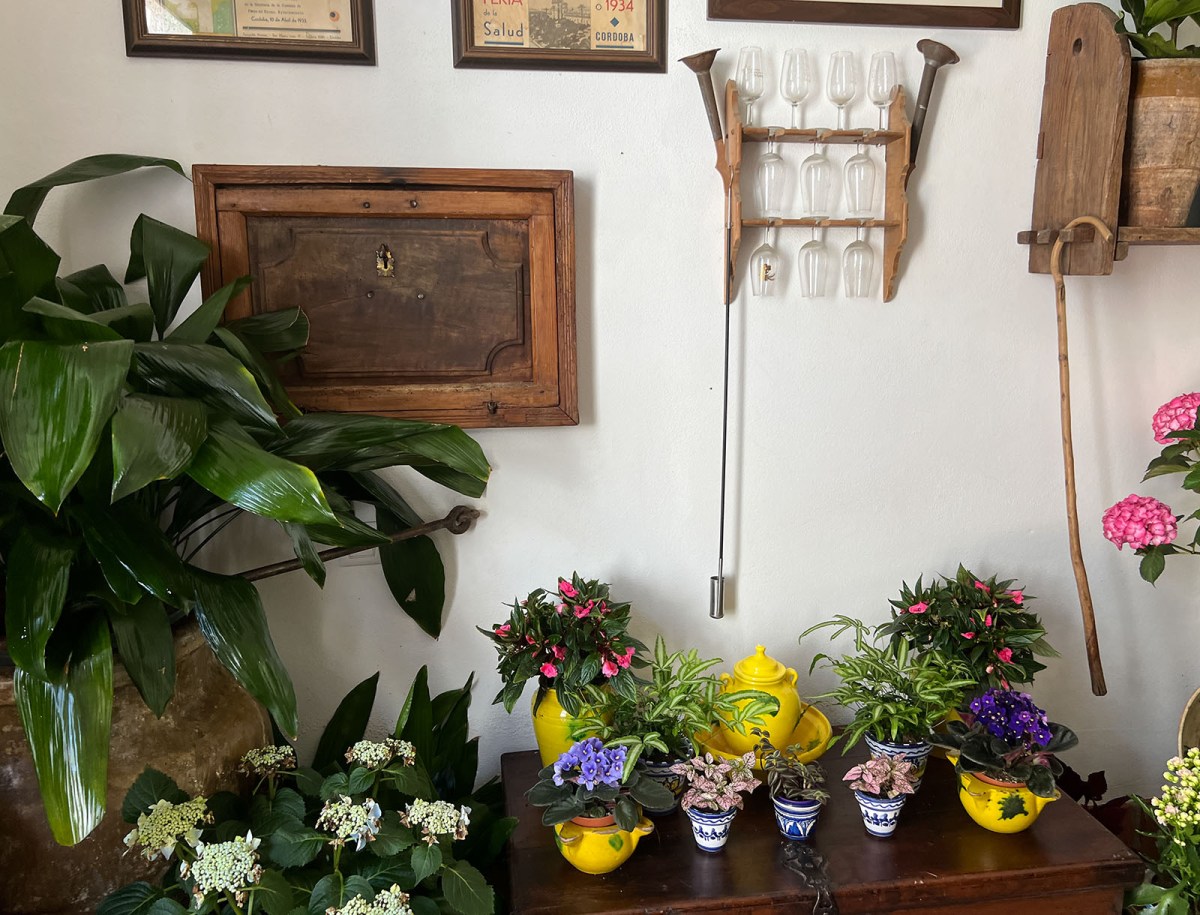
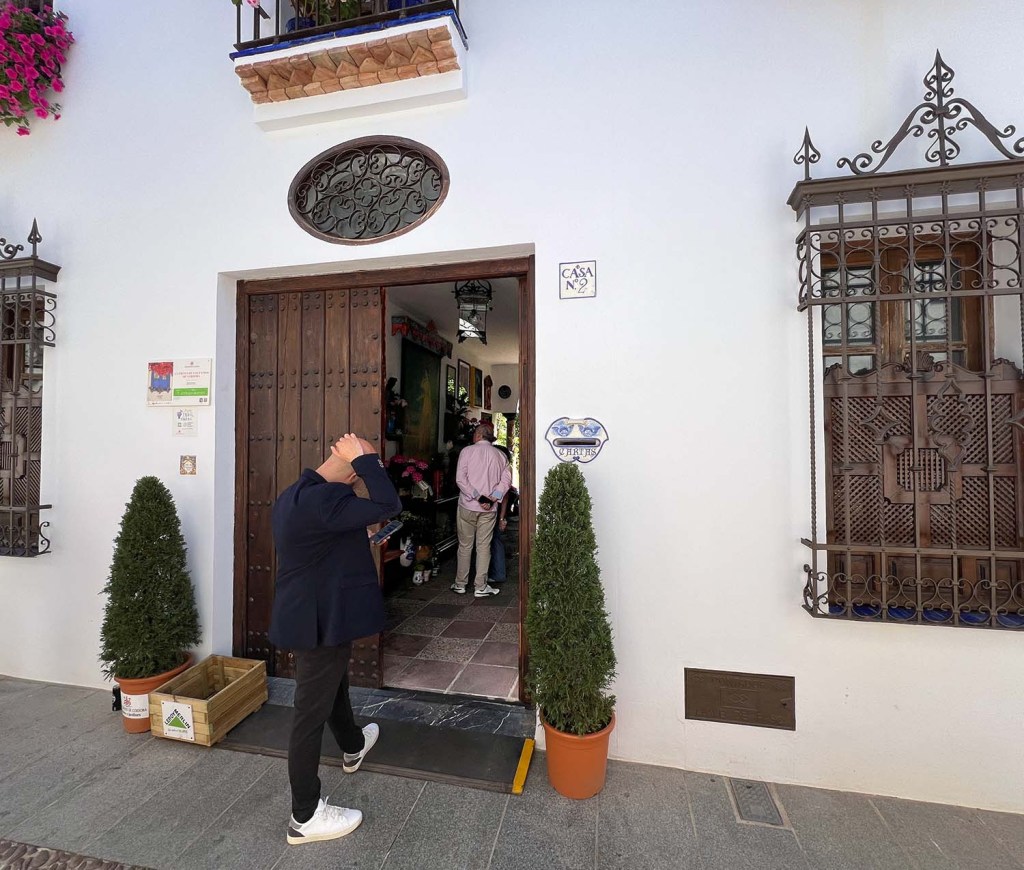
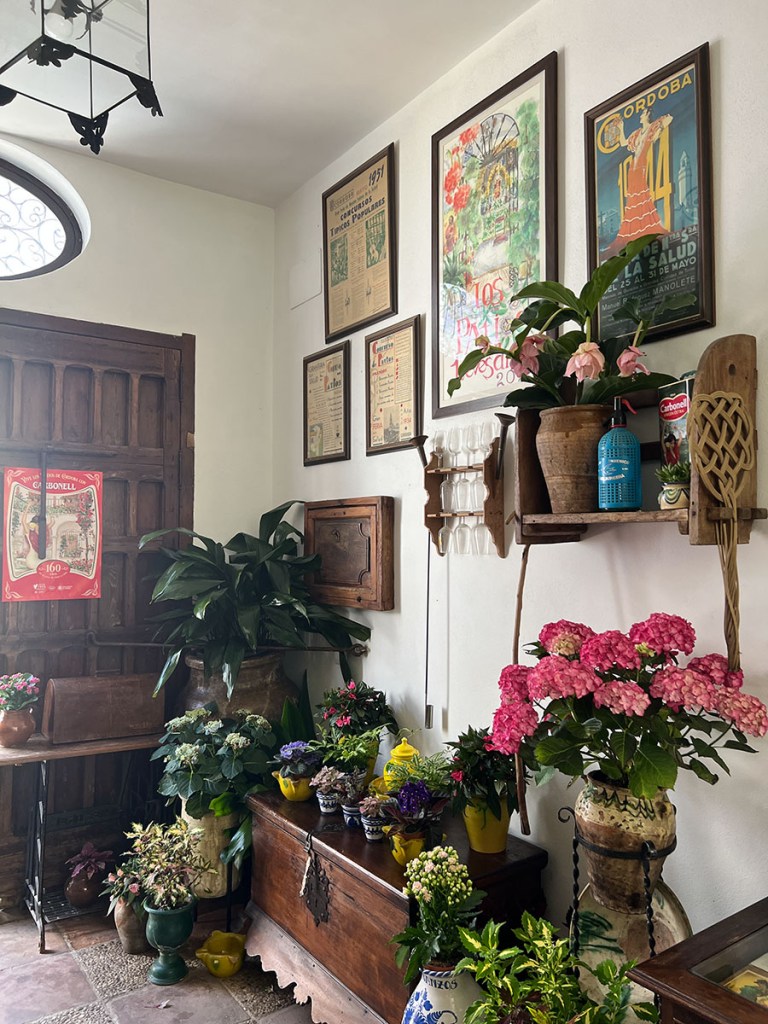
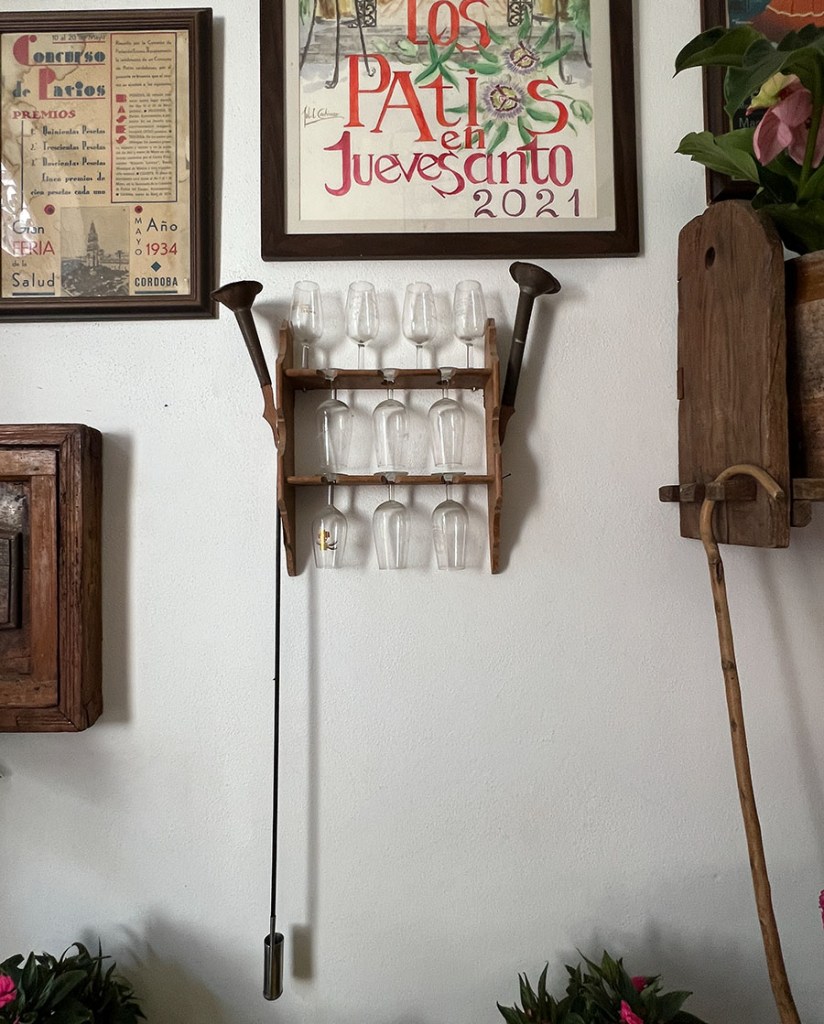
When you first enter the house at Calle de Pastora you are in a room (like an entrance hall) open at the far end to the patio. The room is heavily furnished and the walls are covered with art and historic items from Córdoba. One item was an unusual (to me) rack containing wine glasses. I asked the owner what it was and he said it was a venencia.
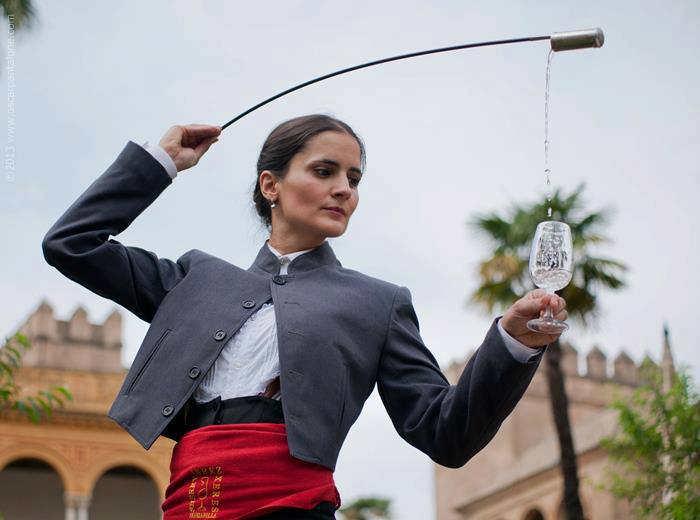
A venencia is used to pull sherry from aging barrels in wine cellars. It’s a cylindrical cup at the end of a long flexible shaft. The cup is dipped into the wine barrel through the bunghole* so it breaks the yeast that covers the aging wine. It’s then poured from head height or higher into a glass.
In earlier times, the shaft was made from a whale whisker. That practice ended in the mid-20th century. In other places, the venencia is made entirely (stem and cup) of bamboo. The person using the venencia is called a venenciador (or venenciadora, as pictured below). Pouring is clearly an art.
When I lived in Boston, one of my hangouts was a restaurant called J.C. Hillary’s. Servers there had what was known as the Hillary’s Pour. They held pitchers at a height and filled water glasses from at least a foot above. They must have trained in Spain.
*A bunghole, in this case at least, is the hole bored in the barrel to remove contents. The hole is capped with a stopper called a bung.
Al entrar en la casa de la calle Pastora, uno se encuentra en una habitación (como un vestíbulo) abierta al patio. La habitación está profusamente amueblada y las paredes están cubiertas de arte y objetos históricos de Córdoba. Entre ellos, destacaba un estante inusual (para mí) con copas de vino. Le pregunté al dueño qué era y me explicó que se trataba de una venencia.
Se utiliza una venencia para servir el jerez de las barricas de añejamiento en las bodegas. Es una copa cilíndrica en el extremo de un largo y flexible mango. La copa se introduce en la barrica a través de la boca de tonel* para romper la levadura que cubre el vino en proceso de añejamiento. Luego se vierte desde la altura de la cabeza o más arriba en una copa.
Antiguamente, el mango se fabricaba con un bigote de ballena. Esta práctica desapareció a mediados del siglo XX. En otros lugares, la venencia se fabrica completamente (tallo y copa) de bambú. La persona que utiliza la venencia se llama venenciador (o venenciadora, como se muestra en la imagen inferior). Servir el vino es, sin duda, todo un arte.
Cuando vivía en Boston, uno de mis lugares favoritos era un restaurante llamado J.C. Hillary’s. Los camareros tenían lo que se conocía como el “Hillary’s Pour”. Sostenían las jarras a cierta altura y llenaban los vasos de agua desde al menos treinta centímetros más arriba. Ellos deben haber entrenado en España.
*Una boca de tonel, al menos en este caso, es el agujero perforado en el cañón para extraer el contenido. El agujero se tapa con un tapón.

Whoa, impressive. They do that to test the wine, check on it’s progress?
ellen abbott:
Yes, that’s how they check on progress and quality.
Wow, that is really cool! So many things in life that have a strong historical background, of which most of us are completely ignorant… thanks, Mitchell!
Judy C:
I’m grateful to be able to find so much historical information online. I thought I was going to have to translate that plaque myself!
What an interesting post, Scoot! I wonder if that’s where the expression “shut your bung hole!” comes from, LOL!
Tundra Bunny:
I just looked it up. The origin of the word (in the 1500s) is for this exact meaning, the hole in a cask. But first verified usage of the word as we know it appears in a work by Rebalaise (of course) in 1653. Shut your bunghole is clearly just an outgrowth (ew!) of shut your mouth and shut your pie hole.
And let’s not forget “bunged up” for constipation, LOL!
A venenciador!! LOVE it.
Jim:
A great word. When he told me, I thought he said velencia. It turns out it’s mis-said and misheard as that regularly.
I love the venencia and the rack it is in. Very unique looking. The whole house is pretty quaint, isn’t it? Love all the flowers. I used to pour a Hillary pour at some parties…but I was far trained from being in Spain. And I’m not going to comment of the definition of the bunghole. I can be so dirty.
Mistress Maddie:
I’d love to see inside the rooms of the house to get a sense of it now. I had no idea a wine cask was the origin of the word bung hole!
Using the venencia properly seems to be a skill, an art, and a beautiful dance. Tradition is much respected in Spain, isn’t it?
Ms. Moon
Ms. Moon:
Yes, it is a dance! Some traditions might be better left behind. But others are pure magic.
Well, live and learn. What a fascinating video! Clearly that pour is both an art and a skill.
Debra:
Yes, it’s just like the Hillary’s Pour. All about the show.
That’s a beautiful skill. I wonder if they pour from a height to introduce oxygen into the wine? I bet it changes the flavor, anyway. Such virtuosity. Boud
Boud:
Yes, it is to oxygenate the wine and bring out the flavors. AND it’s also for show.
If I tried that, the wine would have ended up all over my arm.
Kirk:
You and me both!
In steel barrels you have to replace the bung-gasket, that was one of my duties in the honey-house, inspect and replace the bung hole gaskets.
David:
So, you knew all about bung holes at a very early age.
I was about 13 when I started tinkering with bung holes.
I’m glad you included the Wikipedia photo so we could see it in action! I was having trouble imagining how the pouring would work.
Steve:
When he told me, I had no idea what he meant until I looked it up.
Another way for me to destroy a boring dinner party or work event … talk about Sherry and the bunghole.
Bob:
You’re welcome!
That explains why the (alcoholic) Jester in the comic strip Wizard of Id is named “Bung”! Now I know.
Mitchell, did you ever have Sea Monkeys?
Kelly:
No, I never did have sea monkeys. My mother said, “no.”
The yellow pottery is sublime x
finlaygray:
I love that color.
Hey! I learned something!
Urspo,
My work is done.
I can’t get over “bunghole.” It makes me giggle because I have the brain of an eight-year-old boy. The woman with the wine glass resembles a bullfighter who is going to whip the wine into shape.
Love,
Janie
janiejunebug:
Yeah, it made me giggle, too. The venenciadores do look like bullfighters.