La versión en español está después de la versión en inglés.
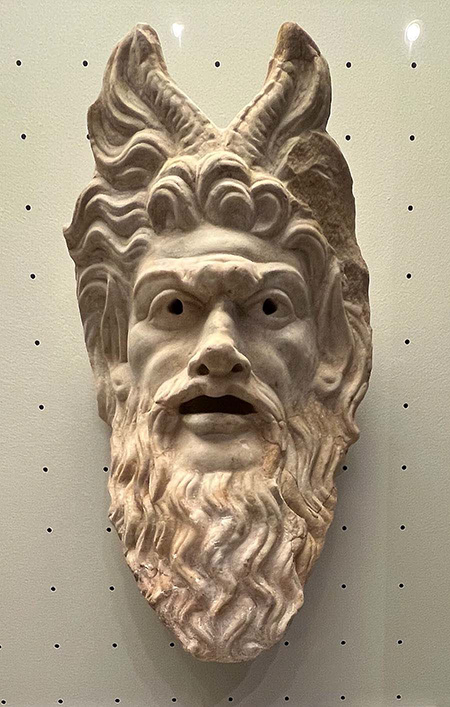
The above image is a 1st-century Roman stone theater mask. My immediate thought was, “Stone? How did the actor wear that thing?” So, I read a bit more. The stone face, in this case of the God Pan, would have been used as a mold. The artist then used something lightweight, like linen, leather, or cork to form the actual mask. This particular stone “mask” was found on Angel de Saavedra Street here in Córdoba, just 1-minute away from the site of the museum. I’m sure it was part of the theater complex at that time.
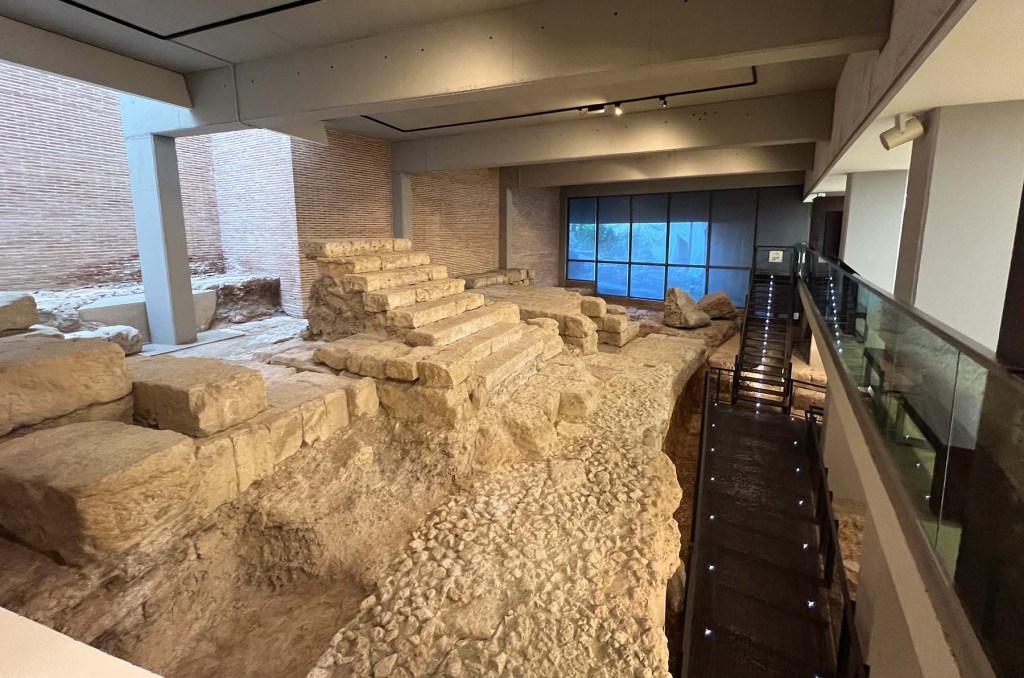
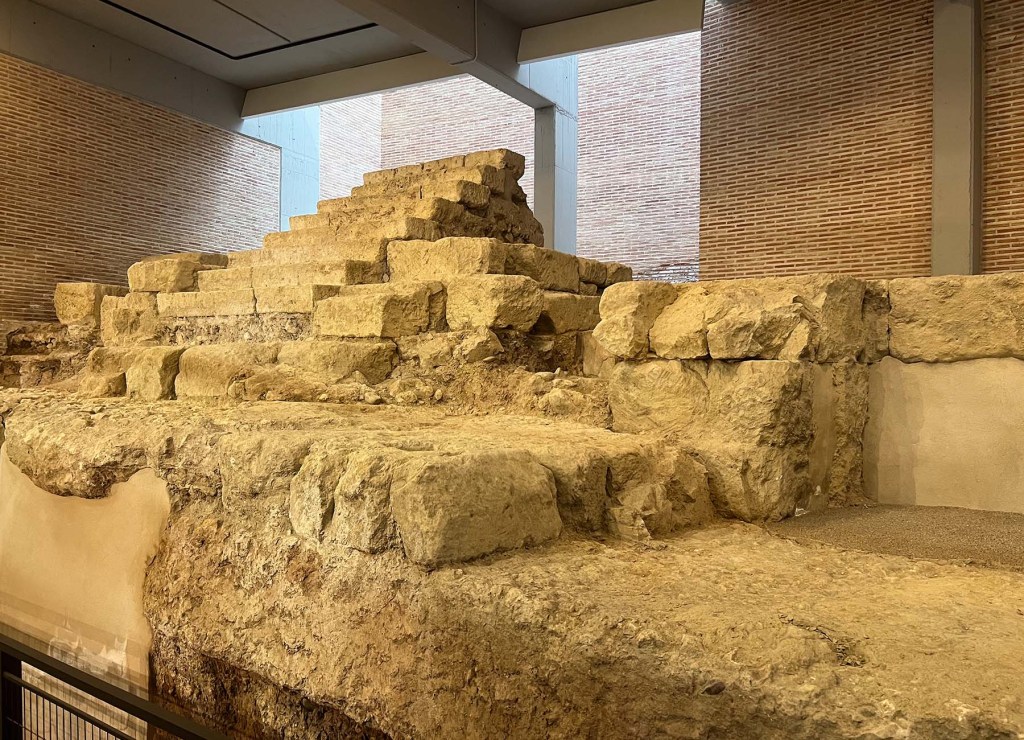
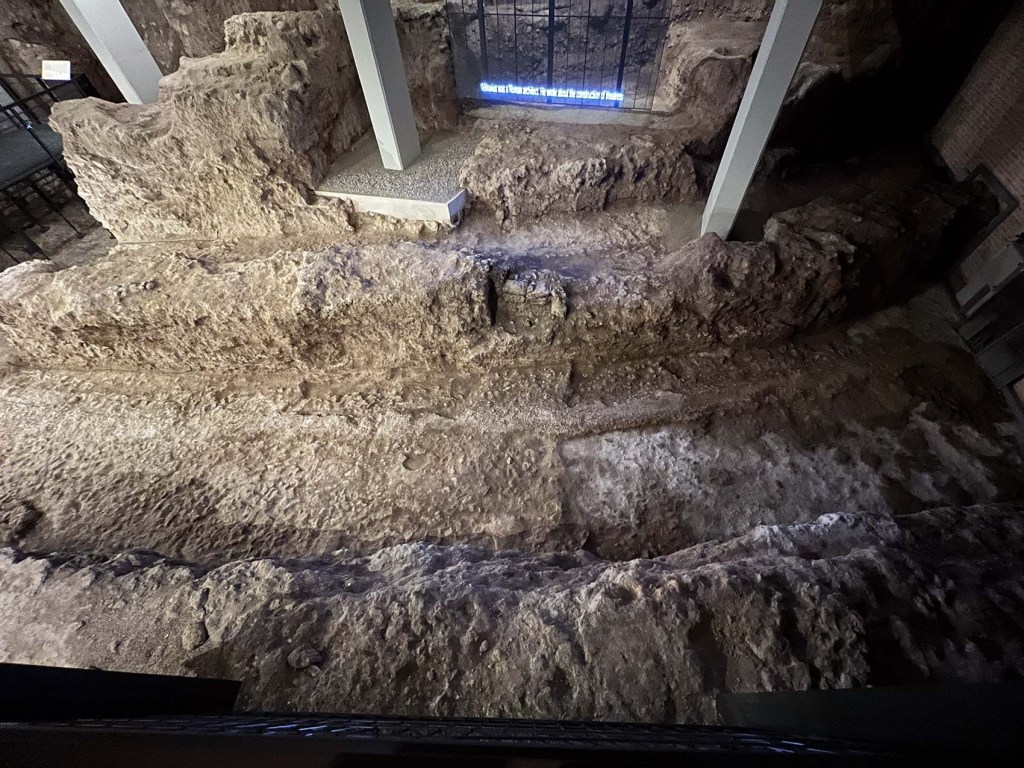
The relics displayed in the museum were found all over the city. I found it exciting when the name of a street, or even a specific address, was provided. The first photo below of a Corinthian capital from before the year 50 AD was found about a half kilometer (3/10 of a mile) north of where we live. The rest of today’s photos are views of the Roman amphitheater in the underground levels of the new museum.
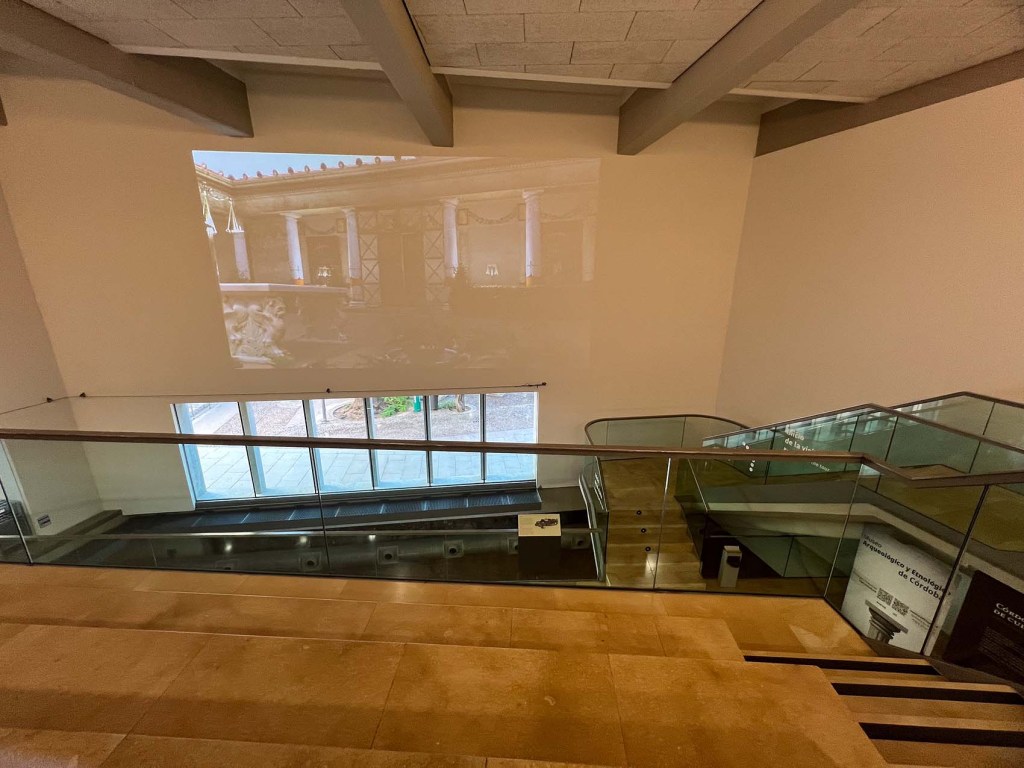
The final photo: There was some seating upstairs that mimicked the amphitheater seating where you could watch a video of the history of the area. It was a bit off-putting, but I did it. At least there’s a glass barrier at the bottom to catch you if you fall. I didn’t make use of it. This time.
La imagen de arriba es una máscara teatral romana de piedra del siglo I. Mi primer pensamiento fue: “¿Piedra? ¿Cómo se la ponía el actor?” Así que leí un poco más. El rostro de piedra, en este caso del dios Pan, se habría usado como molde. El artista luego utilizó algo ligero, como lino, cuero o corcho, para formar la máscara. Esta máscara de piedra en particular se encontró en la calle Ángel de Saavedra, aquí en Córdoba, a solo un minuto del museo. Estoy seguro de que formaba parte del complejo teatral en aquella época.
Las reliquias expuestas en el museo se encontraron por toda la ciudad. Me emocionó mucho cuando se mencionaba el nombre de una calle, o incluso una dirección específica. La primera foto de abajo, de un capitel corintio anterior al año 50 d.C., se encontró a aproximadamente medio kilómetro al norte de donde vivimos. El resto de las fotos de hoy son vistas del anfiteatro romano en los niveles subterráneos del nuevo museo.
La foto final: Había asientos arriba que imitaban los de un anfiteatro donde se podía ver un video sobre la historia de la zona. Fue un poco desagradable, pero lo hice. Al menos hay una barrera de vidrio abajo para protegerte si te caes. No hice uso de ello. Esta vez.


Click the thumbnails to enlarge.
Haz clic en las miniaturas para ampliar.

Fabulous.
The idea that you could be excavating for something so pedestrian as a basement and you find something from the first century is mind-blowing.
Now I want one of those…
XOXO
Sixpence
Sixpence:
Many people with homes in these old cities avoid doing foundation work if at all possible. Something is always found that stops the work cold until an archaeological dig has been done. In Seville, they were digging to put in an underground parking lot when they discovered part of the city dating back to the Year 1 with homes, factories, and sewer lines. Plans were completely reworked and there’s now an amazing underground museum with a public market above. Check out the Metropolitan Parasol if you have a chance.
It’s insane! Just think of how much history you trod upon while walking to get a coffee. I mean, I think of what lies beneath me here of things like the bones of animals both ancient and recently dead, stone weapons, farm implements, pottery, toys, old animal paths…
But amphitheaters? Stone masks of Pan? Nope.
Please continue not to test the abilities of the glass barrier. I have come to depend on you.
I think I may have figured out how not to be anonymous. We shall see.
Ms. Moon
Mary Moon:
The glass barrier would be no problem for me. If I fell on that seating, I’d fly right over the top. I’m astounded by the history we’re surrounded by (and on top of).
So interesting! And to think it all happened nearby. Thanks for sharing.
Jim:
I’ve never before appreciated how much is around us.
I love ruins, artifacts, etc. As for Pan… it’s been my experience any stories he figures into are going to be “exciting”. (take that however you wish) I think the Victorians had an obsession with him.
Kelly:
An old friend of ours, an actor, played Puck in A Midsummer Night’s Dream. He was made to directly resemble the god Pan and was he ever sexy!
The idea of a stone mask to shape masks on is great. The stuff people find in your neighborhood. I wonder if developers build in the possibility of accidentally unearthing treasures and having to stop work or even abandon the site.
That was me, Boud.
Boud:
Developers do often have major challenges when digging. I’m sure most dread what they’ll find because, depending on the importance, it can completely change their plans. But, oh, the incredible history they dig up.
Very cool!
Rade:
I’m thinking about when I will go back next.
Love that representation of Pan! And of course it makes total sense that the sexually repressed, hypocritical Victorians were obsessed with Pan. It’s like all those MAGA guys who are secretly on Grindr.
Debra:
Yes, Pan is the dream of the sexually repressed.
I think that must have been a fascinating museum to visit. And imagine finding all that with the city confines.
Mistress Borghese:
I keep saying it and I won’t stop: This city is incredible.
A glass barrier to catch you if you fall? That’s not good enough for me. I watched a multi-part show on BritBox about the greatest treasures of Great Britain. It was a long list of amazing historical treasures ordinary people had come across in their yards or while out walking, whatever. It was fascinating. All I’ve found in my back yard is a few long-buried children’s toys.
Love,
Janie
Janie:
I figure that if I were to fall, I’d probably flip over that glass barrier anyway. Our friends in Colchester, England, are also surrounded by ancient history and never know what builders will dig up. A family treasure of gold and jewels obviously hidden during a raid in ancient times was found below the city department store!
Now THAT’S a mask mold! The season premiere of “Secrets Of The Dead” on PBS last night featured the latest archaeological discoveries at the Colosseum in Rome and a newly unearthed gladiatorial school in what is now southern Germany. Absolutely fascinating!
Tundra Bunny:
Those shows astound me. I can’t get enough.
Where I grew up in Caerleon in Wales, we had a complete amphitheatre (and barracks) next to my senior school! It’s easy to become somewhat blasé about such things when they’re just something you walk past every day, or hide from teachers in if you’re bunking off school… but uncovering artefacts under one’s feet? – that that mask (mould) would be one helluva find!
It’s stunning! Jx
Jon:
Your early life made you much more aware of the possibilities of your local environment. When I was growing up in the suburbs of Long Island, I used to find Indian arrowheads in the woods. THAT was amazing to me. I had no idea what I would get to experience in later life and how much more there was out there.
Those stone bleachers couldn’t have been too comfortable. I wonder if the ancients brought along cushions.
Kirk:
Ha! Can you imagine a “historic” movie showing everyone arriving with their own memory foam cushions? I wonder how many complained about the hard seats.
I am quite fond of Pan; he stands next to the cement pond in the backyard
Urspo:
A very sexy god. I’d love to see a photo of your Pan.
Would you go over or through the glass barrier? Either way, someone would catch it on video.
David:
And that would make it all worthwhile!
How cool to live in a place that goes back so far in time.