

La versión en español está después de la versión en inglés.
There’s a residential building I’ve always found interesting near the Brooklyn-Queens Expressway (a historic and now awful three-tier elevated highway that separates several neighborhoods from the East River and Brooklyn Bridge park as it rots and crumbles its way around and through the two boroughs). I usually pass by the building when I walk from my hotel to Brooklyn Bridge Park. This time, I turned the corner (from Joralemon Street to Columbia Place) and noticed for the first time that it’s more than one building and the complex continues for a long way on Columbia. How I didn’t notice that before, I have no idea. Given its size, this development had to have an interesting history. So I did some research.
The developer of what is called the Riverside Building was Alfred Tredway White, a well-known philanthropist. It was presented as a solution to the tenement problem. Originally a nine-building complex, it was completed in 1890 as affordable housing for the working poor. The apartments (280 in total) were rented for $8–$11 a month to people who earned from $1.50–$3.50 a day.
In a large central courtyard was a park, playground, bath house, fountain, and gazebo with free concerts open to the neighborhood. The builder even returned one month’s rent to tenants who didn’t require repairs due to negligence in that first year. Rare for the times, the apartments (from two to four rooms) were well-lit and well-ventilated.
The construction of the Brooklyn-Queens Expressway in the 1950s, which was a marvel at the time but has been unpleasant for as long as I can remember, required that half the complex (four of nine buildings) had to be to razed.
The current landlord wanted to push through an underground parking garage in what used to be the beautiful courtyard which would require the removal of most of the 135-year-old trees, but the strong and active resident association fought him in court.
The previous landlord illegally paved part of the courtyard, destroying much of the garden and replacing it with parking spaces he planned to rent monthly. The current landlord is now under a court order to restore the Courtyard Garden to how it was before it was illegally paved over. The photo above, from 1890 before the complex was completed, is thanks to New York Public Library.
In case you’re wondering, a one-bedroom apartment currently rents for around $3,000 a month.
Siempre me ha parecido interesante un edificio residencial cerca de la autopista Brooklyn-Queens Expressway (una histórica y ahora horrible autopista elevada de tres niveles que separa varios barrios del East River y del parque Brooklyn Bridge, mientras se deteriora y desmorona a su paso por los dos distritos). Suelo pasar por delante del edificio cuando camino desde mi hotel hasta el parque Brooklyn Bridge. Esta vez, al doblar la esquina (de la calle Joralemon a Columbia Place), me di cuenta por primera vez de que se trata de más de un edificio y que el complejo se extiende a lo largo de Columbia. No tengo ni idea de cómo no me había fijado antes. Dado su tamaño, este complejo debía de tener una historia interesante. Así que investigué un poco.
El promotor del edificio Riverside fue Alfred Tredway White, un conocido filántropo. Se presentó como una solución al problema de las viviendas de alquiler. Originalmente un complejo de nueve edificios, se terminó de construir en 1890 como vivienda asequible para los trabajadores pobres. Los apartamentos (280 en total) se alquilaban por entre 8 y 11 dólares al mes a personas que ganaban entre 1,50 y 3,50 dólares al día.
En un gran patio central había un parque, un área de juegos infantiles, baños públicos, una fuente y un mirador donde se ofrecían conciertos gratuitos para el vecindario. El constructor incluso devolvió un mes de alquiler a los inquilinos que no requirieron reparaciones por negligencia durante el primer año. Algo inusual para la época, los apartamentos (de dos a cuatro habitaciones) estaban bien iluminados y ventilados.
La construcción de la autopista Brooklyn-Queens en la década de 1950, que fue una maravilla en su momento pero que ha resultado desagradable desde que tengo memoria, obligó a demoler la mitad del complejo (cuatro de los nueve edificios).
El propietario actual quería construir un aparcamiento subterráneo en lo que antes era el hermoso patio, lo que implicaría la tala de la mayoría de los árboles de 135 años, pero la activa y numerosa asociación de vecinos se opuso en los tribunales.
El anterior propietario pavimentó ilegalmente parte del patio, destruyendo gran parte del jardín y sustituyéndolo por plazas de aparcamiento que planeaba alquilar mensualmente. El actual propietario tiene ahora una orden judicial para restaurar el Jardín del Patio a su estado original, antes de que fuera pavimentado ilegalmente. La fotografía superior, de 1890, anterior a la finalización del complejo, es cortesía de la Biblioteca Pública de Nueva York.
Por si te lo preguntabas, un apartamento de una habitación se alquila actualmente por unos 3.000 dólares al mes.
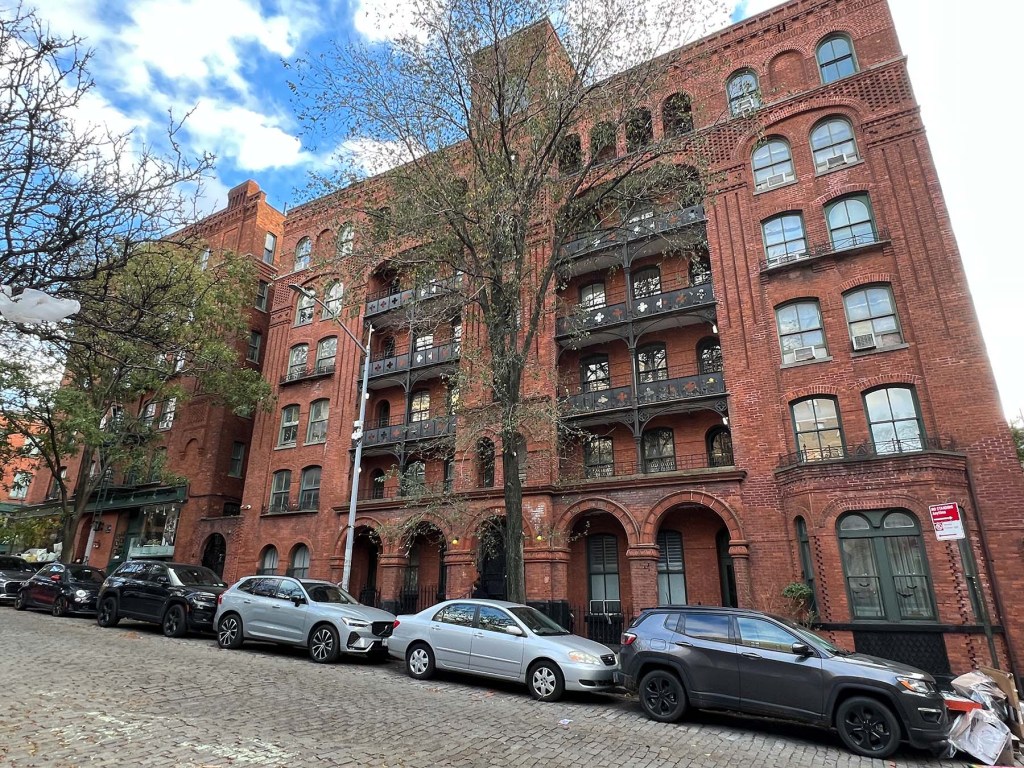
• Calle Joralemon. Nombrada en 1805 en honor a Teunis Joralemon, la primera persona en poseer una casa de ladrillo en Brooklyn.
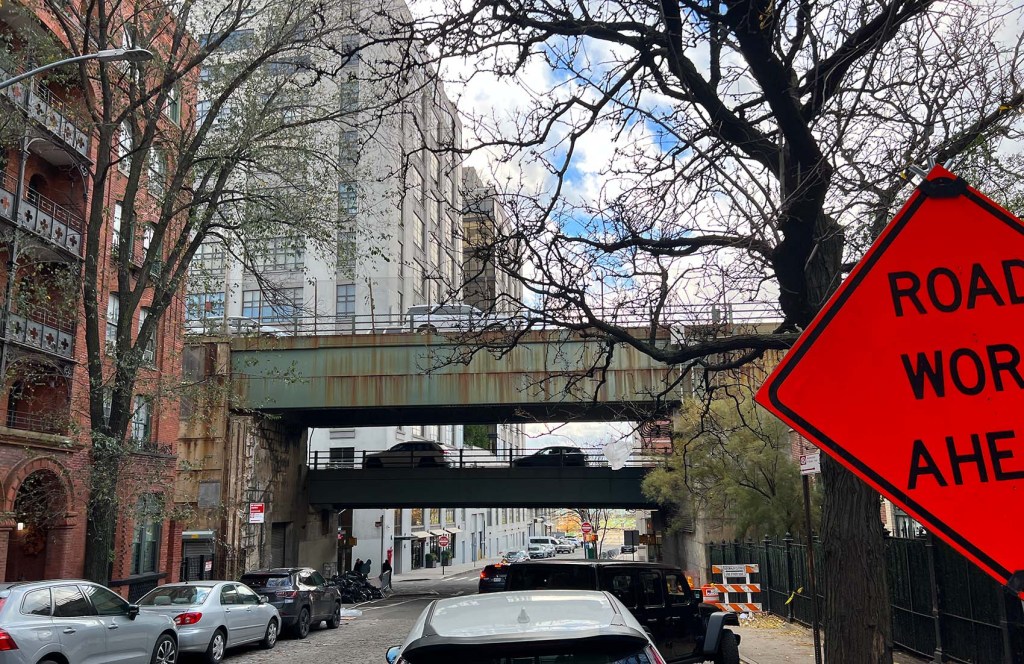
• Edificio Riverside a la izquierda. Autopista Brooklyn-Queens al frente.
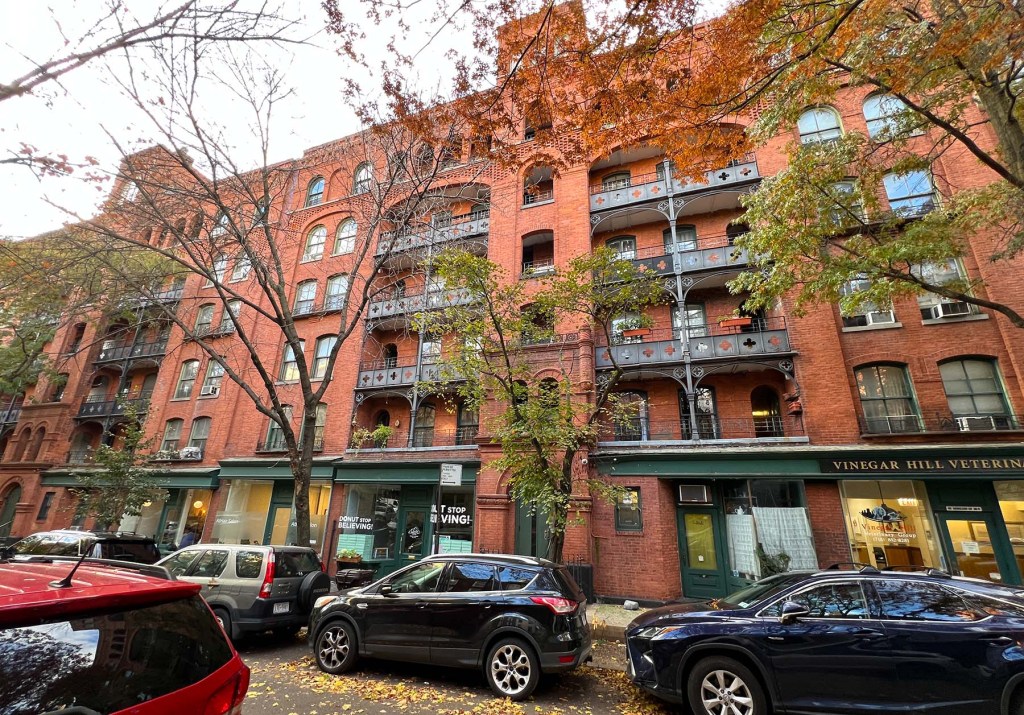
• A la vuelta de la esquina, en Columbus Place.
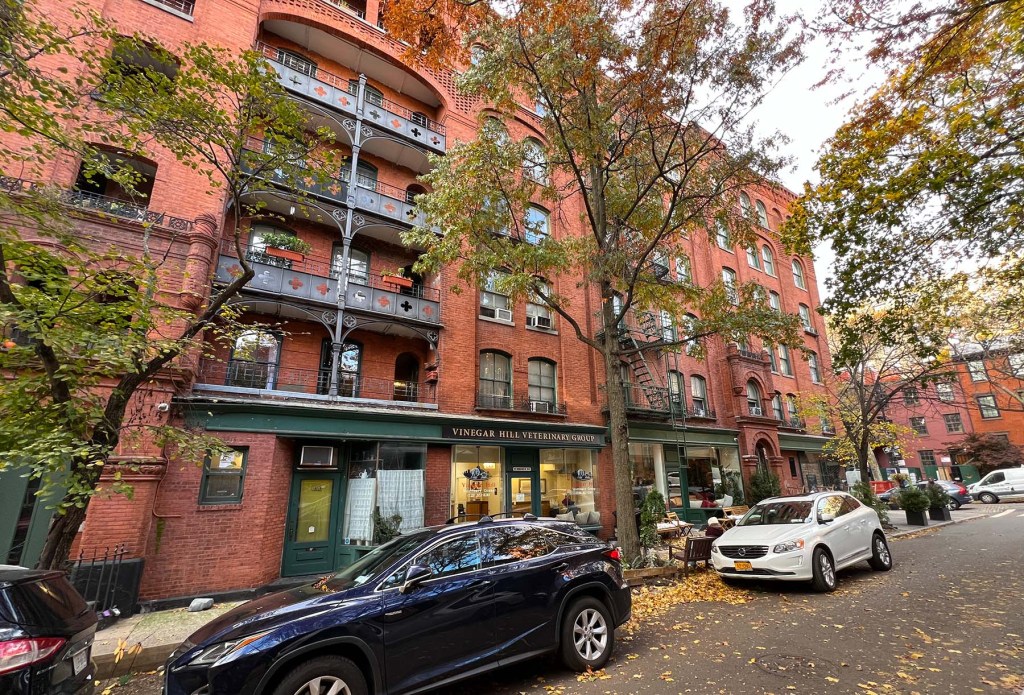
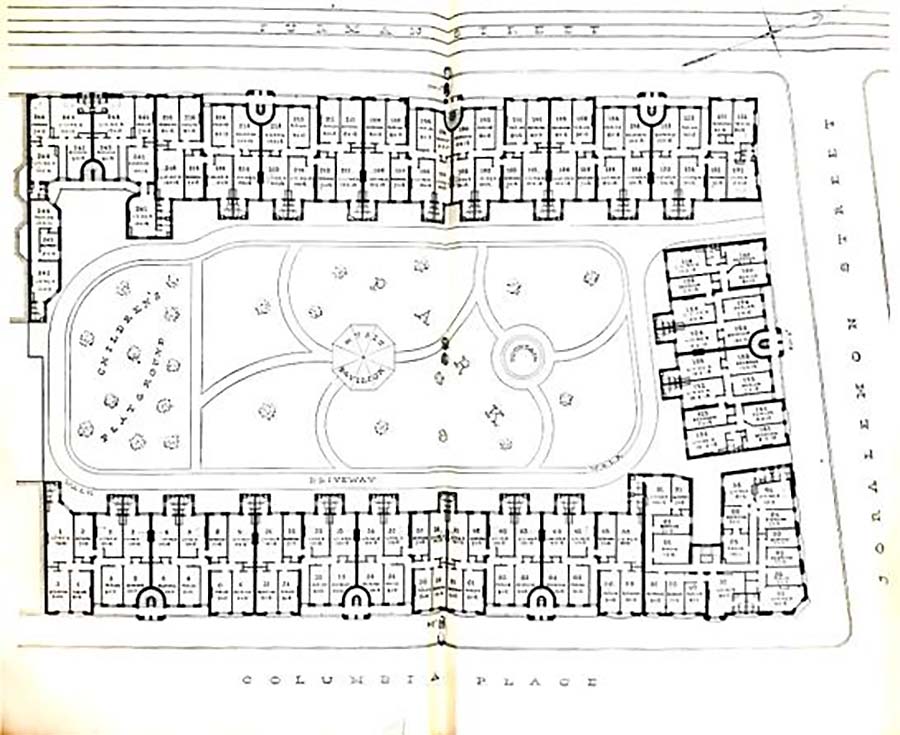
• La sección superior fue eliminada para la construcción de la autopista Brooklyn-Queens.
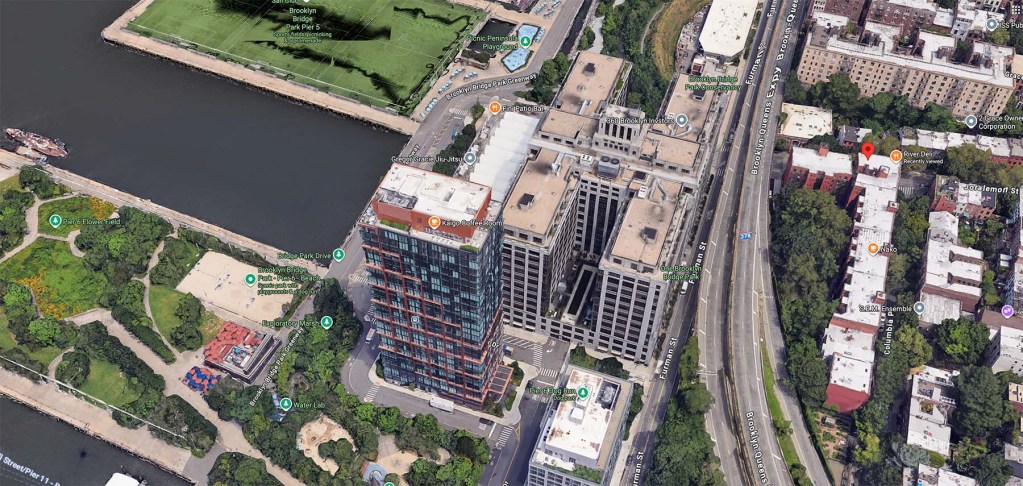
• Gracias a Google Maps por esta vista aérea, tomada antes de que gran parte del antiguo patio central fuera pavimentado.


Click the thumbnails to enlarge.
Haz clic en las miniaturas para ampliar.

NYC sure is a unique place. I think if I had tons of money (which of course I don’t) I would entertain the thought of living there. I am glad that you had a successful trip to the USA. I am catching up on all of my blog reading!
Michael:
I agree. It would take a lot of money for me to be comfortable living there.
I’m glad the residents fought back! And sad about the destruction for a highway. Wonder which capitalist pushed that one through, with which mayor. I’m betting a lot of tenants were minorities. Thanks for the bit of history. Boud
Boud:
I do wonder that there was no other option for that part of the expressway than to cut those apartments in half and remove part of the gardens.
Greedy landlords are all the same.
Debra:
The greed hasn’t changed.
Gorgeous building, and deserved to be saved and restored. Such a shame that they tore half of it down for a freeway, and even worse the greedy landlords.
Glad they were stopped in court.
Bob:
I agree. Surely there must have been another option for positioning the expressway.
Bob:
I’m glad that tenants association is so determined. Tragic the neighborhoods that were destroyed in the name of progress.
Neat building, I wish I knew where my grandmother lived there in the mid to late 19-teens. An uncle of hers had a bar near the Brooklyn Bridge during and after WWII. He died of liver failure in Miami shortly in the early 50s. He apparently LIKED the bar a bit too much.
David:
Oh, I wish you knew, too. It would be fun to see. Have you checked census records? That’s been a great resource for me. I found everywhere my grandparents lived in New York.
Interesting history of that development…….obviously no longer for the ‘working poor’.
Jim:
I think there are still rent-controlled apartments there, but it’s not like it was.
I can only imagine that the building and completion of that complex gave Alfred Tredway White such a feeling of satisfaction. Do we still have philanthropists like that now? I suppose we do. I wish we had more.
Ms. Moon
Ms. Moon:
Thankfully, there are still philanthropists around, but a lot more mega-rich combatants, too.
Fascinating post and a great building. “as it rots and crumbles its way around and through the two boroughs” verges on the poetic!
WickedHamster:
When I read that line back, I thought it might be taken that I was talking about the Riverside Building itself.
Wow, I know sooooo little about Brooklyn… these posts are very interesting to me.
Damn greedy landlords.
Do you usually stay in the same hotel when you go to visit Chuck?
Judy C:
I stay at the Nu Hotel on Smith Street in Brooklyn. A small boutique hotel conveniently located for subwaying to and from Chuck’s neighborhood. I like it although I wouldn’t rave about it.
Whoops! I hit send before my name came up… that was Judy C, of course 🙂
How interesting! How depressing. Someone actually cared to do good, and it gets perverted. Good question about who was in government that allowed that expressway to be built. Now I want to see it for myself. Thank you for sharing, and the photos of course. Olivia
Olivia:
A lot of the blame is laid at the feet of Robert Moses, urban planner and power broker in the early- and mid-20th century. He’s credited with destroying many neighborhoods in NYC. He started off well with Jones Beach and public parks but was keen on highways cutting right through the middle of everything, especially poor and working class neighborhoods.
I am not familiar with these buildings, even though I walked all over New York when I lived there. I didn’t spend a whole lot of time in central Brooklyn — which I suppose this would be? I was more in Williamsburg and Bushwick, because I found good street art to photograph there! Fascinating history, though. A forerunner of the public housing that came later.
The BQE is a dreadful road — almost as bad as the Cross-Bronx Expressway.
Steve:
The Riverside Building is in Brooklyn Heights. I’ve never spent any time in Williamsburg or Bushwick which are now trendy neighborhoods but were not when I lived there. Good old Robert Moses had a lot to do with many of the terrible highways in NYC. He would have cut the entire city up with highways had he had the chance. And he is said to have been racist and cutting up minority neighborhoods and affordable housing was a goal.
These sorts of historical nuggets need to see the light of day because they’re a) interesting and b) still relevant today. God forbid the working poor have decent, affordable housing and access to green spaces.
I also liked all the street art murals you featured in yesterday’s post!
Tundra Bunny:
I wish I had gotten around enough this time to get more street art photos. It was satisfying to read of the history of those buildings. Not much of that going on now.
Can you imagine that! Rent for $8 a month! The best I ever hit was sub-letting a rent control studio apartment in Cambridge MA from a coworker for $250 a month, and that was in the late 80’s!
Rade:
I had 2-room apartment in Brooklyn in the late ’70s for $200 a month. It was a deal then. But, now that same apartment is going for over $2,000. It’s not even in one of the trendy neighborhoods.
You were able to find out a lot with your research! I love seeing the diagram with all the apartments. Seems like it would have been a great place to live.
Kelly:
I try to imagine what it must have been like for those working poor families at the time.
It’s always humbling to read about those marvellous late Victorian/turn of the century visionaries, who saw the need for decent homes for the underclass, and actually did something about it! Over here in the same era, we had the likes of Joseph Rowntree, Sir Edward Cecil Guinness, George Peabody (an American ex-pat; surprisingly many of the blocks that were built by the trust he established are very similar in appearance to the Riverside Buildings in your post) and the lovely lesbian philanthropist and campaigner Octavia Hill, all of whose legacies survive to this day in social housing associations and/or social developments such as (in Miss Hill’s case), the preservation of green spaces in London, and the foundation of the National Trust. Jx
Jon:
So much more would be gone had it not been for great people like the ones you name.
I looks like a hospital
finlaygray:
I hadn’t thought about it, but you’re right.
Oh, I love that story!
And I love the apartment buildings! I love New York (so expensive!!!) and I would love to be able to afford something with all this history!
So many beautiful buildings were razed down for ‘progress’. Same thing happened here in Chicago…
XOXO
Sixpence
Sixpence:
It’s a shame how much history was destroyed by developers and uncreative city planners.
I love the style and look of the building. Hell, I’d take an apartment there! These new landlords though destroy so much. Anything that takes more money or maintenance and get rid of it. I have lucked out and had many perks to the places I have lived. People have rocks in their head to pay that much rent with no perks and a place of nature to enjoy the out of doors. But just like everything else in the US…the prices are spinning out of control.
Mistress Maddie:
The apartments are standard layout and small, but they must have been like castles to the working people at the time.
It’s always the poor and working class housing that gets demolished for ‘progress’. Where do they expect these people to go?
ellen abbott:
I’ve been wondering what happened to all those people who were forced to move when all those apartments were demolished.