La versión en español está después de la versión en inglés.
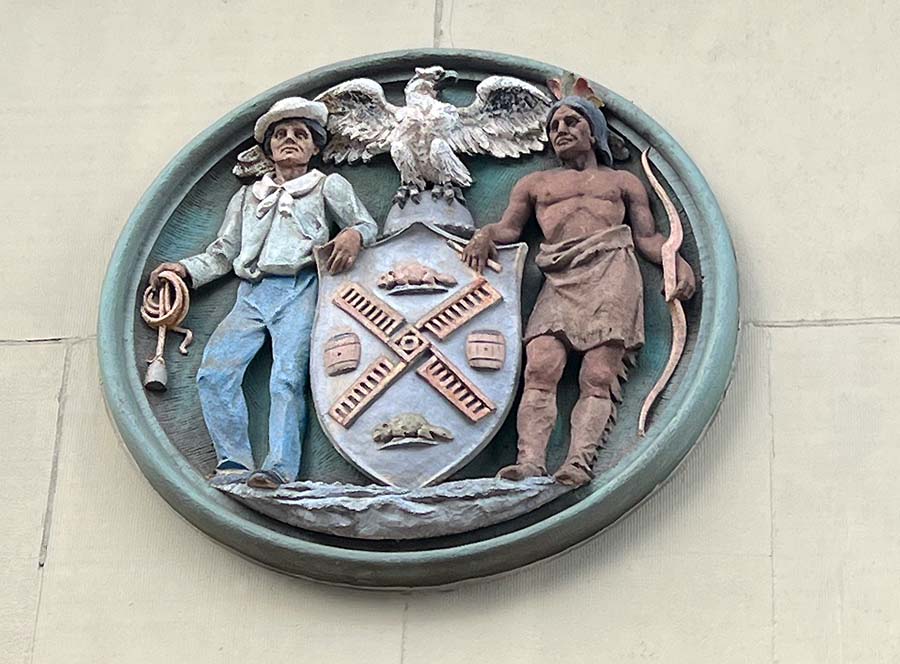
While out walking in the neighborhood of my hotel in Brooklyn, I passed a Board of Education building and noticed the folksy official seals to either side of the entrance. The seal of the City of New York is the one shown above. I had never bothered to research the seal, although I’ve been familiar with it since I was 11.
The city, New Amsterdam when settled by the Dutch, was surrendered to the British in 1654. An official British seal for the City of New York was first introduced in 1686. Although it has changed over the years (i.e., the crown was replaced by an eagle in 1784 after the Revolutionary War), there have always been two people depicted. I finally looked up who they are.
The figures represent friendship between native Americans and colonists. (It’s what they’d like you to believe.) A sailor at one side and a native American of the Algonquin people opposite. The figures are often identified by the names Dexter (the sailor) and Sinister (the Algonquin). But those are simply names given to the position those figures hold on the seal (Latin for right and left). Each section of a seal has a name. The eagle is in the “crest” position. Aren’t you glad to know that?
The Algonquin has at times been illustrated incorrectly with the wrong headdress or wrong longbow. After reading what I have, I noticed that the NYC seal pictured above has an incorrect longbow. The double-curved bow was not typically used by the Algonquin people.
The four windmill sails in the center are a nod to the city’s Dutch history, and the beavers and flour barrels reference trade goods that were responsible for the city’s early wealth (also represented by the windmill sails). I hope this is of interest. I tried to condense it.
I TOLD YOU A BIT about the Brooklyn-Queens Expressway, known as the BQE, (click here and here), the highway that cut through the wonderful and historic Riverside Apartments. So today I’m sharing some views of that expressway as seen from the south end of Brooklyn Bridge Park. I wonder if anyone will ever proudly adorn the BQE with the seal of the City of New York.
Mientras caminaba por el barrio de mi hotel en Brooklyn, Pasé por un edificio de la Junta de Educación y me fijé en los campechanos sellos oficiales a ambos lados de la entrada. El sello de la Ciudad de Nueva York es el que se muestra arriba. Nunca me había molestado en investigarlo, aunque lo conozco desde que tenía 11 años.
La ciudad de Nueva Ámsterdam, cuando fue colonizada por los holandeses, fue entregada a los británicos en 1654. El sello británico oficial de la ciudad de Nueva York se introdujo por primera vez en 1686. Aunque ha cambiado con los años (por ejemplo, la corona fue reemplazada por un águila en 1784 tras la Guerra de Independencia), siempre ha habido dos personas representadas. Finalmente, busqué quiénes son.
Las figuras representan la amistad entre los nativos americanos y los colonos. (Es lo que quieren hacer creer). Un marinero a un lado y un nativo americano del pueblo algonquino al otro. Las figuras suelen identificarse por los nombres de Dexter (el marinero) y Sinister (el algonquino). Pero esos son simplemente nombres dados a la posición que ocupan en el sello (del latín, derecha e izquierda). Cada sección del sello tiene un nombre. El águila está en la posición de la cresta. ¿No te alegra saberlo?
El pueblo algonquino a veces ha sido ilustrado incorrectamente con el tocado o el arco largo equivocados. Tras leer lo que he leído, me di cuenta de que el sello de Nueva York que aparece arriba tiene un arco largo incorrecto. El arco de doble curva no era de uso común entre los algonquinos.
Las cuatro aspas de molino en el centro son un guiño a la historia holandesa de la ciudad, y los castores y los barriles de harina hacen referencia a los bienes comerciales que contribuyeron a la riqueza inicial de la ciudad (también representada por las aspas de molino). Espero que esto les resulte interesante. Intenté resumirlo en pocas palabras.
LES CONTÉ UN POCO SOBRE la autopista Brooklyn-Queens, conocida como BQE (haz clic aquí y aquí), la carretera que atravesaba los maravillosos e históricos Riverside Apartments. Hoy les comparto algunas vistas de la autopista desde el extremo sur del Brooklyn Bridge Park. Me pregunto si alguien adornará con orgullo la BQE con el escudo de la ciudad de Nueva York.
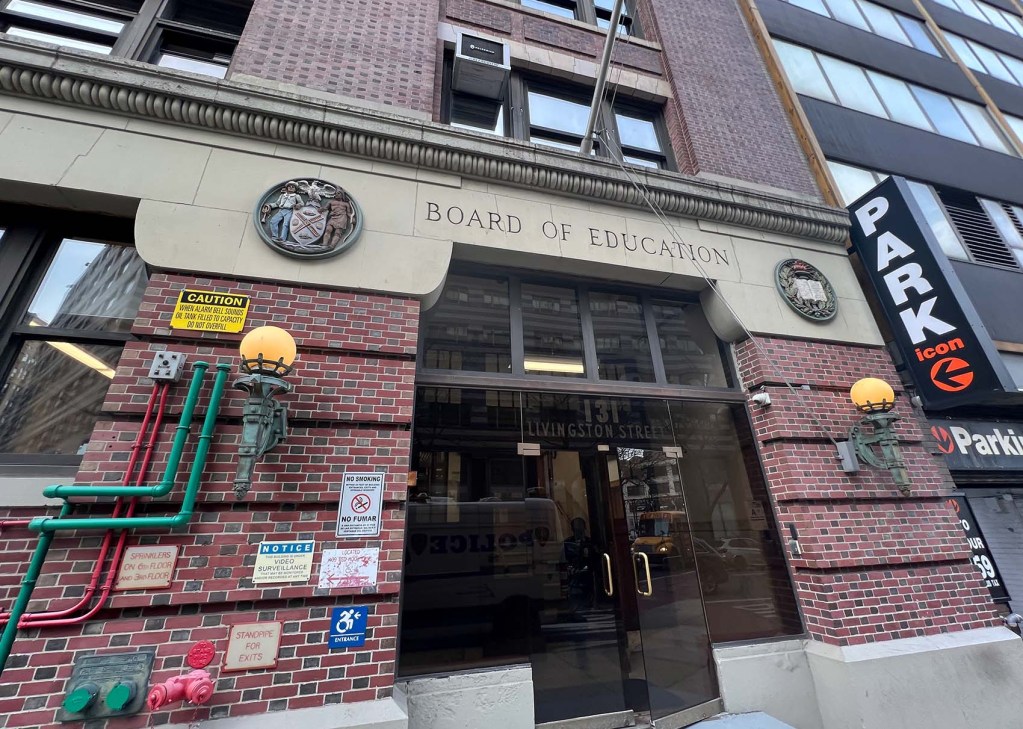
• El sello a la derecha de la entrada es el de la Junta de Educación. Creo haber visto que aparcar en el garaje de al lado costaba solo $19 por media hora.
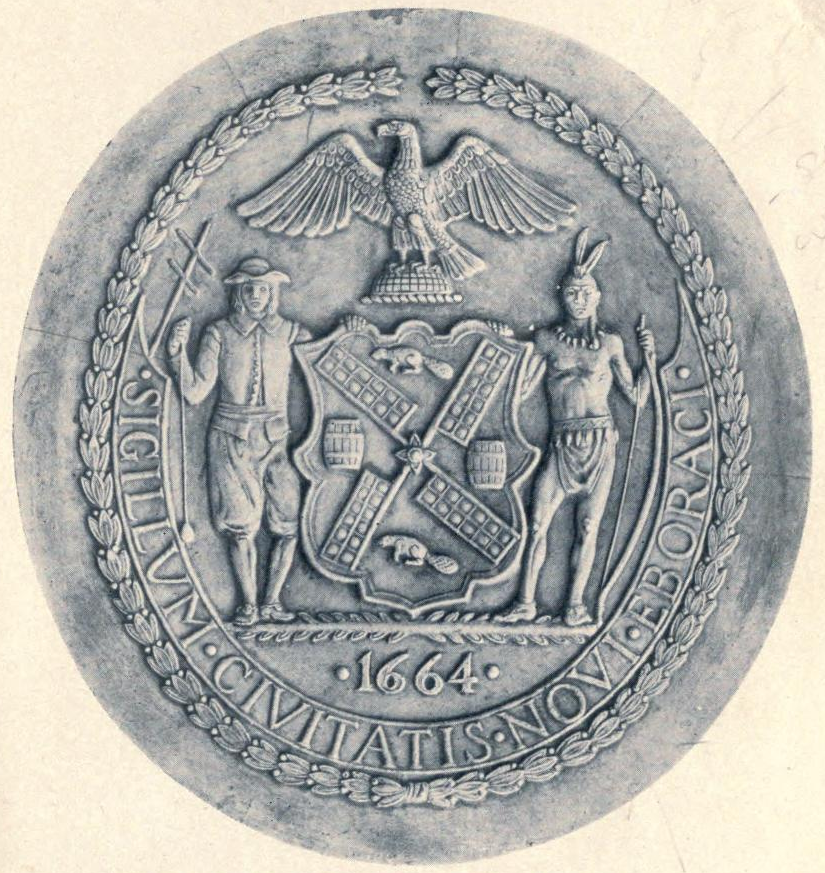
• Official seal by sculptor Paul Manship, 1915. The correct date at the bottom is now 1625 for the arrival of the first Dutch settlers (although it’s argued that the date should be 1624).
• Sello oficial del escultor Paul Manship, 1915. La fecha correcta en la parte inferior ahora es 1625 para la llegada de los primeros colonos holandeses (aunque se argumenta que la fecha debería ser 1624).
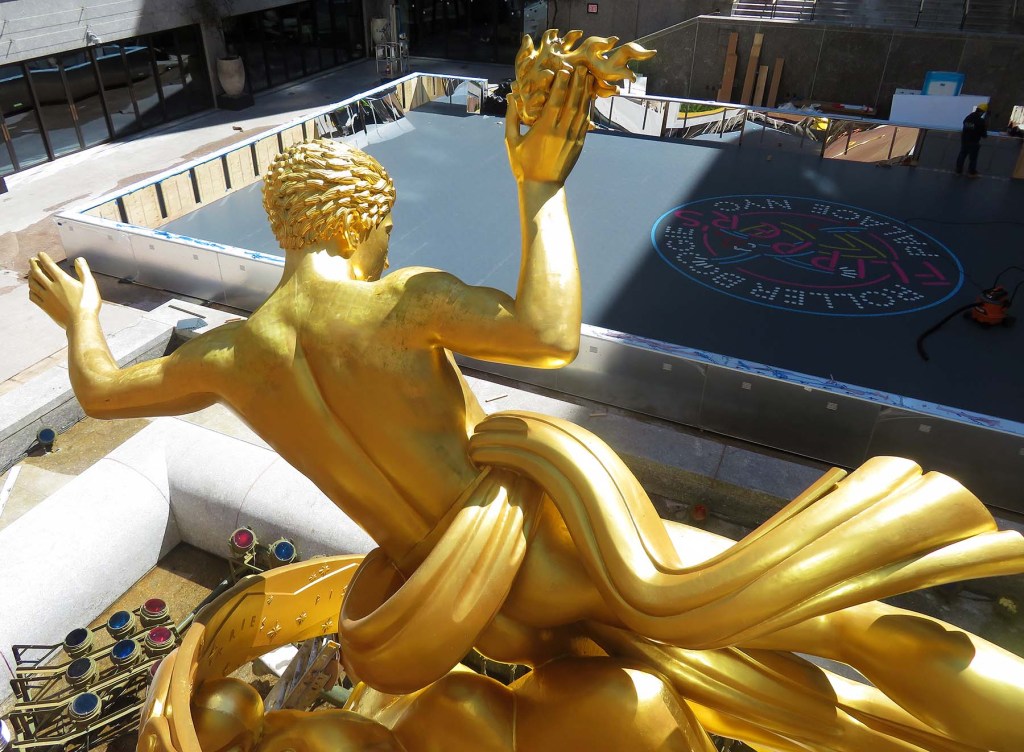
• Prometeo, 1934. En el Rockefeller Center. También del escultor Paul Manship.
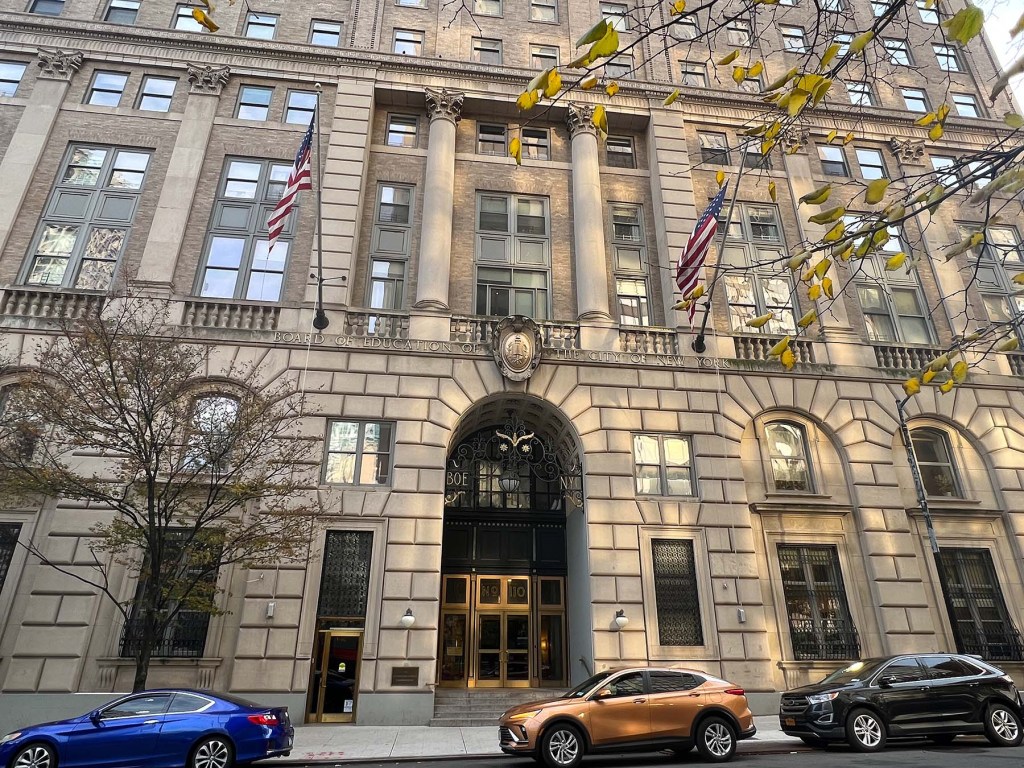
• Hay otro edificio de la Junta de Educación a unas calles de distancia. No sé la diferencia (excepto en su apariencia).
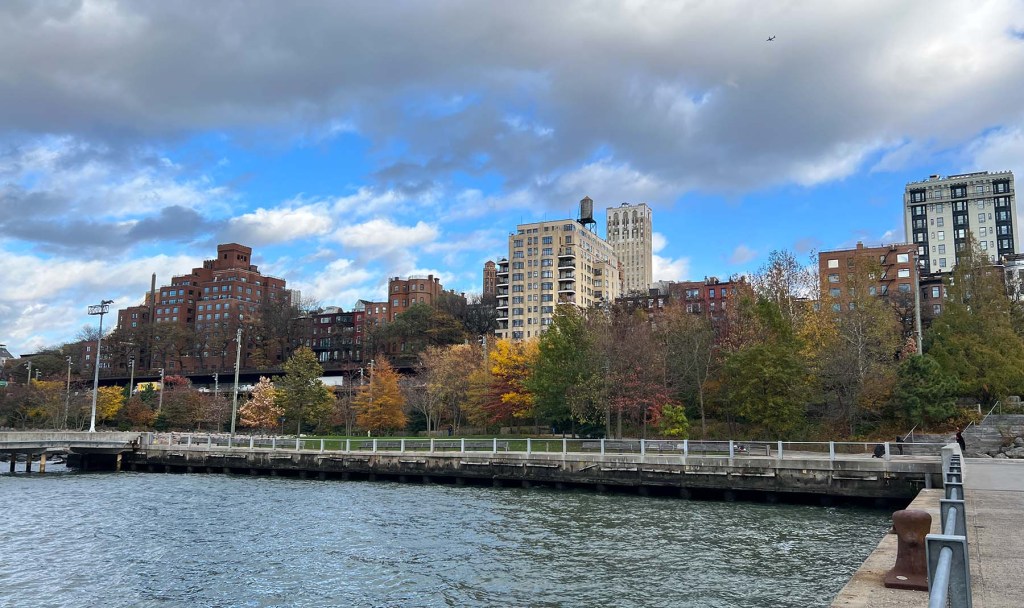
• Mirando hacia atrás desde el Muelle 6 del Brooklyn Bridge Park en Brooklyn Heights con la autopista Brooklyn-Queens visible a la izquierda del centro.
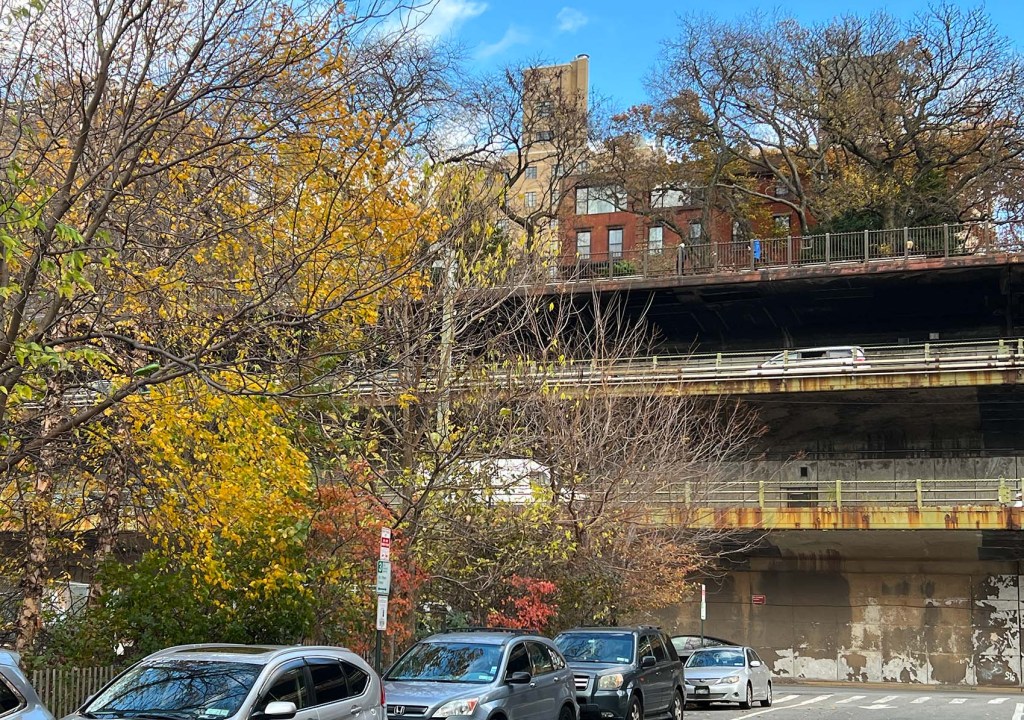
• Promenade (Paseo) de Brooklyn Heights (para pasear) en la parte superior, los dos niveles de BQE y Calle Furman debajo.
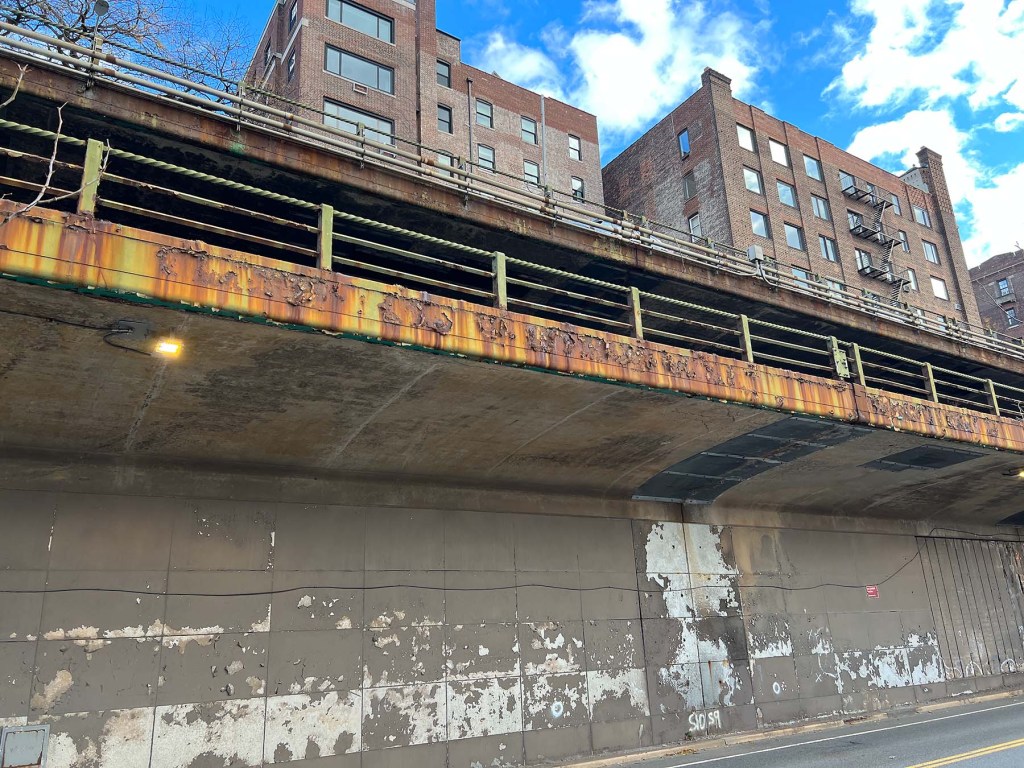
• Calle Furman con la BQE oxidándose y desmoronándose encima. Hay una remodelación importante en curso. No recuerdo un momento en que la BQE no necesitara una remodelación importante.


Click the thumbnails to enlarge.
Haz clic en las miniaturas para ampliar.

The beaver on the seal looks like our beaver on the Canadian nickel.
Debra:
Do you suppose they stole your beaver?
“Yes, that’s EXACTLY what I suppose,” she said darkly.
That is a lot of cantilevered steel and concrete, it is a wonder it has not failed from neglect.
David:
I don’t even know if it’s been neglected. It was never intended for the amount of use and weight it receives and it’s outlived what in reality should have been a very short life (crap design to begin with). I was nervous driving it, especially that tiered section, even in the ’70s.
I’ve been hearing for years on traffic reports about the bqe and now I’m seeing it. Not quite as dramatic as I’d expected from the excitable people on traffic. Boud
Boud:
My photos don’t do justice to how awful it is. If you google BQE Traffic you’ll find lots of shots of the frightening mess. It’s as bad as you’ve heard. Maybe worse.
I’ve never really thought about official seals but I have been fascinated by the state seal of Florida for a very long time. It has a Seminole woman on it along with a steamship and a sabal palm and of course, flowers, seeing how Florida is the land of flowers. They had to replace several of the elements of that seal in 1985 as the indigenous woman was indigenous to the Great Plains, not Florida, and the palm tree they had pictured was not the state palm. I rather like our seal!
And I like the seal of NYC, too. Ironic, though, that the indigenous people portrayed on both are pretty misleading as to how they were truly regarded and treated. From google: “The state seal, adopted in 1868, features a Seminole woman scattering flowers in the foreground, creating a mythological image of peaceful welcome that contrasted with the reality of Native American removal at the time.”
Oh, how we do love our mythology.
Ms. Moon
Ms. Moon:
The Algonquins were of course treated terribly and unfairly by the British, the colonists, and then the Americans. But, hey, look at us, we’re friends!
Thanks for the history lesson and the tour.
Jim:
I hope I didn’t get carried away.
Interesting about the seal. I was wondering what the sailor was holding but it was a device for measuring the depth of the water, right? $19 for half an hour to park! No wonder no one drives a car in NYC.
ellen abbott:
It’s called a. plummet (hence “plumbing the depths”). The parking garages are often full. Still way too many cars on the streets of the city.
Wow, how interesting
John Clarke:
If you pass the test, you’re eligible to become a citizen.
I do find this interesting!
Judy C:
I’m glad. As you can tell, so do I.
As someone who usually votes with the Left, I object to being labeled “sinister.” You can call it Latin if you like, but I say it’s McCarthyism!
“Dexter (the sailor) and Sinister (the Algonquin)”
“Latin for right and left”
OK, I got a bit dyslexic with my joke, but that’s only because “left” is on the right, and “right” is on the left, if you get what I’m saying. Even if you don’t, the sailor strikes me as being much more sinister than the Algonquin.
Kirk:
I do get what you’re saying. I got confused writing right and left given their positions.
Kirk:
The Italian word for “left” is “sinister” which tells you how left-handedness was viewed. And, yes, I’m sinister, too!
Coincidentally, there is a long article in today’s NYT about the Brooklyn Queens Expressway and what needs to be done to update it. Here’s the link:
https://www.nytimes.com/interactive/2025/11/26/nyregion/brooklyn-queens-expressway-new-york-highway.html?unlocked_article_code=1.4k8.Q1_I.pJpsTmE28sTx&smid=url-share
TexasTrailerParkTrash:
Yes! I saw that article came up in my feed after I finally shared my post. An excellent article and much more depth.
It’s funny how the term “sinister” has evolved to mean “creepy” or “evil”. I often take the mick out of Madam Arcati, who is left-handed, by calling him “sinister”…🤣
That rusty road looks like something out of Communist Eastern Europe rather than Noo Yawk! Jx
PS The stereotypical “Honest Injun” is holding a longbow – a crossbow is the one shaped more like a gun with a trigger-mechanism to shoot the arrow/bolt…
Jon:
I remember learning in my Italian class that ”sinistre” meant left. It shows what the church thought of lefties. Thanks for the clarification about crossbow/longbow. I even knew that and should have given it more thought! I’ll correct my post.
I bet the Netherlands wished it hadn’t lost NYC to England. The Dutch weren’t too successful during the Age of Imperialism
Adam
Nekorandom.com
Adam:
I do wonder what many Dutch think now. I wouldn’t want it.
I have a New York trip scheduled for December, but I’ll see how my oral surgery goes if I’m going to make it or not. Seals are always fascinating. You see so many intriguing designs, and then you do the research it’s interesting to see the meaning and how they come up with the seal. You got some great pictures. I wouldn’t expect anything less.
Mistress Maddie:
I hope the oral surgery is a piece of cake and a quick recovery. I always found logo design a fascinating process (when done well). Designing a seal is much more limiting and therefore challenging I think.
Yes NYC used to be quite Dutch. Lots of Dutch words and regional names in the area.
Urspo:
Yes, everywhere.
The Times just had a story about the BQE and all the maintenance work it requires. I didn’t read it, I confess, but from the headline I gather the highway is basically at the end of its life span and they’re trying to figure out what to do next.
I never knew the story of Dexter and Sinister! In fact I don’t even remember ever noticing the seal, though I’m sure I did at some point.
Steve:
Yes, I saw that article after I posted. The BQE truly is a disaster and no easy fix, especially after the way it was built.