La versión en español está después de la versión en inglés.
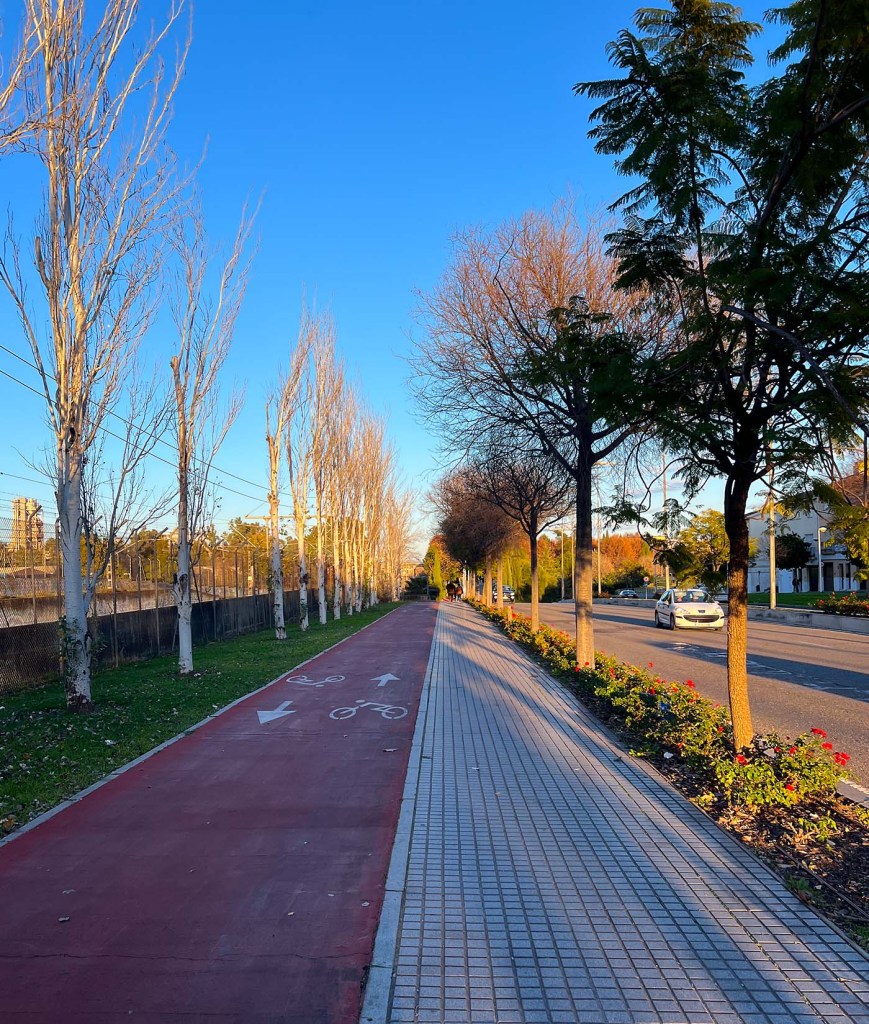
On my walk Tuesday, I decided to explore what happens after the Paseo de Córdoba ends. It runs for 1.5 km and begins at the train station. The park was created when the train tracks were moved underground. Before that time, the train cut through the area above ground.
I had noticed on the map that the footpath and bike path continue beyond the Roundabout of the City of Nuremberg (the end of the paseo) which, along with a monument there, is dedicated to the 345 Cordoban citizens who were deported to Nazi concentration camps “for defending freedom in the Second World War.”
The entire route from the train station to the new-to-me Doctor Alfonso Carpintero Park runs for another kilometer. Although it was chilly, the sun was shining for much of my walk. It began to set as I headed home. I was reminded that I could barely have done the walk a year ago. It was a breeze and I could have easily done more than twice that. I thought most of the walk had been on level ground only to discover on my way back that I had been going slightly downhill for the last kilometer. That meant I was walking slightly uphill on my return. What a surprise. No problem!
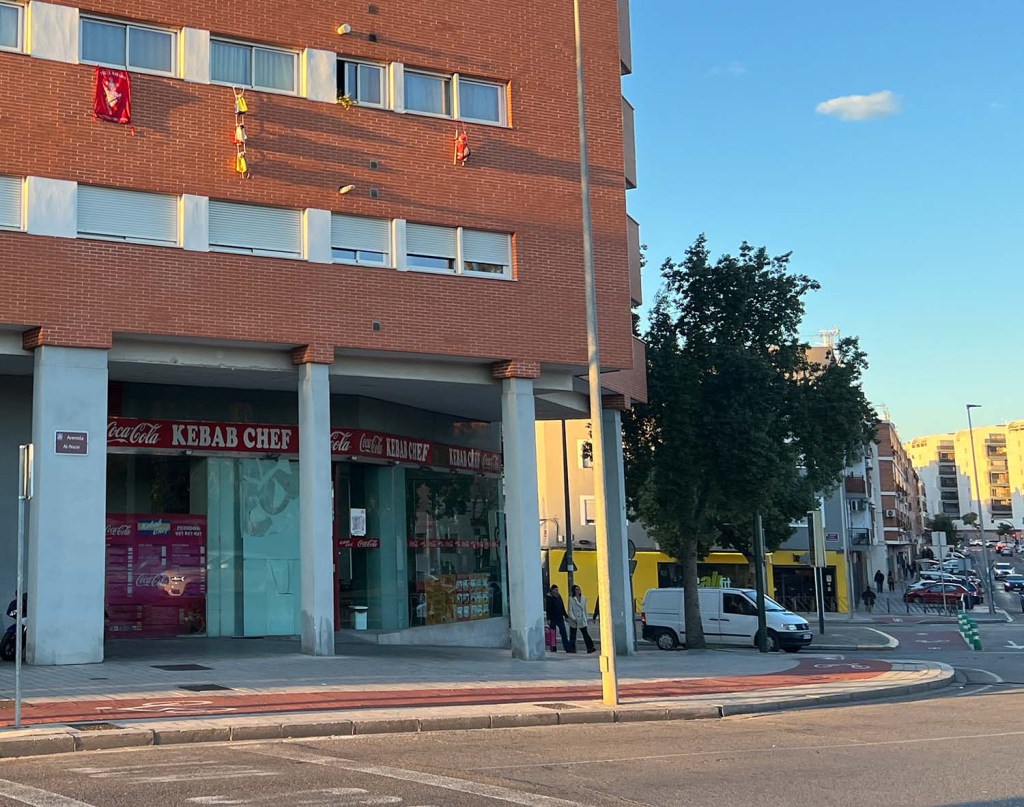
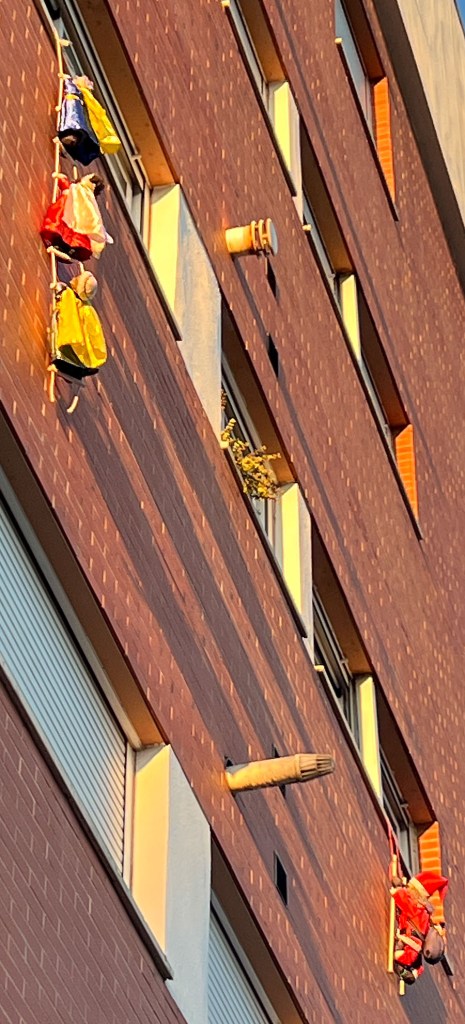
Once I reached the Paseo of Córdoba again, I noticed a building across the street had not only Santa but the three kings climbing ladders to an apartment. I enjoy seeing the three kings on the ladder and that’s the first one I’ve seen in Córdoba this year. So, I had to cross the street to get a slightly better view.
Today, so far, I’ve folded laundry and washed and hung another load. I’m about to get out the Christmas decoration boxes and plan to de-Christmas the house after lunch.
En mi paseo del martes, decidí explorar qué sucede al final del Paseo de Córdoba. Tiene una longitud de 1,5 km y comienza en la estación de tren. El parque se creó cuando se soterraron las vías del tren. Antes, el tren atravesaba la zona de la superficie.
Había visto en el mapa que el sendero y el carril bici continúan más allá de la Rotonda de la Ciudad de Núremberg (el final del paseo), que, junto con un monumento, está dedicada a los 345 cordobeses deportados a los campos de concentración nazis “por defender la libertad en la Segunda Guerra Mundial”.
El recorrido completo desde la estación de tren hasta el nuevo Parque Doctor Alfonso Carpintero se extiende por un kilómetro más. Aunque hacía frío, el sol brilló durante gran parte de mi caminata. Empezó a ponerse mientras volvía a casa. Recordé que apenas habría podido hacer la caminata hace un año. Corría una brisa y fácilmente podría haber hecho más del doble. Pensé que la mayor parte de la caminata había sido en terreno llano, solo para descubrir a la vuelta que había estado bajando ligeramente durante el último kilómetro. Eso significaba que estaba caminando ligeramente cuesta arriba al volver. ¡Menuda sorpresa! ¡Sin problema!
Al llegar de nuevo al Paseo de Córdoba, vi que en un edificio al otro lado de la calle no solo estaban Papá Noel, sino también los Reyes Magos subiendo por las escaleras de un apartamento. Me encanta ver a los Reyes Magos en la escalera, y es la primera vez que los veo en Córdoba este año. Así que tuve que cruzar la calle para verlos un poco mejor.
Hoy, hasta ahora, he doblado la ropa, lavado y tendido otra tanda. Estoy a punto de sacar las cajas de adornos navideños y planeo des-decorar la casa después de almuerzo.
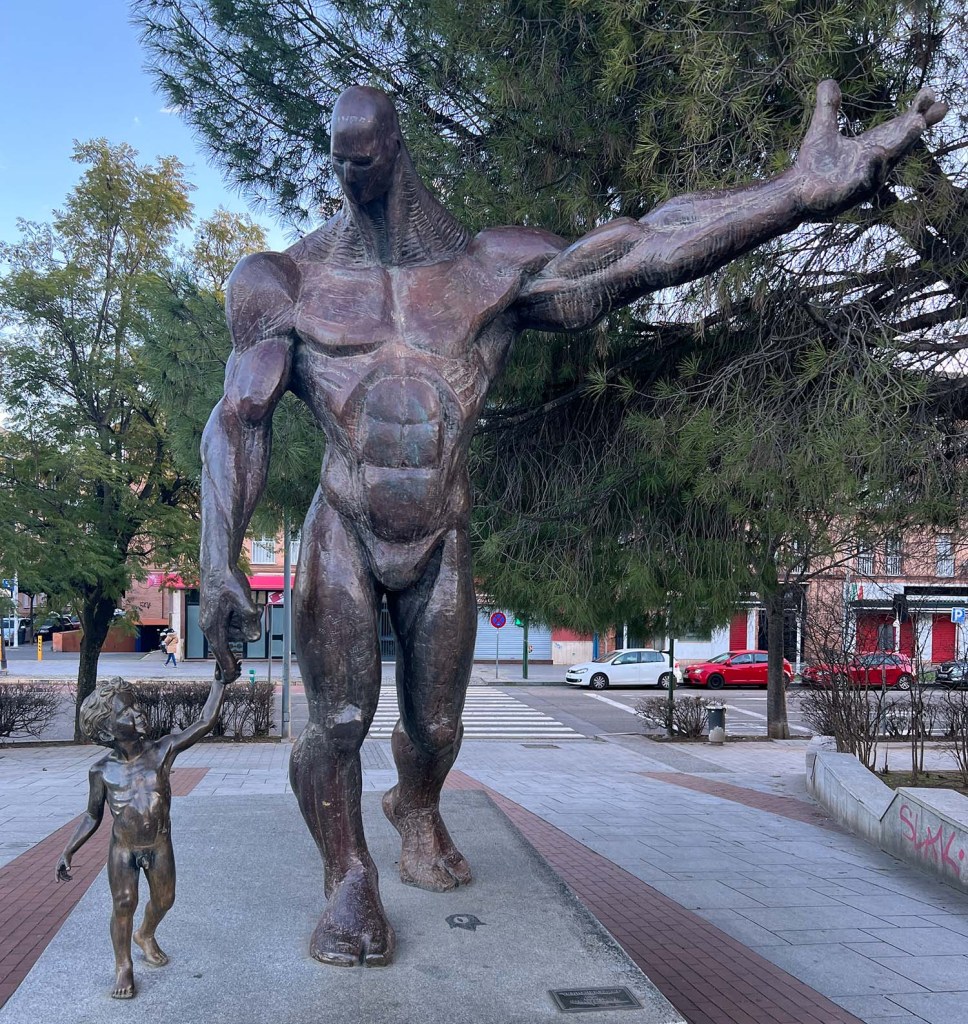
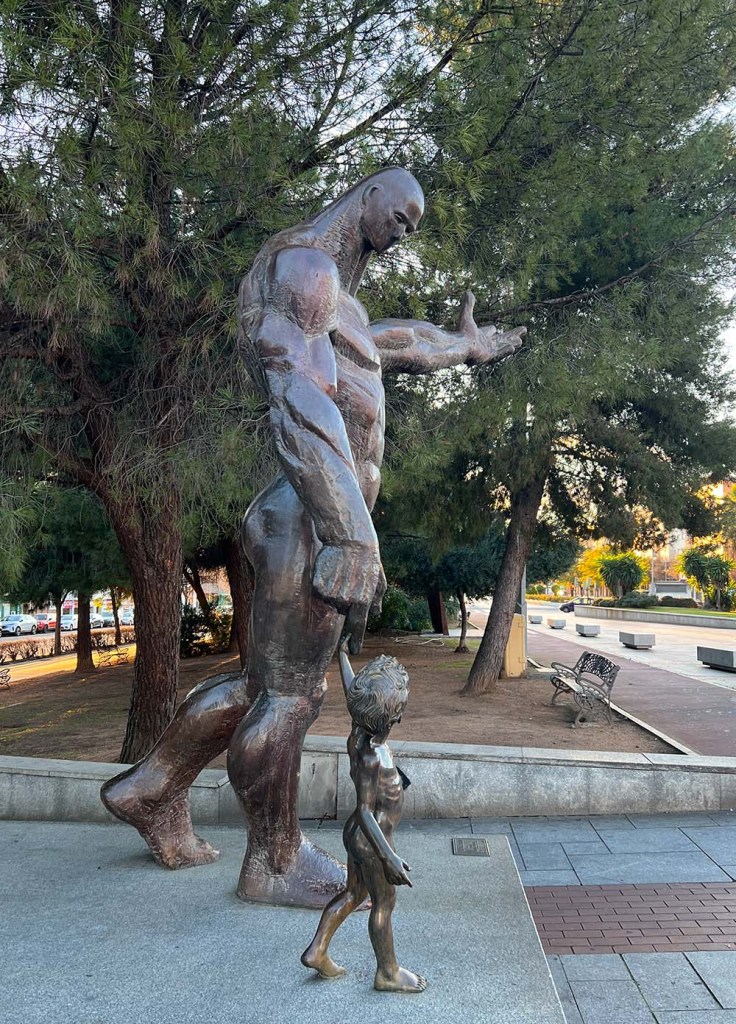
• “Vientos de Cambio” de José María Serrano Carriel. Un hombre le muestra la ciudad a un niño, una metáfora del presente y el futuro de la ciudad. Preguntas: ¿Por qué el niño está desnudo mientras que el hombre está cubierto o le faltan partes? ¿Por qué el hombre parece un superhéroe mutante? ¿Porque el cuello? ¿Tiene aletas de cuello expandibles como un lagarto con volantes?
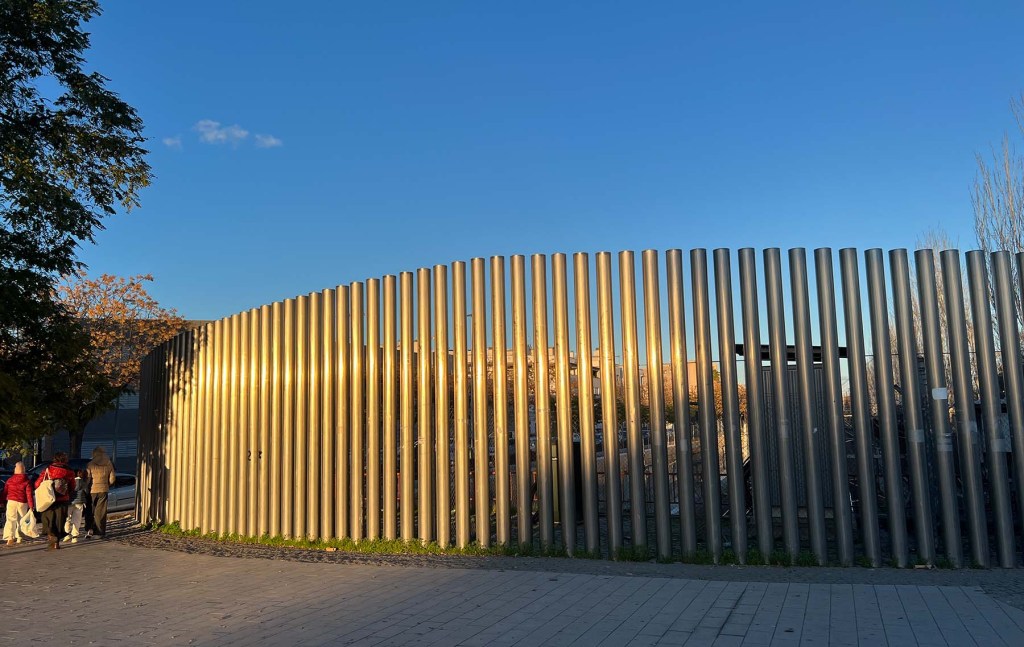
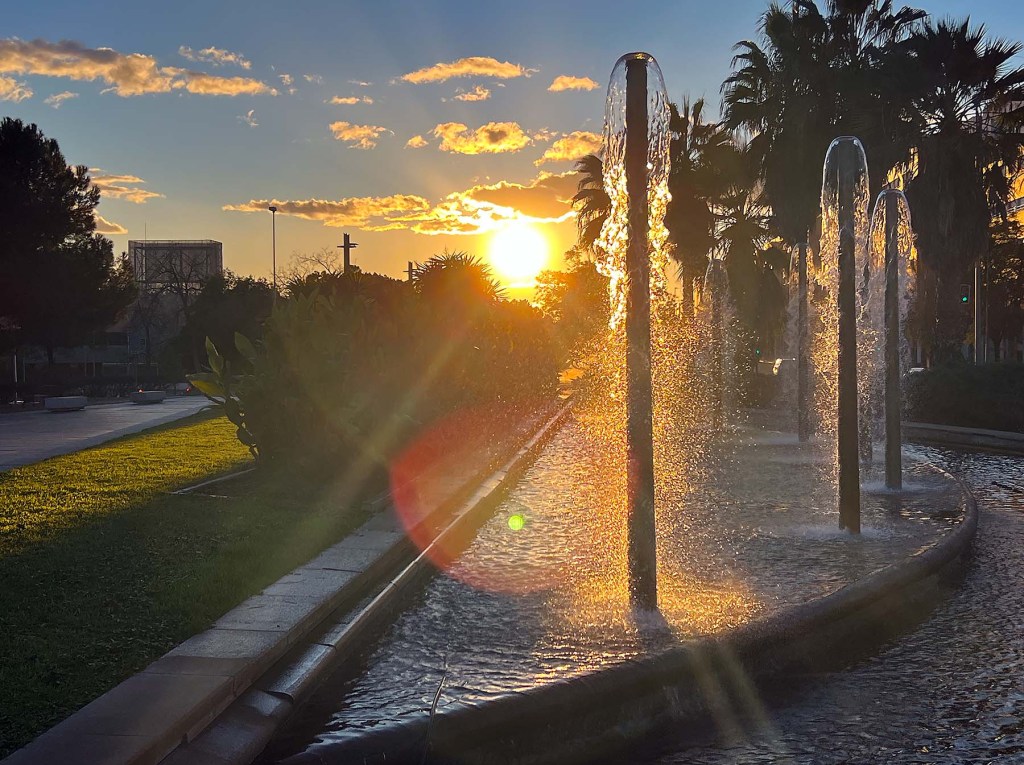
• Esto es lo que se ve al cruzar la glorieta. El tren sale del subsuelo tras lo que creo que parece un órgano de tubos gigante.
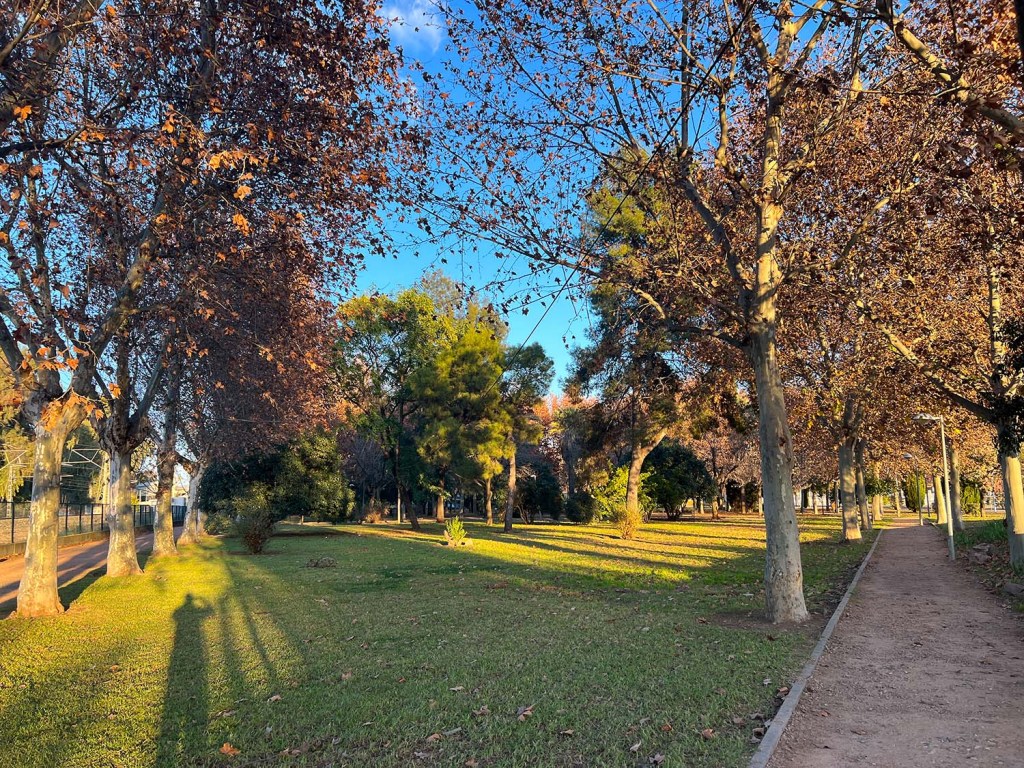
• Parque Doctor Alfonso Carpintero.


Click the thumbnails to enlarge.
Haz clic en las miniaturas para ampliar.

Nice to hear you are getting stronger by the day/year! Keep doing what you are doing/seems to be working for you.
Yes, why aren’t they both naked? Probably some restriction about public nudity. And yes, why is the man so out of proportions? Well, we do live in a paternalistic society do wee not? Men have to be very macho and in control I guess.
Jim:
The bronze is a curious work of art.
I had the same thought on the bronze, odd, well done, but odd. It looks like a great walk, so much to explore.
David:
Yes, odd, well done, odd. It’s a nice walk just for exercise. No shops along the way.
That’s not a father figure – it’s an alien abduction! As well as that neck, he only appears to have two toes…
Well done on your trail-walking. Not the prettiest of parks, admittedly, but an achievement nonetheless. Jx
Jon:
I wonder what the story is behind that figure, because, you’re right, it’s clearly not just a father figure. The stretch to the little park at the end is not pretty but there are no streets to cross so it makes for an excellent fitness walk. I don’t know why I didn’t head into Parque Doctor Alfonso Carpintero. Will have to see what more there is to it. I’m sure it’s all much more picturesque in spring and summer.
Weird ‘n wonderful photos today! But which is which?
Debra:
I’ll leave that up to you.
Definitely an alien cyberorganism. I guess that’s what the future holds…
wickedhamster:
Such a strange “father figure.”
That ‘man and child’ statue looks dead creepy to me. Today in this country it wouldn’t be allowed to stand – at least not without some ‘modification’. Even the Victorians would, at the very least, have covered the kid up – hence the profusion then of added fig-leaves to male figures, though that itself seemed to draw attention to that body’s particular area. As an adolescent I was fascinated in/by not knowing what that ‘thing’ was, and when I got to know, imagining what the real thing underneath looked like.
Raybeard:
A reproduction of Michelangelo’s David was donated to the city of Sioux Falls, South Dakota, in 1971. And oh the furor. After initial installation the statue was later turned to face the river so you couldn’t see his private parts without making the effort. People tried to cover up the offending parts. Then it was removed for 2 years. In 1973, a baptist minister wrote to the paper: “Don’t be surprised if God doesn’t bring a flood or a tornado, or strike the statue with lightning. God will judge this city.” It doesn’t work that way here.
Uggh. De-Christmas-ing my house, is depressing. We started with outside decorations, yesterday, since it was so unseasonably warm.
Judy C:
I never did start the de-Christmas operation yesterday. Today is another day.
That poor child. Do you suppose that his future holds growing up to be a two-toed lizard man? At least the frightening thing appears to be gentle.
Beautiful photos, Mitchell. My favorite is “fuentelight.”
I congratulate you on your increasing strength and stamina! Excellent.
Ms. Moon
Ms. Moon:
Fuentelight would have been better had I hung around until the sun was lower in the sky, but I had to pee! That statue is odd.
Good questions!
Kelly:
I want answers!
Glad to hear you’re feeling better!
Love the idea of repurposing those train tracks.
XOXO
Sixpence:
They did a great job claiming the area for the city.
So good to hear you’re doing better and building serious stamina now. The sculpture is full of questions! Is it hair or a headcovering? Is he wearing a Speedo, and is the little boy trying to tell him he lost his tiny Speedkin somewhere?
Spain has had its share of turmoil, including dictators. Most of what I know is through Barcelonan exiles in the UK because of Franco. The minute he died they went rushing over to visit and find relatives. Not to stay, they’d settled in the UK, English wives, bilingual children. Boud
Boud:
I thought maybe it was a thong, but his backside is completely bare. No waistband. No floss. No nothing. And, yes, the hair! We’ve had little opportunity to gain personal insights into the Franco years. Most people don’t talk about it and it’s not something one brings up independently. I can’t imagine what that was like, although we’re getting glimpses now in the USA.
What a great beautiful space to live and explore; always a new corner to turn ….
Bob:
I have so many more neighborhoods to explore.
Why are the three kings hanging on an escape ladder?
Tundra Bunny:
Have you never seen the Santa Claus figures climbing a ladder to get into a home? I suppose it’s for homes that don’t have chimneys.
Nope! Small Santa figures climbing a ladder into a Xmas tree have recently had a moment in interior decor. Most Santas on rooftops here are either in a sleigh or stuck head first down a fake/real chimney. For those with little ones and no fireplace, I quite like the “Xmas Key” left on the door for Santa to use!
“…345 Cordoban citizens who were deported to Nazi concentration camps…”
I’d almost forgotten that Spain was once a fascist country.
Kirk:
It’s not a subject one brings up independently here. But it wasn’t that long ago.
I saw organ and of course showed up!!!! The adult sculpture to a point gives me the willys. Sort of creepy in a alien like way. I wonder why if looks so minimal and future like compared to the human like child? Jon may be right…alien abduction?
I have missed post again….your blog wasn’t in my reader popping up again. Oh dear, that didn’t sound good did it?
Mistress Maddie:
No, it’s upsetting to know I wasn’t popping up. I’ll try harder. Hope you’ve caught up. The sculpture is so strange.
Powerful statue, open to interpretation. But so glad you are feeling and moving better! Olivia
Olivia.
From the side, you get the sense of the child being led into the future. But the father figure is a curious construction.
Tranquil, meditative and contemplative. A perfect trifecta for self healing! Walks like that are truly a treasure.
Rade:
I’m so grateful to be able to enjoy these here in Córdoba.
Rade:
Yes, so healthy!
I have the same questions about the monstrous man. And is the three kings on a ladder a thing?
ellen abbott:
Yes, the three kings on a ladder is a thing like Santa on a ladder is in the States. Not everywhere. I love it.
That “Winds of Change” sculpture is somewhat terrifying. Maybe it represents some future evolved state of humankind?
Steve:
I normally don’t like having art interpreted for me (not even by the artist) but this had me going. All I could find was an interview with the artist. The question put to him is what we’re all thinking. “Why place a character practically straight out of a comic book next to such an endearing child?” The artist’s response didn’t help me. He said he doesn’t like to discuss his work after it’s finished and prefers it speak for itself: “My idea was to unite the two Córdobas: the one being reborn with that plan and the one considered classical. I wanted to depict a father showing his son the new city and telling him that everything he sees is his. I also wanted to incorporate the concept of Contemporary Art that has influenced me. I believe you’re not a true artist until you master the material and truly master the classical.”