
La versión en español está después de la versión en inglés.
This is a brief post. If I linger, I’ll whine about how awful I feel. I just took a Covid/Infuenza test. Negative, for what it tests. My temperature is 37.7C/99.86F. I was debating urgent care or at least the pharmacy. San Geraldo would willingly go for me, but I need to explain the symptoms. However, as I’ve said, at least I’m getting some sleep.
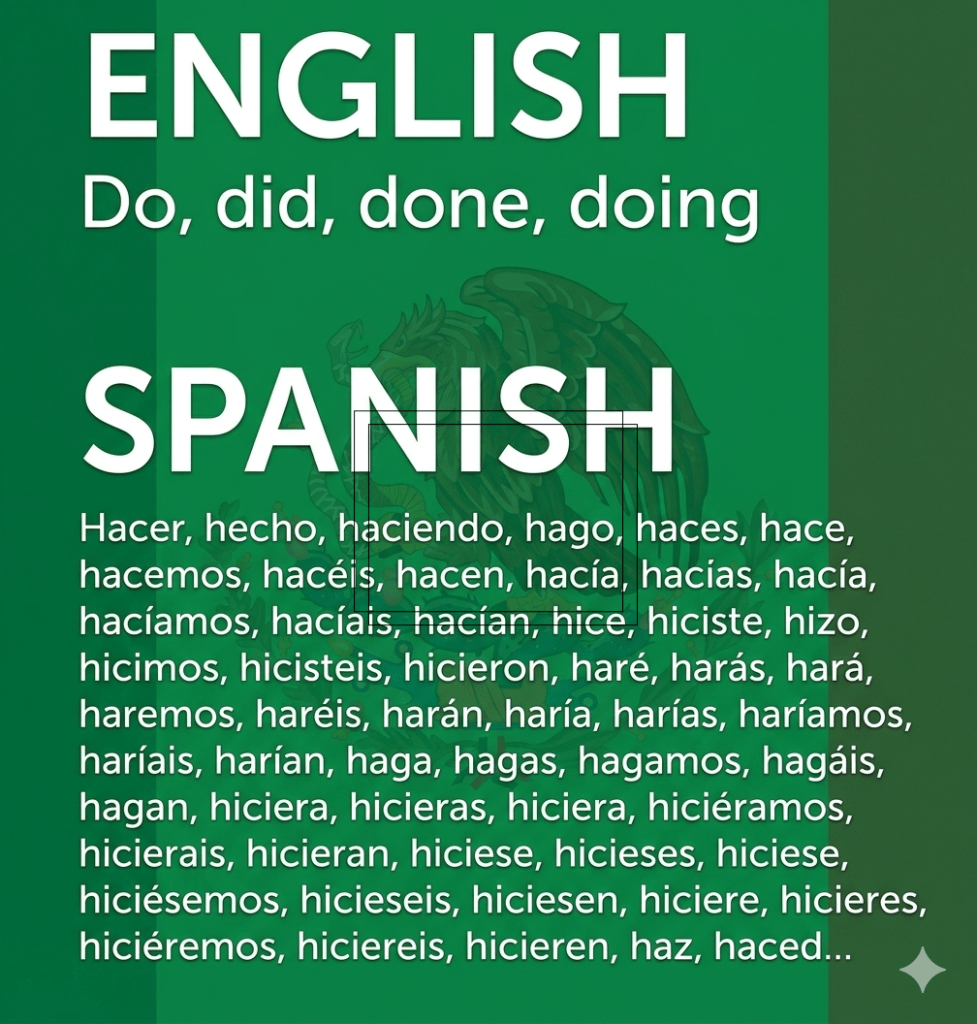
When we first moved to Spain, I had it in my head that Spanish was one of the easier languages to learn. After nearly 15 years, I stand corrected. Today’s breakdown of the verb “to do” (hacer) is a perfect example of how complex and confusing it can be.
An easy solution is to always speak in the present tense and qualify statements with the emphasis on a date or time to clarify what you mean. For example: “YESTERDAY, I make the bed.”
For past occurrences there are some verb tense options. For example, there’s the simple perfect, the simple imperfect, the present perfect, and the pluperfect. And, unlike English, the word form changes almost every time. It’s not like English: I went, he went, she went, they went, we went. Not that English makes a whole lot of sense either.
Just so you know, the correct phrase in Spanish is, “Hice la cama.” (I made the bed.) San Geraldo will never need to concern himself with this phrase.
Esta es una entrada deblog breve. Si me extiendo demasiado, me quejaré de lo mal que me siento. Me acabo de hacer una prueba de COVID/influenza. Negativo, en lo que respecta a lo que analiza. Tengo una temperatura de 37.7°C/99.86°F. Estaba dudando entre ir a urgencias o, al menos, a la farmacia. En San Geraldo me atenderían sin problema, pero necesito explicarles los síntomas. Sin embargo, como ya dije, al menos estoy durmiendo un poco.
Cuando nos mudamos a España, tenía la idea de que el español era uno de los idiomas más fáciles de aprender. Después de casi 15 años, me doy cuenta de que estaba equivocada. El análisis de hoy del verbo “hacer” es un ejemplo perfecto de lo complejo y confuso que puede ser.
Una solución sencilla es hablar siempre en presente y matizar las afirmaciones enfatizando una fecha u hora para aclarar el significado. Por ejemplo: «AYER, hago la cama».
Para los sucesos pasados, existen varias opciones de tiempo verbal. Por ejemplo, está el pretérito perfecto simple, el pretérito imperfecto simple, el pretérito perfecto y el pretérito pluscuamperfecto. Y, a diferencia del inglés, la forma de la palabra cambia casi siempre. No es como en inglés: I went, he went, she went, they went, we went. Aunque tampoco es que el inglés tenga mucho sentido.
Como tú sabes, la frase correcta en español es “Hice la cama”. San Geraldo nunca tendrá que preocuparse por esta frase.

Yikes to Spanish verb tenses! I thought French was bad, but Spanish seems worse. And I hope that fever breaks and you feel better soon.
Debra:
I never got that far in French to know how difficult or not it was. Only one year when I was 8. I can still recite the script from the vinyl record we listened to in class. Allô, allô. Ici George. Qui est là? Ici Jean. Comment allez-vous? Très bien, merci.
I feel your pain…
The French name for our home is “Chutes de merde”… it is applicable on SO many levels.
Rade:
Do you have that on a plaque on the wall?
I’d never learn it.
When I was studying for a Diploma in Spanish with our Open University (which I never achieved as after three years I couldn’t afford the final year) I found that something especially hard for me is that Spanish, moreso than German and French which I also studied – and got Diplomas in – makes more assumptions on expecting the listener or reader to fill in unspoken blanks as to what is being left UNsaid. It was driving me crazy! If that makes sense I wonder if other students and non-native speakers have the same problem, or is it just me?
Raybeard:
I remember that with language workbooks in Spanish, Portuguese, and Norwegian. Drove me crazy, too.
David:
As long as you can make yourself understood somehow.
Perhaps all this verb stuff is making you sick. Is there a test for that?
To be fair, in this instance, I am SG about never having to use that phrase.
Bob:
If I have the energy I’ll ask for the Spanish verb test at the pharmacy.
My sister’s approach when trying to speak in a foreign country was to shout a bunch of nouns and hope someone would be kind enough to figure her out.
I had that up and down slightly raised fever that didn’t get critical. It was a long drawn out cold. Boud
Boud:
I knew a woman a while back who simply said everything loudly in English with what she thought was a Spanish accent. Thanks for the reassurances regarding the cold. Since my kidney thing, I’ve become a bit catastrophic with my health.
I am having the same problem with French as I study it. There are so many tenses, and I simply cannot keep them all straight. I try and listen to spoken French, and I find that I just cannot keep up. I am sure English is the same thing for people learning it. I admire anyone who is fluent in another language. Your last line made me smile as I am the bed maker in the family too. Feel better!
Michael:
Spelling and pronunciation are always a problem with my English students. Here are some examples from a poem by Lord Cromer:
break/freak
sew/few
horse/worse
beard/heard
comb/tomb/bomb
paid/said
blood/food/good
mould/could
done/gone/lone
Every language has its quirks, and English sure has lots of them!
Michael:
I never truly appreciated how quirky it is until I tried teaching it here. Put a bow on it. Take a bow. Bow and arrow. Bough. Oh, and beau.
So true!
You speak Spanish better than I speak French, but I use that same technique when speaking French — I just stick to the present tense! Sorry you’re under the weather.
Steve:
When we first arrived in Spain, I stressed about getting everything right (which wasn’t in the realm of possibilities). One day I finally said “present tense will have to do.” I now use other tenses but I know I don’t use them at the right time.
I took spanish for two years for my language requirement. Present tense? No problem. anything else just did not stick. Sorry to hear your cold is not behaving and being a good guest and leaving after the required three days.
ellen abbott:
Day 5 of my cold. Smells like rotten fish.
At least you’re sleeping, which I consider one of the best medicines! I hope you feel better soon, Mitchell.
Kelly:
Oh, yeah. So lucky to be able to sleep.
Well, best to test for covid again tomorrow. I wish there was a helpline you could call and ask if there’s something going around with the symptoms you are having and if so, does it need medical attention? Of course they’d never do that.
Today I make the bed.
I better get to it.
Ms. Moon
Ms. Moon:
I THINK I’m improving. It’s hard to tell when I feel like such garbage. Yesterday, I do not make the bed… nor today or tomorrow.
Learning Spanish would definitely give me a permanent headache!
Hope you are feeling better soon. Take care.
Jim:
I wonder how many people get it all corrrect.
I’m sorry the health gods have been kicking your ass so much lately. Sending healthy hugs your way!
Sassybear:
Thanks. Argh!
“An easy solution is to always speak in the present tense and qualify statements with the emphasis on a date or time to clarify what you mean.”
Sounds like One Flew Over the Cuckoo’s Nest.
Kirk:
Well, I suppose that fits!
French and Spanish are quite easy, I know why English speaking person might think it is difficult, it’s the context of the language. It was explained to me once, that it is not sufficient to speak a language you also have to think in that language when speaking, it makes it easier. In your case you speak the language and write it, so you have mastered it. Catalan I discovered is almost like French, when in Barcelona I was surprised I could understand people.
Larry:
Yes, very difficult to master a language if you always first have to think in your native language.