La versión en español está después de la versión en inglés.
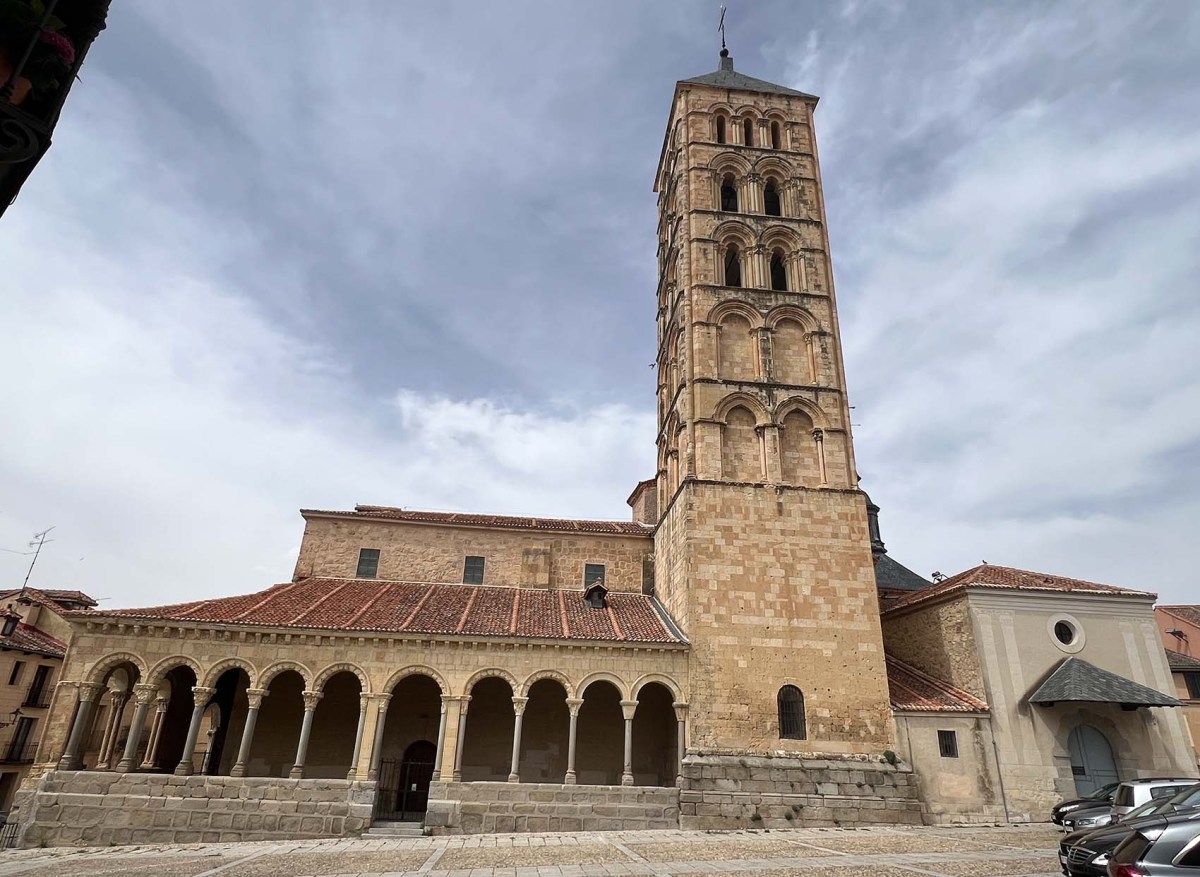
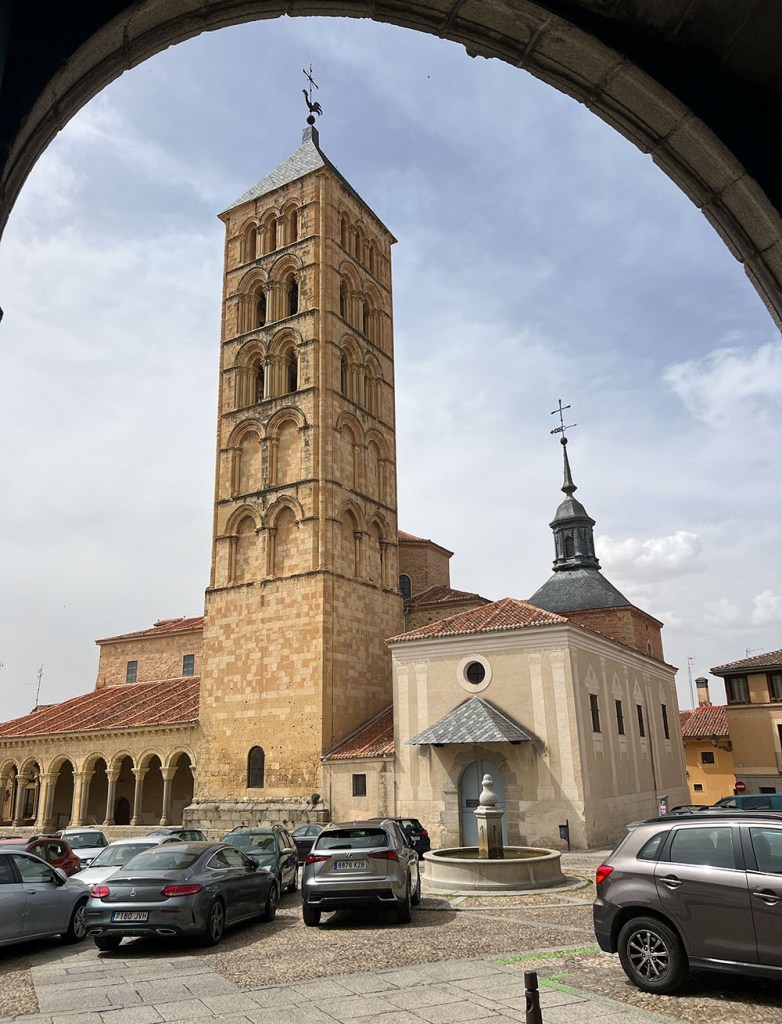
During my brief exploration of the city of Segovia, I reached a square that was home to the interesting church you see above. As I stood on the plaza in the extreme heat, an American couple arrived behind me. The woman said, “Ooh, look at that church.” The man mansplained, “Well, that would be the cathedral.” He clearly had no clue about Spanish cathedrals. I pretended to not speak English and kept on walking. I didn’t yet know what the church was but I did know it was not the cathedral. You can see that in the rest of today’s photos. The first church (of around 400 in the city of Segovia) turned out to be San Esteban, a Romanesque church built in the 12th century.
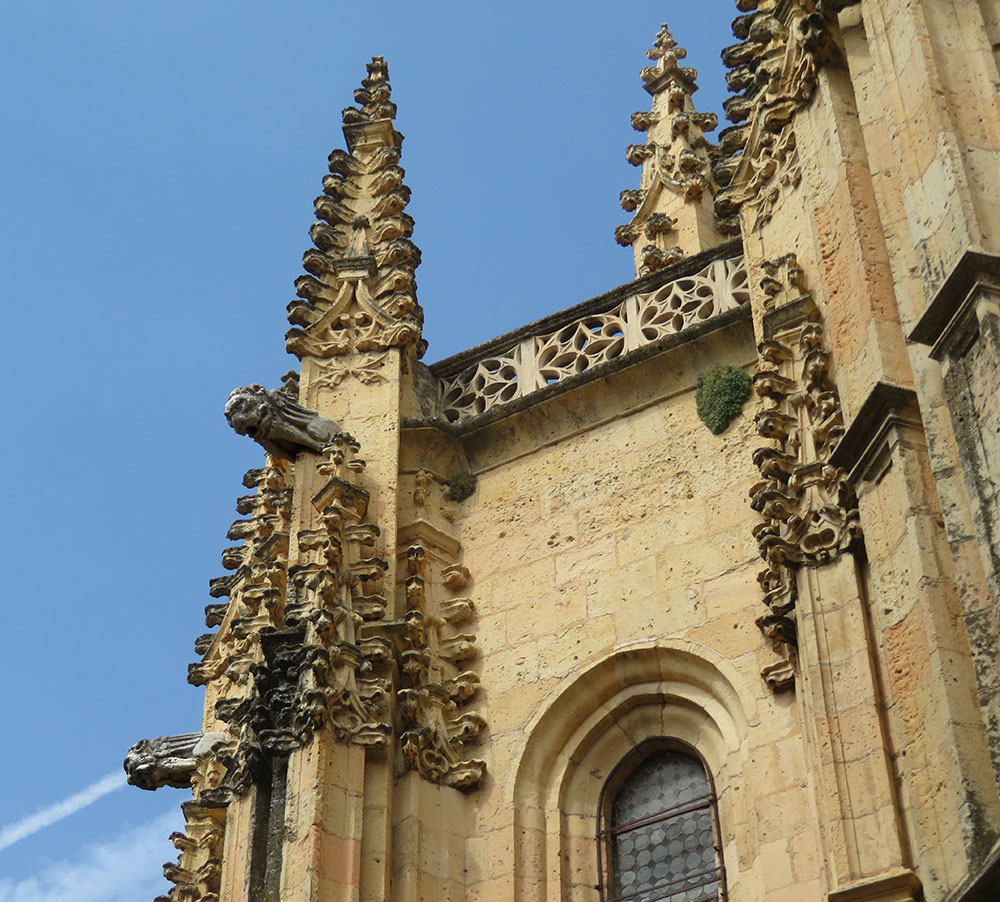
The Holy Cathedral Church of Our Lady of the Assumption and Saint Frutos of Segovia [deep inhale] was built between the 16th and 18th centuries in the Gothic style with some Renaissance features. It replaced an earlier cathedral that was destroyed in the Revolt of the Comuneros in 1521, a citizens’ uprising against the rule of Charles I. Although the revolt had great momentum, it finally failed.
This is one of the last Gothic cathedrals at a time when Renaissance architecture was spreading. The new cathedral was built partly in the Jewish quarter of the city and some of those original narrow streets and medieval homes remain. The original spire was constructed of American mahogany but it was replaced in 1614 by a stone spire after a lightning strike.
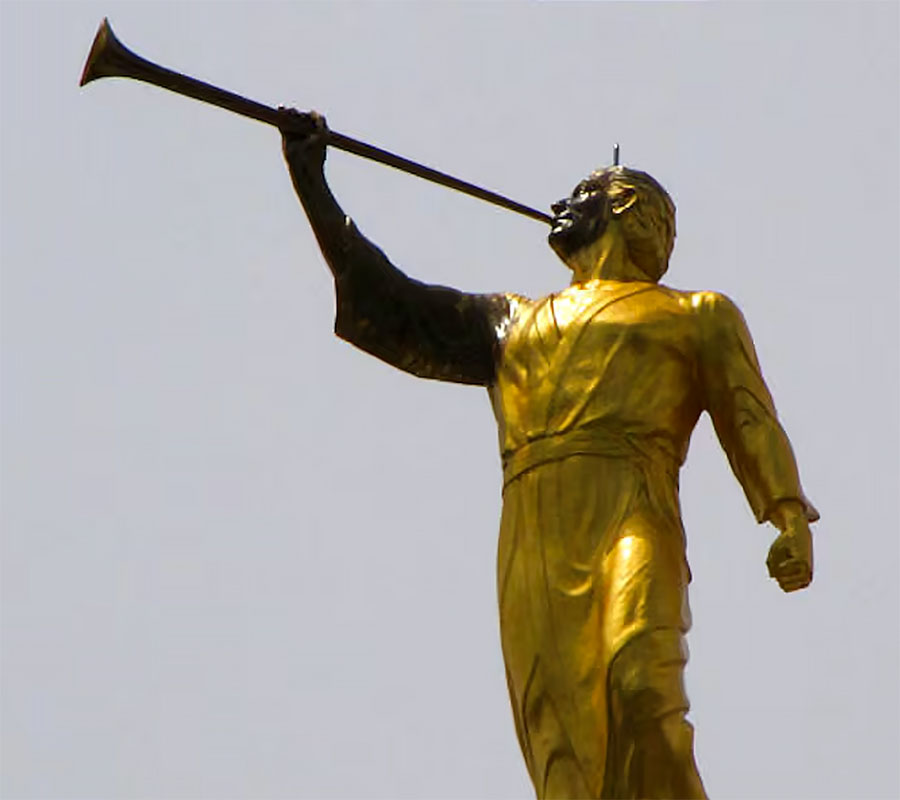
A former friend in San Diego told me the statue of the Angel Moroni atop the spire of the Mormon temple in La Jolla, California, was struck by lightning. He said it was poetic justice because the lightning strike turned Moroni black at a time when the Mormon Church was often accused of being exclusionary and racist. I just looked up the story and it appears the former friend didn’t have it quite right. Only Moroni’s trumpet was blackened.
Several other Moroni statues have been struck by lightning which created holes. A lightning strike to Moroni atop Oquirrh Mountain Utah Temple turned the trumpet black, as well as the arm holding the trumpet, and Moroni’s golden visage. I just read that, since 2018, Moroni is no longer a standard design feature on Mormon temples.
Note: In the thumbnails, I’ve included a map of Segovia with the Church of San Esteban and the Cathedral outlined for comparison.
Durante mi breve exploración de la ciudad de Segovia, llegué a una plaza donde se encuentra la interesante iglesia que ven arriba. Mientras estaba en la plaza bajo un calor sofocante, una pareja estadounidense llegó detrás de mí. La mujer dijo: «¡Oh, mira esa iglesia!». El hombre explicó con aires de superioridad: «Bueno, esa debe ser la catedral». Claramente no tenía ni idea de las catedrales españolas. Fingí no hablar inglés y seguí caminando. Todavía no sabía qué iglesia era, pero sí sabía que no era la catedral. Pueden verlo en el resto de las fotos de hoy. La primera iglesia (de unas 400 en la ciudad de Segovia) resultó ser San Esteban, una iglesia románica construida en el siglo XII.
La Santa Catedral de Nuestra Señora de la Asunción y San Fruto de Segovia [respira hondo] fue construida entre los siglos XVI y XVIII en estilo gótico con algunos elementos renacentistas. Sustituyó a una catedral anterior que fue destruida durante la Revuelta de los Comuneros en 1521, un levantamiento ciudadano contra el gobierno de Carlos I. Aunque la revuelta tuvo un gran impulso, finalmente fracasó.
Esta es una de las últimas catedrales góticas de una época en que la arquitectura renacentista se extendía. La nueva catedral se construyó parcialmente en el barrio judío de la ciudad, y algunas de esas calles estrechas y casas medievales originales aún se conservan. La aguja original estaba construida de caoba americana, pero fue reemplazada en 1614 por una aguja de piedra tras el impacto de un rayo.
Un antiguo amigo de San Diego me contó que la estatua del Ángel Moroni en lo alto de la aguja del templo mormón de La Jolla, California, fue alcanzada por un rayo. Dijo que era justicia poética porque el rayo ennegreció a Moroni en una época en que la Iglesia Mormona era frecuentemente acusada de ser excluyente y racista. Acabo de buscar la historia y parece que mi antiguo amigo no tenía razón del todo. Solo la trompeta de Moroni se ennegreció.
Varias estatuas de Moroni han sido alcanzadas por rayos, lo que les ha provocado agujeros. Un rayo impactó en Moroni, la estatua del Templo de Oquirrh Mountain en Utah, tiñendo de negro la trompeta, el brazo que la sostenía y el rostro dorado de Moroni. Acabo de leer que, desde 2018, Moroni ya no forma parte del diseño habitual de los templos mormones.
Nota: En las miniaturas, he incluido un mapa de Segovia con la Iglesia de San Esteban y la Catedral señaladas para poder compararlas.


• Catedral de Segovia
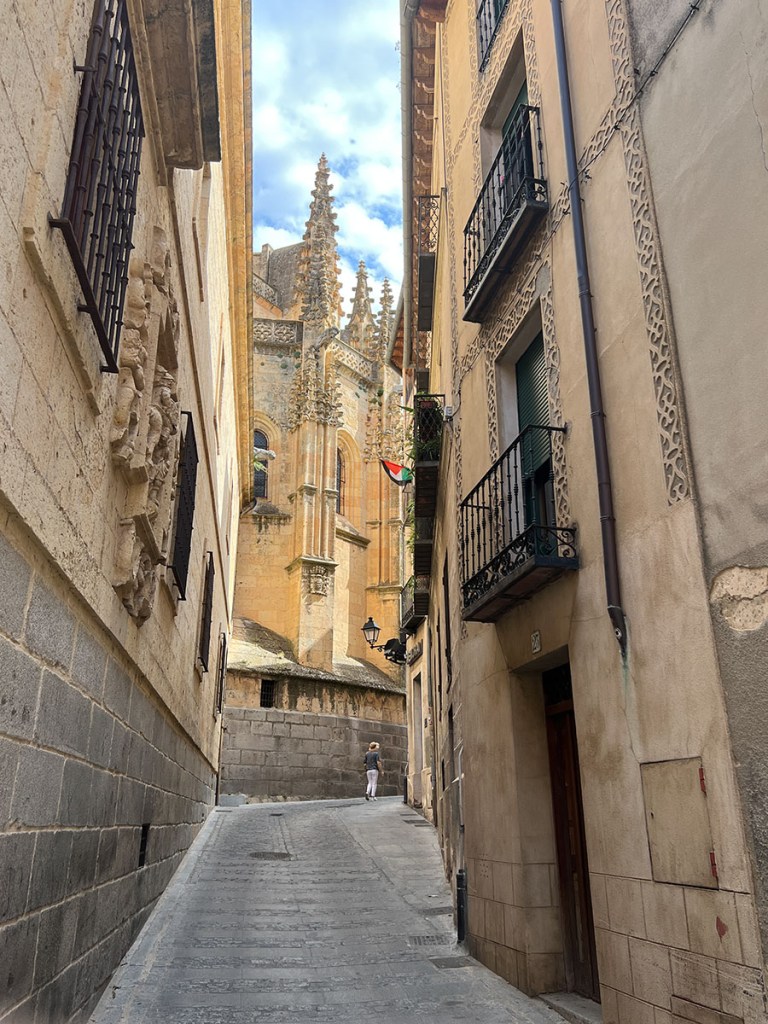
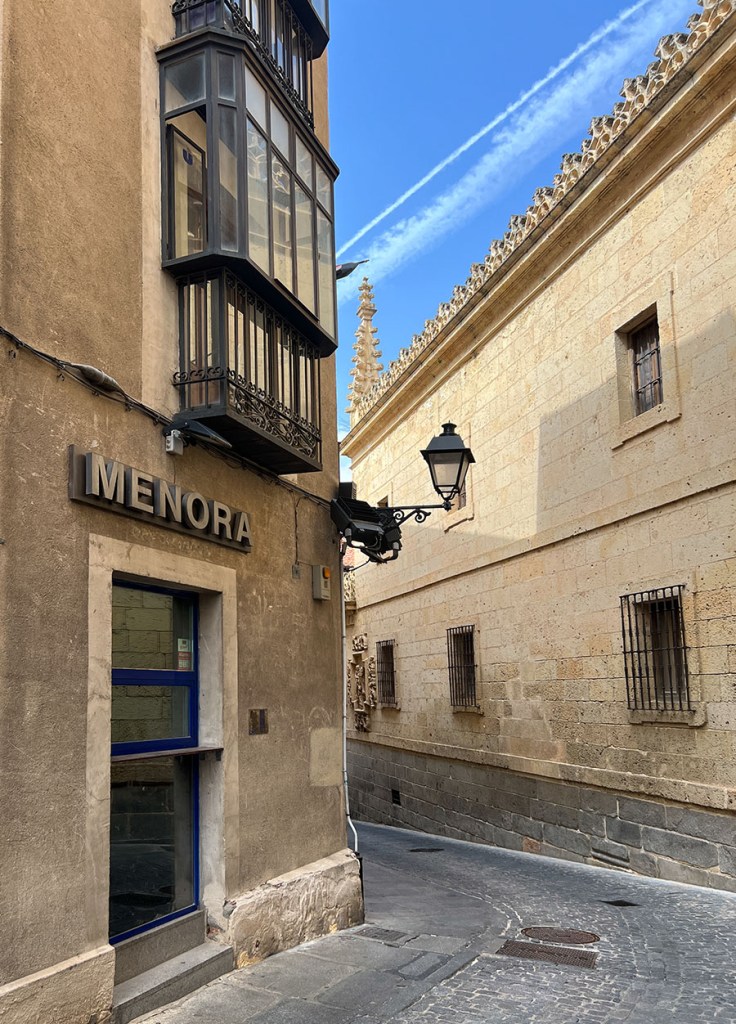
• Gin Club Menora. Un retiro religioso (para muchos) en el antiguo barrio judío, junto a la catedral.
The first Moroni in La Jolla.
El primero Moroni en La Jolla.


Click the thumbnails to enlarge.
Haz clic en las miniaturas para ampliar.

I’m afraid that if I’d been in your position with Mansplainer Man I would have had to have said, “Wrong,” before I walked off.
Blackened Moroni? Sounds like an Italian pasta dish. Perhaps one that had been struck by lightning.
Of course I had to look up Gin Club Menora. Yes. I would absolutely stop there for a small moment of spiritual reflection.
Mary Moon:
I thought maybe I was being more Spanish by just walking away. I just didn’t want to be known as American and then have an entire conversation begin.
Even I know that’s not the Segovia cathedral — which I remember as immense, but it was one of the first cathedrals I’d seen in Europe at that time (1994). Funny about God “smiting” Moroni! I didn’t realize (s)he was no longer a required element of Mormon architecture.
Steve:
I don’t know why they don’t use him anymore. Maybe because of all the lightning strikes.
Me, I think you should have corrected the mansplainer. “Actually, your wife is correct. The cathedral is 10 times bigger and over that way.”
Mansplainers are insufferable. I’ll bet that guy’s wife get really, really tired of his shit.
Jennifer
Jennifer:
I know too many mansplainers. They like ’splaining to men, too.
ellen abbott:
I prefer remaining incognito.
This heat 🥵 ain’t no joke this summer ☀️
But climate change is a myth according to Faux News 📰
-Adam
Nekorandom.com
Adam:
You probably shouldn’t use the French word Faux. They won’t know what you mean. (I remember seeing ads for “genuine faux fur.”)
You should have corrected him. It might have made her day.
I keep thinking of that David Sedaris story about eavesdropping on the American couple in the Metro. He never did tell them he could understand them.
Kelly:
I love David Sedaris. I enjoy blending in and listening to conversations people don’t realize I can understand. I remember hearing two women whispering that I was hot. OK, that time I did smile and say thank you. They both wanted to die.
He has a new book out, I have it on my Kindle for a little upcoming trip.
That is great! Olivia
Kelly:
Not my business, I figured. Anyway, he would have some more mansplaining to do in a few minutes when they arrived at the actual cathedral.
It sounds like what the Mormon temples really need as a standard feature is lightning rods.
Great photos.
Infidel753:
Yes, I would have thought they might have figured that out after Moroni’s first lightning strike
The ‘real’ Cathedral is incredible! Blows my mind the work that is/was put into these structures.
Jim:
Amazing, isn’t it? I didn’t get inside. Next time.
Once again, I love a church, and even a cathedral, for the architecture, but not what goes on inside!
Bob:
Same here. Sometimes I get seriously depressed when I visit churches.
The architecture was stunning as always…thanks for sharing it with us, but you damn well know you had me a gin club!!!!!!
Mistress Borghese:
When I discovered what Menora was I wished I could have phoned and said, “Meet me!” even if it meant I would have simply watched you drink.
And trust me. that would be enough to tire you out.
I remember a friend being peeved about the cathedral city as it wasn’t a proper cathedral by catholic definition. People get awfully queer about word choices.
Urspo:
Too bad your friend didn’t know it was named for Cathedral Canyon which was thought to be cathedral-like. Still, to think that annoyed your friend. People!
When I hear “Moroni” all I can hear is “Carmine Moronie” from “Johnny Dangerously”…
“You fargin’ sneaky bastich!!!!”
Rade:
So, now I have to see Johnny Dangerously.
That photo of the grand cathedral taken from the narrow little street is fabulous! Shame about the Palestine flag spoiling the scene.
I love the fact that lightning keeps “smiting” the Mormon tabernacles. Very Old Testament. Jx
Jon:
Yes the lightning strikes were satisfying. I won’t get into Mideast politics (or world); we’ll be here all day.
I came for the gin but stayed for the gargoyles!
IDV:
Such great gargoyles. I wish I could stay for the gin.
The ornate roof of the Segovia Cathedral reminds me of buildings at Oxford. Perhaps they are of similar vintage?
Of all the gin joints in the world, you have to walk into Menora’s…. and have a virgin martini, LOL!
Tundra Bunny:
Segovia is late gothic (flamboyant, the ornate phase of gothic), so caught the tail end of the gothic style of Oxford. Get lit at Menora!
Your post compelled me to google “What is the difference between a church and a cathedral?” Apparently, the latter is the headquarters or something like that.
Kirk>
I think of the cathedral as the “mother church.”