
La versión en español está después de la versión en inglés.
The drive to Segovia is easy on a couple of main highways (mostly smooth) with few auxiliary roads, and beautiful scenery until you near the great city of Madrid. Around Madrid are loads of commuter towns and a myriad of roads and highways. We didn’t give any thought to when we would pass Madrid on our way to Segovia, but timed it perfectly for rush hour. That was hectic and we were happy to get through it. We drove through 7 of Spain’s 50 provinces and 5 of the 17 autonomous communities. Lots of new road for us.
Along the way we passed billboards that are no longer advertising but are instead national symbols. There are 92 Osborne Bull billboards (click for an earlier post about these) in Spain with 24 in Andalusia, 14 in Castille and La Mancha, 2 in Madrid, and 14 in Castilla and León, the regions we were in for our trip. The bulls are named for the Osborne Group, makers of Brandy of Jerez,
Tio Pepe is one of the most famous wines of Jerez de la Frontera (click here for our visit to Jerez) and, like the Osborne bull, they too advertised along the highway until 1994 when large billboards were banned. They were such a part of the culture of Spain, that they were permitted to maintain the billboards without any advertising. Unlike the Osborne Bull, the Tío Pépe billboards can only be found in Andalusia.
Of course in Castilla and La Mancha on our way up, we passed Don Quixote and Sancho Panza (they’re all over the place) but I caught sight of a pair too late and didn’t get any photos worth sharing. However, on our way home, we stopped for lunch in the town of Mandridegos (outside the town really in the middle of nowhere) and I saw Don Quixote as we pulled into the dirt lot.
We had stopped at what seemed like a lucky choice along the roadway and next to a gas station. Lots of locals. Warm welcome. Good menu. I chose well and had gazpacho, pork loin, and ice cream. San Geraldo did not choose well and wasn’t thrilled with his meal. When we were done he went and used the toilet while I waited my turn. He returned and said, “I hope you don’t have to do anything important. You won’t like it in there.” He wasn’t kidding. And I didn’t have to do anything important.
El viaje a Segovia es fácil por unas autopistas principales (en su mayor parte en buen estado) con pocas carreteras secundarias y hermosos paisajes hasta llegar cerca de la gran ciudad de Madrid. Alrededor de Madrid hay muchas ciudades dormitorio y una infinidad de carreteras y autopistas. No pensamos en cuándo pasaríamos por Madrid de camino a Segovia, pero calculamos el tiempo a la perfección para la hora punta. Fue un caos, pero nos alegramos de haberla superado. Recorrimos 7 de las 50 provincias de España y 5 de las 17 comunidades autónomas. ¡Muchas carreteras nuevas para nosotros!
En el camino pasamos junto a vallas publicitarias que ya no anuncian nada, sino que son símbolos nacionales. Hay 92 vallas publicitarias del Toro de Osborne (haz clic para ver una publicación anterior sobre ellos) en España, 24 en Andalucía, 14 en Castilla y La Mancha, 2 en Madrid y 14 en Castilla y León, las regiones que visitamos durante nuestro viaje. Los toros reciben su nombre del Grupo Osborne, fabricantes del Brandy de Jerez.
Tío Pepe es uno de los vinos más famosos de Jerez de la Frontera (haz clic aquí para nuestra visita a Jerez) y, al igual que el toro de Osborne, también se anunciaban a lo largo de la carretera hasta 1994, cuando se prohibieron las grandes vallas publicitarias. Eran una parte tan importante de la cultura española que se les permitió mantener las vallas sin publicidad. A diferencia del toro de Osborne, las vallas de Tío Pepe solo se pueden encontrar en Andalucía.
Por supuesto, en Castilla y La Mancha, de camino al norte, pasamos junto a Don Quijote y Sancho Panza (están por todas partes), pero los vi demasiado tarde y no pude sacar ninguna foto que mereciera la pena compartir. Sin embargo, de regreso a casa, paramos a comer en el pueblo de Mandridegos (a las afueras, en medio de la nada) y vi a Don Quijote cuando aparcamos en otro aparcamiento de tierra.
Habíamos parado en lo que parecía una elección afortunada, junto a una gasolinera. Muchos lugareños. Una cálida bienvenida. Buen menú. Elegí bien y pedí gazpacho, lomo de cerdo y helado. San Geraldo no eligió bien y no quedó muy contento con su comida. Cuando terminamos, fue al baño mientras yo esperaba mi turno. Regresó y dijo: «Espero que no tengas que hacer nada importante. No te va a gustar ahí dentro». Y no bromeaba.
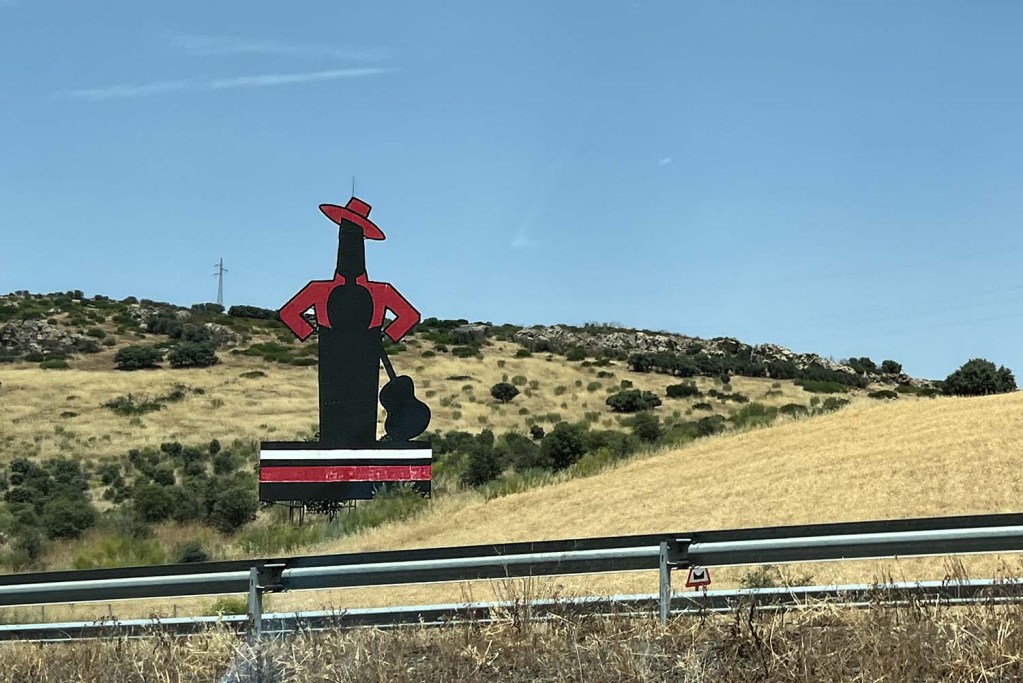
• Cartel publicitario de Tío Pepe sin publicidad.
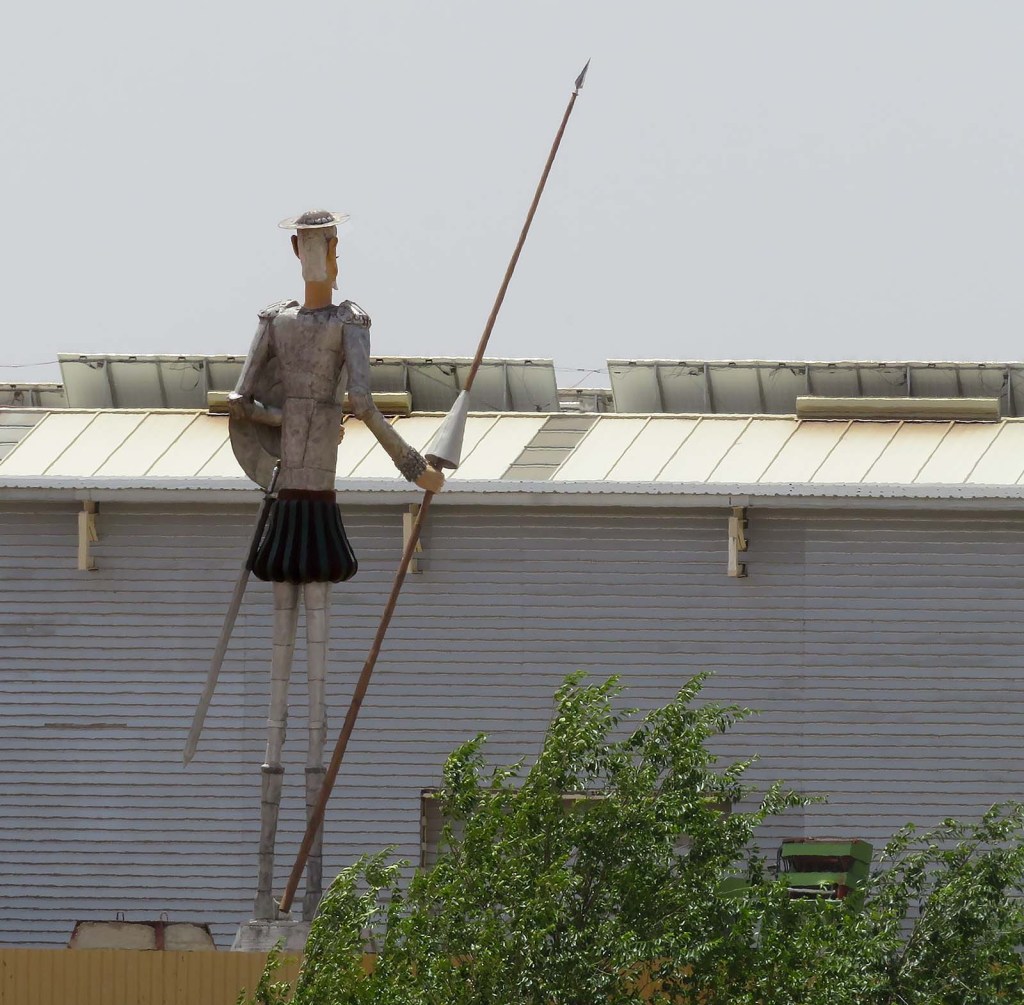
• Don Quijote. Frente a una fábrica de metal en Madridejos, en Castilla y La Mancha, vista en la distancia desde el aparcamiento.
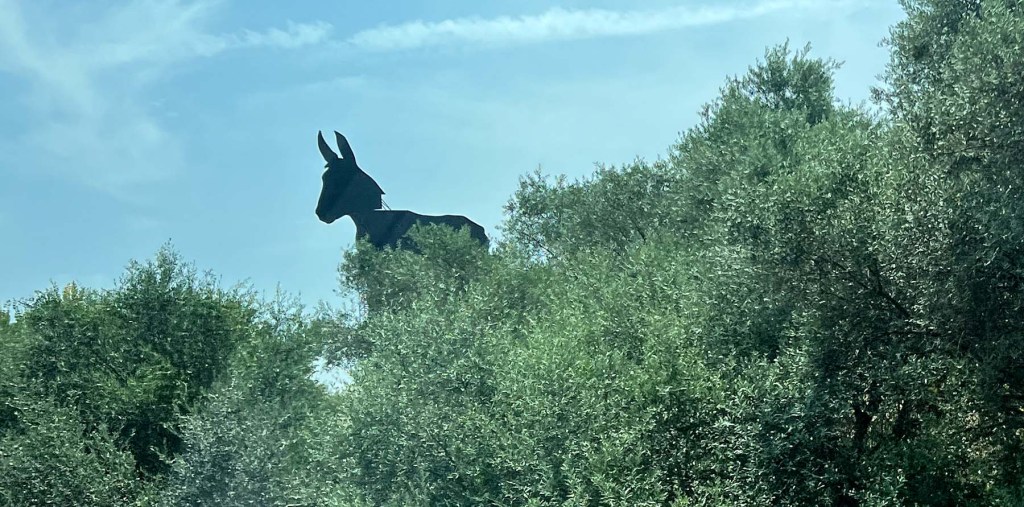
• En la provincia de Córdoba, cerca del pueblo de El Carpio, se encuentra el Burro Grande, de 17 metros de altura. Fue creado en 2010 para parodiar al Toro de Osborne, símbolo de la clase trabajadora y homenaje al asno andaluz, especie en peligro de extinción. El Toro de Osborne se considera un símbolo de los valores aristocráticos.
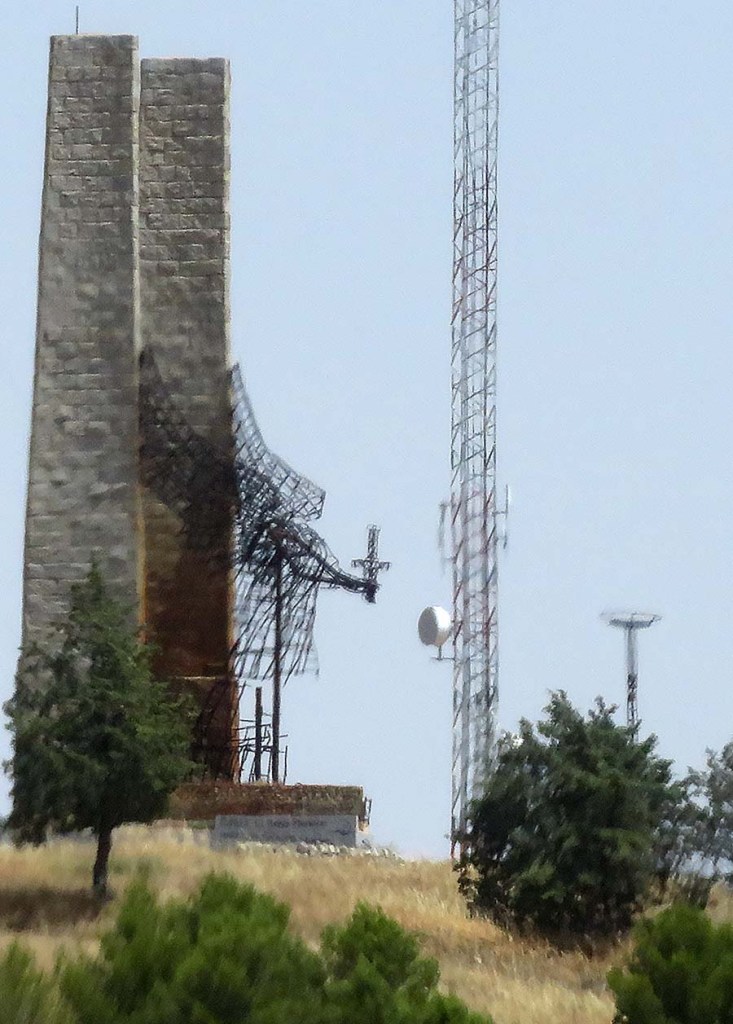
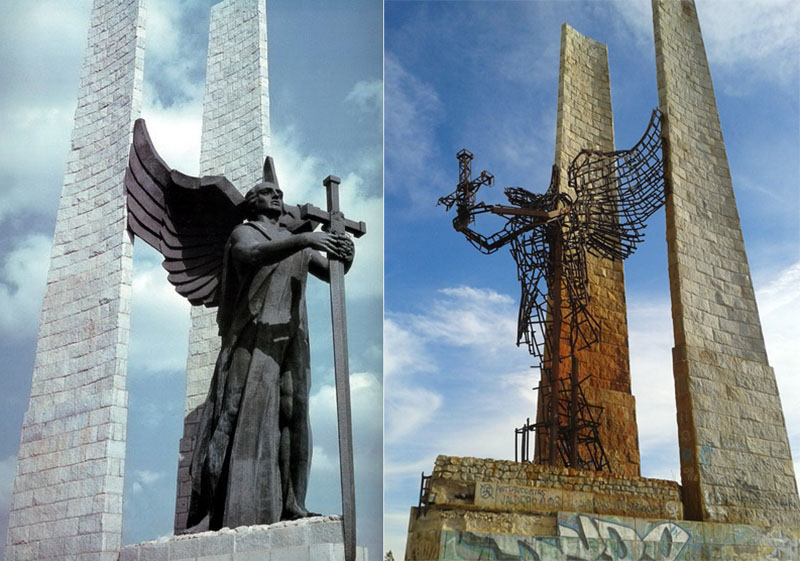
• El Ángel de la Victoria y la Paz en Valdepeñas, provincia de Ciudad Real. Creado en 1964 con una placa en memoria de los franquistas que murieron durante la guerra civil. En 1976, el grupo terrorista antifascista, GRAPO, colocó una bomba. La estatua permanece en ruinas (sin la placa), lo cual quizás sea más apropiado. Estábamos lejos y pasábamos de largo antes de darme cuenta. Vea a continuación fotos comparativas del antes y el después, obtenidas de internet.
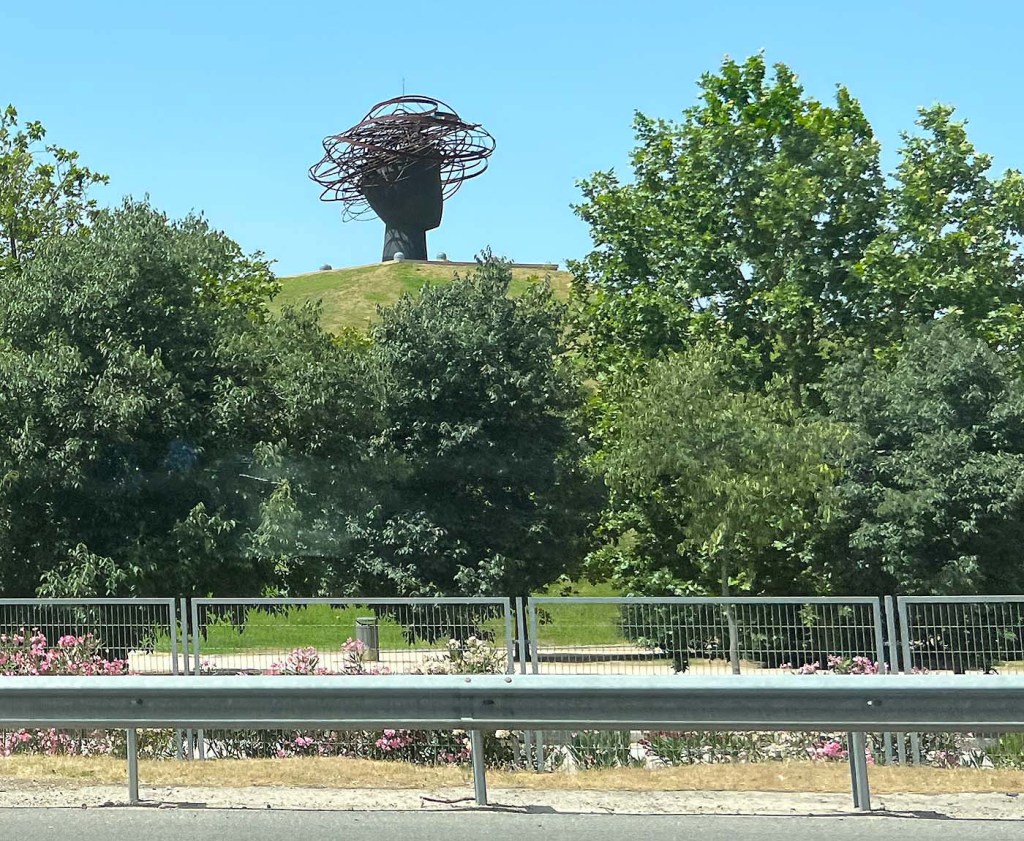
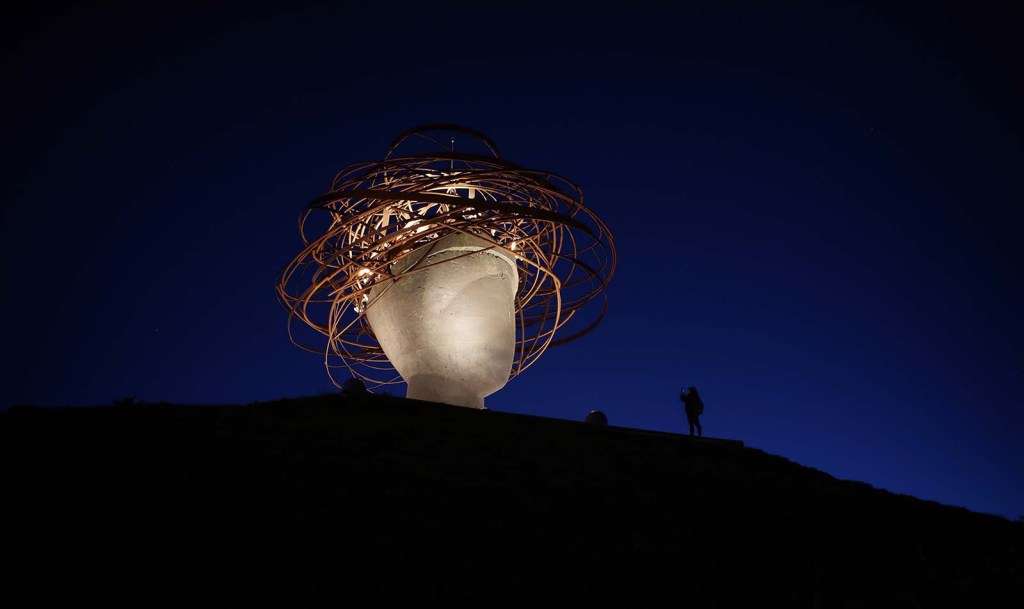
• La Dama del Manzanares se encuentra en un gran parque junto a la autovia de Madrid. Realizada en bronce y acero en 2003, se basa en un diseño del artista Manolo Valdés. 13 metros de altura. Representa la cabeza de una mujer mirando hacia el norte, hacia el paisaje urbano de Madrid, y está dedicada al río Manzanares. Al parecer, su iluminación nocturna, que cambia con las estaciones, resulta muy espectacular. Véase más abajo.


Click the thumbnails to enlarge.
Haz clic en las miniaturas para ampliar.

That reminds me of the old “South of the Border” signs along I-75. The attraction, essentially a glorified rest area, is on the NC/SC border, but the signs begin in Ohio and Florida. They are old and weathered in neon orange, yellow and green.
Rade:
I remember those road trips! The South of the Border signs and the Stuckey’s signs kept us occupied.
South of the Border ^^^ is about an hour from us and just a blight along the highway.
That said, I love the sculptures along your road and the “billboard” sculptures.
Good food, bad bathroom?
Bob:
Oh yeah. Those and the Stuckey’s signs kept us entertained as kids but they were a blight and didn’t compared to these in Spain.
No photo of the offending banos? The joys and pains of a good road trip. I have become very experienced with avoiding rush hour traffic.
David:
I thought of snapping a picture but didn’t.
Love these! Such ‘landmarks’ on a number of levels.
50 provinces?! Some must be very small ones. Canada has only 10 provinces and 2 territories over a much larger landmass…..interesting.
Jim:
Interesting comparisons
Canada with 10 provinces is nearly 10 million sq km.
USA with 50 states is 9.8 million sq km.
And Spain’s 50 provinces fit in 506,030 sq. km.
The Lady of the Manzanares is a stunner. Maybe that bathroom was, too, in a bad way. 🙂
Anonymous:
Yep, the bathroom stunned alright.
Spain for drama! That pro Franco sculpture is the equivalent of Confederate monuments in the US.
I love the mule, taking it to the aristos. Yes, my little working class heart is stirred! Boud
Boud:
Yes, I love the Burro Grande! And I love the current look of the Franco sculpture.
Those shaped billboards are a huge improvement over the giant rectangles we have to contend with.
ellen abbott:
I agree. It’s nice to take a drive and not have the views marred by all that ugly advertising.
I so wish they’d ban huge billboards here. Especially the ones about Jesus and how every life is precious. What they don’t add is that as soon as that precious life is born, it is no longer precious enough to help feed and clothe and provide health care and child care for.
I love the protest donkey. We could do with a few of those around here, nestled in between the housing developments which feature the word “plantation” in them. Aristocratic values indeed.
Mary Moon:
Oh, those American billboards. I remember entering South Dakota on a drive from Minneapolis and being “welcomed” to a town with a billboard telling us if we were for abortion and against guns, we should turn around and leave. I was SO tempted, but we were going to visit SG’s family. I don’t know why I’m shocked by the fact that there are housing developments there that use the word “plantation.” But then, of course there would be!
I once saw a beautiful Black woman driving a Mercedes convertible pull into a local housing development with the word “plantation” in it like she owned the place and you know what? I bet she did.
I like the bull and the donkey. And interesting about the bombing of the pro-Franco statue. That’s a story I’ve never heard before. I think it actually looks better bombed!
Steve:
I found the Franco statue story interesting and I agree it looks much better bombed.
I love the bulls, everywhere in Andalusia – and the donkey, too!
Just followed the link to your post about Jerez la Frontera. It was one of our “three-cities-in-three-days-whirlwind-tour”, along with Seville and Cadiz, a couple of years ago, and we found it charming. Worth another visit, I’d say, even if it can’t really compete with either of the others (Seville is so utterly splendid, and Cadiz is very special indeed), even it’s just for the sherry (which we sampled extensively)! Or the Lola Flores Museum, which we didn’t even go in, to our chagrin… Jx
PS Renfe caught us out on that occasion, too – because all seats on all other trains were fully booked, we had to get up at 7am in order to walk to the station to get a train that connected with the mainline to Malaga!
Jon:
We were in Jerez in January 2011 during the economic crisis and it was showing the signs. It was so depressed at the time. Another thing we learned from RENFE on that trip was it didn’t matter how we ordered our seats; the cars could be facing the opposite direction anyway. We now order a seat on either side of a table so SG always has the option to face forward.
Don Quixote should really be outside a windmill.
Kirk:
I forgot to mention, La Mancha was filled with solar farms. Don Quixote’s replacement for windmills.