
La versión en español está después de la versión en inglés.
When I left the special exhibit galleries at the Picasso Museum, I noticed a small sign at the top of a small set of stairs leading to a nondescript door. The sign read “Arqueología” (Archaeology). The sign was so simple and the door so ordinary that I didn’t know if I was even permitted to enter. But I took my chances. What was the worst that could happen?
I went down the stairs and opened the door. In front of me was another short flight of stairs that then turned right to a longer flight of stairs. I’ve visited the museum countless times and I’m ashamed to say I didn’t know about the underground, thousand-year-old ruins. Information is readily available online and I do read.
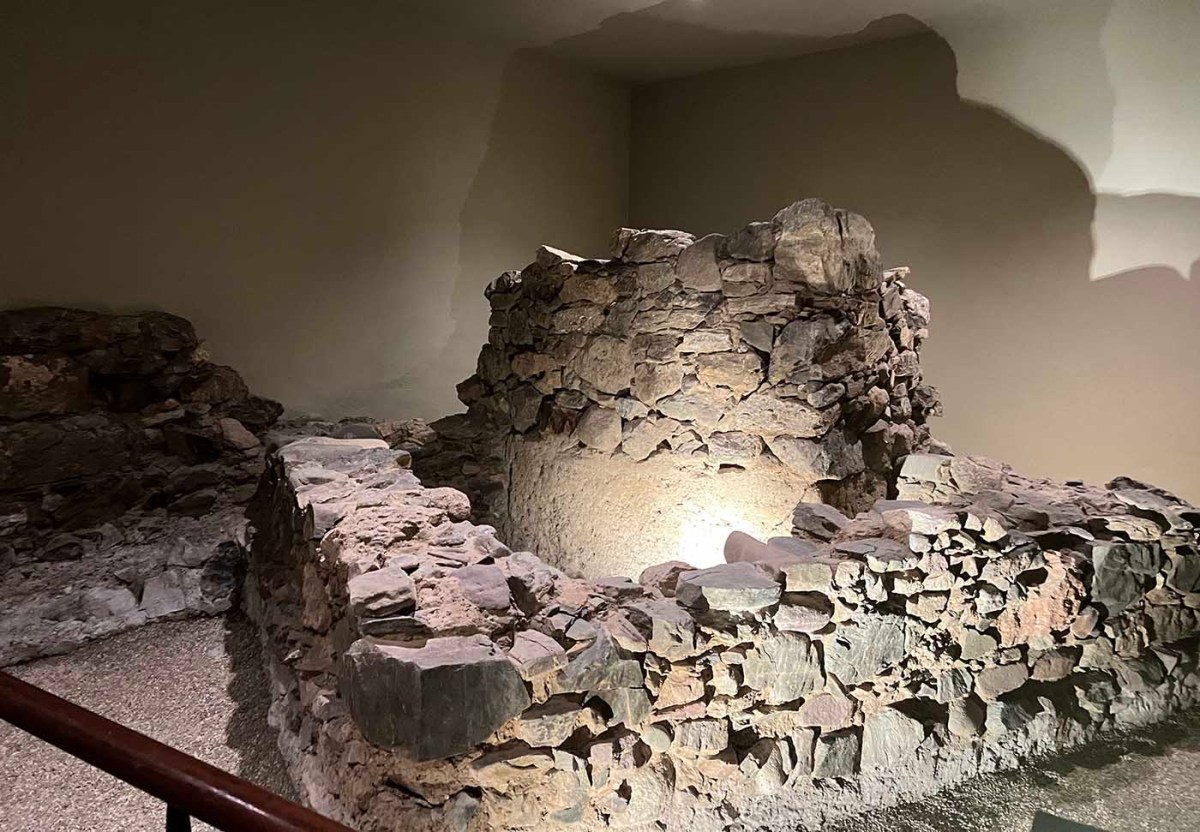
The museum is housed in a renovated 16th-century palace and 15 adjacent houses. The 16th-century palace was built atop the ruins of a 13th-century Nasrid palace and the tower from that palace remains. So, it’s already a fascinating structure inside and out. However, beneath the palace are preserved portions of a 6th-century BC Phoenician home; one of the outer city walls and a tower with interior rooms; Greco-Italo amphora from the late 3rd–early 2nd-century BC; remnants of a Roman, 5th-century AD salt-fish factory; and the 16th-century cobblestone street that was the carriage entrance to the palace. I’ve now, finally, read all about it.
The weather here remains warm and humid. Even the cats are spending most of their daytime indoors. The chance of rain today is 4%. It was 100% the other day and all we got was a drizzle. Oh well. San Geraldo baked another apple crisp this week. It’s all gone. Heavy sigh.
Cuando salí de las galerías de exposiciones especiales del Museo Picasso, noté un pequeño cartel en lo alto de unas pequeñas escaleras que conducían a una puerta anodina. El cartel decía “Arqueología”. El letrero era tan simple y la puerta tan ordinaria que ni siquiera sabía si me permitían entrar. Pero me arriesgué. ¿Qué fue lo peor que pudo pasar?
Bajé las escaleras y abrí la puerta. Frente a mí había otro tramo corto de escaleras que luego giraba a la derecha hacia un tramo más largo. He visitado el museo innumerables veces y me avergüenza decir que no sabía nada de las ruinas subterráneas milenarias. La información está disponible en línea y la leo.
El museo está ubicado en un palacio renovado del siglo XVI y en 15 casas adyacentes. El palacio del siglo XVI fue construido sobre las ruinas de un palacio nazarí del siglo XIII y la torre de ese palacio permanece. Entonces, ya es una estructura fascinante por dentro y por fuera. Sin embargo, debajo del palacio se conservan partes de una casa fenicia del siglo VI a.C.; una de las murallas exteriores de la ciudad con una torre y habitaciones interiores; Ánfora greco-ítalo de finales del siglo III y principios del II a.C.; restos de una fábrica romana de pescado salado del siglo V d.C.; y la calle adoquinada del siglo XVI que era la entrada de carruajes al palacio. Por fin he leído todo sobre ello.
El clima aquí sigue siendo cálido y húmedo. Incluso los gatos pasan la mayor parte del día en el interior. La probabilidad de lluvia hoy es del 4%. El otro día estaba al 100% y lo único que nos dio fue una llovizna. Oh bien. San Geraldo horneó otra apple crisp esta semana. Todo se ha ido. Suspiro pesado.

• ¿Qué hay debajo?


• Muralla fenicia del siglo VI a.C.

• Phoenician fashion.
• Moda fenicia.

• Habitaciones interiores de una de las torres fenicias.

• Fondo: Restos del pavimento original del palacio del siglo XVI con incrustaciones de tinajas para provisiones.

• Parte de una torre de una ciudad fenicia.
Click the thumbnails to enlarge.
Haz clic en las miniaturas para ampliar.

Amazing things under our noses for us to discover. Be brave, be bold, open that door.
David:
I thought the door would be locked.
Now that is something to see! All that history right under your feet.
Jim:
Coming from North America, it’s always a surprise to me. You can’t dig a hole without an archaeologist onsite to note what you discover.
What an amazing find! (The ancient Phoenician site as well as the plaid get-up!)
mcpersonalspace54:
I hadn’t even noticed the plaid. I was taking a picture of a pedestrianized street and he walked right into the frame.
Wow…. Just… wow!
Judy C
Judy C:
I’ve got a bit more to tell today. It wasn’t as new to me as I thought!
I would love that underground exhibit. My kind of thing.
Kelly:
Commonly found here. You should check out the Antiquarium in Seville.
Fantastic! It is always fascinating when one sees the layers of history exposed like that.
I grew up in a village on the site of a Roman military garrison, so it’s very familiar territory for me. The remains of the barracks – which were a source of endless fascination for visitors and archaeologists alike – were next to my senior school, and merely served as the place where we kids would hide from the teachers to have a smoke. Next to that was one of the very few remaining amphitheatres remaining in the UK. It’s easy to become blasé about antiquities when they are in your own back yard (so to speak)… Jx
Jon:
Being North American, I’m still amazed by these finds. Our European friends see this all the time. Wow!
Hola, we live in Nyon, a Roman site, we, like Jon just take it for granted. Roman Pillars, Roman museum, Roman remains. In England too we had Roman ruins and sites. We went to MoMa was it or MamCa – in New York. I get confused between New York and Geneva. We saw lots of Picasso Sculptures of goats… lots and lots of metal sculptures of goats. He sure was not a Minimalist. LOL.
Karen:
So much of this is common for Europeans. For me, it still amazes. There’s a house in Brooklyn that was built in the 1650s!
Reminds me of the caves and other ruins under the Buda side of Budapest. Was there in November and remember walking into a bookstore where part of the flooring was glass and you would walk over these ruins that were lit from underneath. Fascinating, but also a bit vertigo-inducing.
Mary (weird not to sign in)
Mary:
These sites are so normal to Europeans and so magical to North Americans like me. And I love the places that have put in the glass floors.
How cool is that part of the museum. Seeing things like this in the past that used to be structures from way back, but I still don’t know what the hell I’m looking at. Meanwhile our latest rain has brought about some cooler temperatures. Which means up in the Poconos it’s probably going to be in the 50s at night. But it is bear weekend after all!!!!
Maddie:
The museum had excellent numbered floor plans that showed exactly what each thing was. They did a great job. Just a few minutes walk from the museum is a Roman amphitheatre — easy to tell what THAT is. Glad you’ll have a bearskin or two to keep you warm.
Fascinating ruins! And you know, those Phoenicians were just like us in their love of fashion. Now that autumn is here, SG’s apple crisp is putting the idea in my head to make one myself — thanks!
Debra:
Can you imagine the genius of the Phoenicians, printing plaids all those years ago. I don’t know how they ever lost the 2nd Punic War. I wish we had more apple crisp. This is the one that includes ginger and I love it. Enjoy yours.
Well! That was a lovely side tour.
As the images loaded, I thought the “inlaid jars for storage” were part of the lavatorium!
And as for the fashions–
dinahmow:
That’s exactly what I thought those holes were until I read the sign. Don’t you just love Punic Plaid? THAT’S why they lost the war.
I have to slow down and read your photo captions more carefully — I thought the seventh one was a 16th century “6 Hole” crapper too, LOL!
Tundra Bunny:
You’re in good company, I’d say. Dinahmow and I thought the same thing. It’s good I read the sign.
There must be something about Malaga that makes it an ideal spot for settlement, to have all those layers of civilization there. Strategic location near the Strait of Gibraltar, maybe?
Oh, that’s me — Steve. I don’t know why it’s telling you I’m anonymous! LOL
Steve:
It’s apparently all about the browsers. What worked for me was. Here’s a link to a blog post of mine from May. Maybe this will help. https://movingwithmitchell.com/2023/05/11/ee-da-dee-da-day/
Anonymous Steve:
Málaga (called Malaka at the time of the Phoenicans) had an excellent natural port and also silver and copper mines. So, it became a powerful trading outpost as well as an important spot on Phoenician trade routes. The port also served as the port of the great city of Granada. A lot of history.
I don’t know how I missed this one, but I love the ruins … except for this plaid d-i-saster.
Bob:
Life among the ruins isn’t so bad.
Always find such sites fascinating, how did people live and the construction of dwellings etc. Again clear and nice photos. Gov of Spain should give you a medal.
Anon:
Or, as my mother used to say, “a chest to pin it on.”
I just love this sort of stuff.
Urspo:
As you can tell, so do I. Our European and UK friends are less impressed.